Preview
 Send
Send Share
Share
 Details
 Guide
Guide

 Download
 Similars
 X-Ray
X-Ray Diaporama
 Q&A
Q&A Stats
StatsBathsheba

- 173.0 x 126.0 cm


 Read More
Giclée / Art Print
Museum-quality giclée or canvas print with fast production and flexible finish options. ( Buy Hand Made Painting Switch to Digital Image)




P118B $10

P118H $10

P118W $10

P438Z $10

P508JH $12

P508YH $12

P805H $10

P805Z $10

P919BZ $10

P919G $10

P919XJ $10

P959ZH $10

P968JZ $12

W106C $8

W218G $10

W218JH $8

W218Y $10

W307PJ $10

W316G $10

W316PJ $8

W316Y $10

W398PJ $8

W4111J $10

W500HY $15

W500JH $15

W692G $12

W849H $8

W940BG $15

W953PJ $8




Pick from our preset sizes that match the artwork's original proportions.

Type the width and the height you need, to fit your frame or your wall. A print can only be cut, never made bigger than the picture, so a size with a different shape loses a part of the image. We send you a digital mockup to approve before we print anything. The picture shown on this page does not show the real cut — only the mockup does.
Worldwide Delivery () in 2 weeks instead of standard 4/5 weeks. (4 November)

Free Worldwide Express Shipping

High-Quality Linen Canvas

Full Shipping Insurance

Customs Tax Refund Guarantee

True Color Matching Guarantee

100-Day Return Policy (Defects Only)

100% Money-Back Guarantee

Bulk Discount Offer
 Glass option is only available in size under 110 CM

Bathsheba
Giclée / Art Print
Reproduction Size
-


Total Price
$ 81
A Vision of Romantic Intimacy
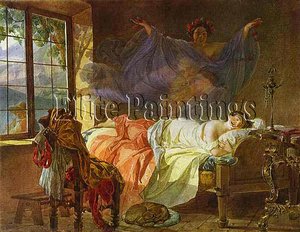
In the quiet, luminous depths of Karl Pavlovich Bryullov’s 1832 masterpiece, Bathsheba, we find ourselves transported to a moment where time itself seems to hold its breath. This monumental canvas is far more than a mere biblical illustration; it is a profound psychological study wrapped in the velvet textures of the Romantic era. The scene captures the biblical Bathsheba in a state of private contemplation, seated as she tends to her hair, her reflection caught in the subtle glow of a mirror. Beside her, the presence of King David, kneeling in a gesture that blurs the line between devotion and desire, introduces a tension that vibrates through the composition. Bryullov does not simply paint a story; he invites the viewer into a sacred, almost voyeuristic space where the boundaries between the divine and the human are beautifully blurred.
The emotional resonance of the work lies in its ability to balance grandeur with vulnerability. As one gazes upon the delicate rendering of Bathsheba’s features, there is an undeniable sense of the ephemeral—a fleeting moment of beauty caught before the inevitable storm of consequence. For the discerning collector or interior designer, this painting offers a centerpiece of immense narrative weight. It possesses the rare ability to anchor a room, providing a focal point that encourages long periods of reflection and conversation. The interplay between the figures suggests an unspoken dialogue, making the artwork feel alive, as if the characters might continue their silent communion the moment we turn away.
Mastery of Light and Romantic Technique
Technically, Bathsheba stands as a testament to Bryullov’s extraordinary command over light and shadow. Drawing inspiration from the dramatic chiaroscuro of Caravaggio, the artist employs a masterful manipulation of illumination to sculpt the figures from the darkness. A soft, ethereal light seems to emanate from within the scene, catching the sheen of silk, the luster of skin, and the intricate details of the royal attire. This technique does not merely illuminate the subject; it imbues the atmosphere with a palpable, heavy air of mystery and importance.
Moving away from the rigid, polished surfaces of Neoclassicism, Bryullov embraces a more textured, emotive brushstroke that is characteristic of the Romantic movement. He prioritizes the feeling of the atmosphere over clinical perfection, allowing the paint to convey the warmth of skin and the weight of fabric. This tactile quality makes the reproduction of such a work incredibly impactful in a physical space; the play of light across the textured surfaces of a high-quality hand-painted piece can bring a sense of classical luxury and historical depth to any modern or traditional interior. To possess this work is to hold a fragment of 19th-century artistic fervor, rendered with a precision that honors the soul of the original masterpiece.
A Timeless Addition to the Curated Space
For those seeking to curate an environment of sophistication and intellectual depth, Bryullov’s work offers unparalleled inspiration. The painting serves as a bridge between eras, blending the anatomical realism of the Renaissance with the emotional turbulence of the Romantic period. Its palette—rich, deep, and harmoniously balanced—complements a wide array of decor styles, from the opulent grandeur of a classical estate to the moody, dramatic accents of contemporary luxury design.
Investing in a reproduction of Bathsheba is an investment in storytelling. It is a piece that demands attention not through loudness, but through its quiet, commanding presence. Whether placed in a private study, a grand salon, or a curated gallery wall, this artwork brings with it the legacy of Saint Petersburg’s finest Romantic master, offering every viewer a window into a world of beauty, longing, and the eternal complexities of the human heart.
Questions & Answers
Where should a reproduction of "Bathsheba" by Karl Pavlovich Bryullov be hung?
The portrait format of "Bathsheba" by Karl Pavlovich Bryullov is recommended for a living room. Format and space together guide the placement of a reproduction.
Which reproduction size is suggested for "Bathsheba" by Karl Pavlovich Bryullov?
The recommended print size for "Bathsheba" by Karl Pavlovich Bryullov is large.
Does "Bathsheba" by Karl Pavlovich Bryullov use strong contrasts or soft harmonies?
The color composition of "Bathsheba" by Karl Pavlovich Bryullov combines a statement contrast with a balanced harmony harmony.
Artist Biography
Karl Pavlovich Bryullov: A Life in Romanticism
Early Life and Training
Karl Pavlovich Bryullov (born Karl Briullo) was born on December 23, 1799, in Saint Petersburg, Russia. His father, Pavel Ivanovich Briullo, was an academician, woodcarver, and engraver of Huguenot descent, who instilled in young Karl a love for the arts. Bryullov’s artistic journey began under his father's guidance before he formally enrolled at the Imperial School for the Arts in St. Petersburg in 1809.
Artistic Development and Influences
Though educated within a classical framework, Bryullov never fully embraced its rigid constraints. He felt a strong pull towards Italy from an early age, and his artistic development was significantly shaped by Italian Renaissance masters. His work demonstrates influences from artists like Raphael, Michelangelo, and Caravaggio, particularly in their dramatic use of light and shadow and mastery of anatomical detail.
- He distinguished himself as a promising student, showcasing imaginative talent during his education.
- After completing his studies, he moved to Rome in 1821, where he spent over a decade honing his skills.
Major Achievements and Notable Works
Bryullov’s breakthrough came with “The Last Day of Pompeii” (1830-1833), a monumental historical painting that catapulted him to international fame. The work, depicting the chaotic eruption of Mount Vesuvius, was lauded for its dramatic composition, emotional intensity, and technical brilliance. It garnered immense praise from contemporaries like Pushkin and Gogol.
- “The Taking of the Life of a Tsar” (1827) – An early work demonstrating his skill in historical narrative.
- “The Defense of the Sepulchre” (1846) - Showcasing Bryullov’s ability to balance emotion and historical accuracy.
- "Princess Yuliya Pavlovna Samoilova Leaving a Ball with Adopted Daughter Amacilia Pacini" (1832) – A stunning example of his portraiture skills.
- “Genserich's Invasion of Rome” (1835) - Another dramatic historical scene displaying Baroque influence.
Career and Later Life
Following the success of “The Last Day of Pompeii,” Bryullov returned to Russia in triumph, securing a prestigious position at the Imperial Academy of Arts in 1836. He served as a professor there until 1848, influencing a generation of Russian artists.
- He developed a distinctive portrait style blending neoclassical simplicity with romantic sensibilities.
- His health began to decline while working on the plafond of St Isaac's Cathedral.
- In 1849, seeking improved health, he left Russia for Madeira and eventually settled near Rome, Italy.
Historical Significance and Legacy
Karl Pavlovich Bryullov is considered a pivotal figure in Russian Romanticism. His work marked a shift towards greater emotional expression and dramatic storytelling within Russian art. He bridged the gap between Neoclassical formality and the burgeoning Romantic movement, influencing subsequent generations of artists, including Gavriil Gorelov.
Bryullov’s legacy extends beyond his paintings; he was a respected teacher and a champion of artistic innovation. His contributions solidified his place as one of the greatest visual artists in Russian history, leaving an enduring mark on the nation's cultural heritage. He died on June 23, 1852, near Rome and is buried at the Cimitero Acattolico.

Karl Pavlovich Bryullov
1799 - 1852 , Russia
Quick Facts
- Name: Karl Pavlovich Bryullov
- Movement: Romanticism
- Birth_Date: 1799-12-23
- Death_Date: 1852-06-23
- Birth_Place: Saint Petersburg, Russia
- Nationality: Russian
- Date Of Birth: 1799
- Date Of Death: 1852
- Notable_Works:
- The Last Day of Pompeii
- The Taking of the Life of a Tsar
- The Defense of the Sepulchre
- Place Of Birth: Saint Petersburg, Russia
Related Articles

The Enduring Legacy of Fine Art Prints: Technique, History & Aesthetic Impact
Explore the rich history & techniques of fine art prints. Discover investment potential, assess authenticity, and learn how to preserve your collection with expert guidance. Trusted insights for discerning collectors.

Echoes of Time: Exploring the Enduring Appeal & Historical Context of Vintage Art Prints
Explore the captivating world of vintage art prints! Discover their history, collecting tips & enduring appeal. Expert insights on chromolithography and building a legacy collection with OriginalUniqueArt.

Romantic Realism's Finest: 10 Masterpieces for Your Home | OriginalUniqueArt
Explore 10 defining masterpieces of Romantic Realism! Discover Courbet, Millet & Daumier's powerful paintings—capturing emotion and social realities. Find museum-quality reproductions for your home at OriginalUniqueArt.com.

Romantic Landscapes: 10 Masterpieces for Your Home | OriginalUniqueArt
Journey through 10 Romantic landscape masterpieces by Friedrich, Turner & Cole. Explore emotional art, sublime nature scenes & iconic 19th-century paintings. Find museum-quality reproductions for your home at OriginalUniqueArt.com – discover the full collection online!

Giclée Prints: Archival Quality & Aesthetic Nuances for the Discerning Collector
Explore the world of giclée prints with OriginalUniqueArt. Learn about archival quality, aesthetic nuances & investment potential. Expert guidance for discerning art collectors seeking museum-quality reproductions and lasting value.