Preview
 Send
Send Share
Share
 Details
 Guide
Guide

 Download
 Similars
 X-Ray
X-Ray Diaporama
 Q&A
Q&A Stats
StatsUntitled (from For Jorn)


 Read More
The artwork displayed on this page is protected by copyright law, which means we cannot legally create or sell an identical reproduction. This protection is enforced under international agreements such as the Berne Convention and by national laws, including those outlined by the U.S. Copyright Law - Title 17.
This method fully complies with copyright regulations because it does not involve copying or duplicating the protected artwork. Instead, it is a creative reinterpretation - a new painting that is influenced by the original but not identical to it.
Giclée / Art Print
Museum-quality giclée or canvas print with fast production and flexible finish options. ( Buy Hand Made Painting Switch to Digital Image)




P118B $10

P118H $10

P118W $10

P438Z $10

P508JH $12

P508YH $12

P805H $10

P805Z $10

P919BZ $10

P919G $10

P919XJ $10

P959ZH $10

P968JZ $12

W106C $8

W218G $10

W218JH $8

W218Y $10

W307PJ $10

W316G $10

W316PJ $8

W316Y $10

W398PJ $8

W4111J $10

W500HY $15

W500JH $15

W692G $12

W849H $8

W940BG $15

W953PJ $8




Pick from our preset sizes that match the artwork's original proportions.

Type the width and the height you need, to fit your frame or your wall. A print can only be cut, never made bigger than the picture, so a size with a different shape loses a part of the image. We send you a digital mockup to approve before we print anything. The picture shown on this page does not show the real cut — only the mockup does.
Worldwide Delivery () in 2 weeks instead of standard 4/5 weeks. (5 November)

Free Worldwide Express Shipping

High-Quality Linen Canvas

Full Shipping Insurance

Customs Tax Refund Guarantee

True Color Matching Guarantee

100-Day Return Policy (Defects Only)

100% Money-Back Guarantee

Bulk Discount Offer
 Glass option is only available in size under 110 CM

Untitled (from For Jorn)
Giclée / Art Print
Reproduction Size
-


Total Price
$ 81
A Burst of Joyful Rebellion: Karel Appel’s “Untitled”
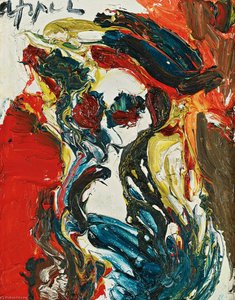
Karel Appel's "Untitled," a vibrant lithograph from 1976, isn’t merely a painting; it’s an embodiment of the CoBrA movement’s core philosophy – a raw, immediate expression of feeling translated onto canvas. Born in Amsterdam during the turbulent years following World War II, Appel’s artistic journey was profoundly shaped by his working-class upbringing and the lingering anxieties of a continent grappling with its past. This piece, executed in the mid-career of a man who had already established himself as a significant figure in European art, feels remarkably unburdened, almost childlike in its exuberance – a deliberate rejection of the formal constraints that had previously dominated artistic practice. The painting’s immediate impact is one of joyous rebellion; it's an invitation to abandon intellectual analysis and simply *feel*.The CoBrA Spirit: Spontaneity and Materiality
Appel was a key founder of CoBrA (Copenhagen-Brussels-Amsterdam), a group that sought to break free from the perceived artificiality of post-war European art. Rejecting the cool detachment of Abstract Expressionism, CoBra artists embraced a more direct, tactile approach. They favored using everyday materials – paint applied with their hands, found objects incorporated into compositions, and a deliberate disregard for traditional techniques. “Untitled” perfectly encapsulates this ethos. The thick, gestural strokes of olive green, black, and flashes of red and yellow aren’t carefully planned; they emerge spontaneously from the artist's hand, conveying an energy that feels both primal and intensely personal. The use of a lithograph technique lends a slightly grainy texture to the surface, further emphasizing the materiality of the work – it’s not about illusion, but about the physical act of creation itself.Biomorphic Forms and Evocative Symbolism
Within this energetic composition reside a series of loosely defined biomorphic forms—shapes that resemble figures, animals, or even abstracted landscapes. These aren't meticulously rendered representations; instead, they are suggestive, inviting the viewer to project their own interpretations onto the canvas. The overlapping and intersecting lines create a dynamic sense of movement, as if the forms are constantly shifting and transforming. Some art historians interpret these shapes as echoes of Appel’s childhood memories – fragments of his working-class life in Holland, imbued with a potent emotional resonance. The inclusion of red and yellow, colors often associated with passion and vitality, further amplifies this sense of raw feeling. The lack of a clear narrative allows for multiple readings, making the piece endlessly engaging.A Window into Appel’s Process: Technique and Context
The choice of lithograph as the medium is significant. Lithography, involving transferring ink from a stone to paper, demands a degree of control while still allowing for expressive marks. It's a technique that balances precision with spontaneity – mirroring the core tenets of Appel’s artistic approach. Created in 1976, “Untitled” reflects a period where Appel was firmly established as an international artist, yet he continued to prioritize direct expression over stylistic adherence. The painting’s relatively small scale—approximately 30 x 40 cm—contributes to its intimate and immediate quality, drawing the viewer into its vibrant world. It's a testament to his belief that art should be accessible, unpretentious, and deeply rooted in human experience.Collecting Appel: A Legacy of Joyful Expression
Karel Appel’s “Untitled” is more than just a beautiful artwork; it’s a powerful statement about the nature of creativity and the importance of embracing one's own unique voice. Reproductions of this piece offer a wonderful opportunity to bring a touch of CoBrA’s spirited energy into any space, serving as a reminder to find joy in the simple act of creation. Its bold colors and dynamic composition make it an ideal addition to contemporary interiors, injecting a sense of playful rebellion alongside a profound emotional depth. Collectors seeking works that embody authenticity and raw expression will undoubtedly find Appel's "Untitled" a compelling and rewarding acquisition.Questions & Answers
Is "Untitled (from For Jorn)" a famous CoBrA Expressionism artwork?
"Untitled (from For Jorn)" by Karel Appel is classified as recognized and belongs to the CoBrA Expressionism movement.
Did "Untitled (from For Jorn)" stay in its artist's homeland?
No - the artwork is kept abroad. Karel Appel was born in Netherlands, and the original "Untitled (from For Jorn)" is held in a museum in United Kingdom.
What is "Untitled (from For Jorn)" made with, and in which style?
"Untitled (from For Jorn)" by Karel Appel combines the lithograph technique with the CoBrA Expressionism style. Technique and movement describe the making and the style of the work.
Artist Biography
A Life Painted in Bold Strokes: The World of Karel Appel
Christiaan Karel Appel, known affectionately as ‘Kik’ from childhood, burst onto the post-war art scene like a vibrant explosion of color and energy. Born in Amsterdam in 1921, his early life was steeped in the everyday rhythms of working-class Holland – his father a barber, his lineage tracing back to French Huguenots through his mother. This grounding, however, would soon be superseded by an irrepressible artistic drive that defied convention and ultimately reshaped the landscape of European art. A pivotal moment arrived at age fourteen with his first painting, a still life of fruit, followed shortly after by a paint set and easel gifted by his uncle Karel Chevalier, who also provided early instruction. These gifts weren’t merely tools; they were keys unlocking a world where imagination reigned supreme. The shadow of the Second World War loomed large over Appel's formative years. Studying at the Rijksakademie van Beeldende Kunsten in Amsterdam during the German occupation proved challenging, yet it was there he forged lifelong bonds with fellow artists Corneille and Constant, friendships that would prove crucial to his artistic evolution. Facing opposition from his parents regarding his chosen path and fearing forced labor under Nazi rule, Appel bravely left home, choosing a life dedicated to art over conformity.The CoBrA Revolution: Spontaneity and the Childlike Vision
Appel’s artistic journey truly ignited with the formation of the CoBrA group in 1948 – an acronym derived from Copenhagen, Brussels, and Amsterdam, representing the movement's core cities. Alongside Corneille, Constant, Jan Nieuwenhuys, and Christian Dotremont, Appel spearheaded a radical departure from established artistic norms. CoBrA wasn’t merely a style; it was a philosophy rooted in spontaneity, experimentation, and a profound embrace of the untamed creativity found in children's art and primitive cultures. Influenced by masters like Pablo Picasso and Henri Matisse, as well as the raw energy of Jean Dubuffet, Appel rejected rigid formalism in favor of intuitive expression. He began sculpting in 1947, utilizing assemblage techniques – constructing works from found materials painted in a bold palette of white, red, yellow, blue, and black. This period saw him involved with the Experimentele Groep, further solidifying his commitment to artistic innovation. The controversial fresco "Questioning Children" (1949), commissioned for Amsterdam City Hall, exemplified CoBrA’s provocative spirit but also sparked public outcry, ultimately leading to its being covered up – a testament to the movement's challenging nature. Appel drew inspiration from Danish and Nordic mythology, weaving these ancient narratives into his increasingly abstract compositions.International Horizons: From Paris to New York and Beyond
Facing resistance to CoBrA’s radical vision in the Netherlands, Appel relocated to Paris in 1950, a city that offered greater artistic freedom and recognition. This marked the beginning of an expansive period of international travel and exposure. He journeyed to Mexico, the USA, Yugoslavia, and Brazil, absorbing diverse cultural influences that enriched his artistic vocabulary. His time in New York City and Florence further broadened his horizons, allowing him to connect with a wider network of artists and collectors. A breakthrough moment arrived in 1954 with his first American gallery exhibition at the Martha Jackson Gallery, followed by the inclusion of "Child and Beast II" (1951) in the influential Museum of Modern Art exhibition “The New Decade” in 1955. Appel’s murals became increasingly prominent during this period, showcasing his ability to translate his dynamic style onto a larger scale. Despite initial challenges, his work experienced a resurgence in popularity in the Netherlands after 1990, with major exhibitions organized by Rudy Fuchs in Amsterdam and Brussels, solidifying his legacy within his homeland.A Lasting Legacy: The Karel Appel Foundation and Enduring Influence
Karel Appel’s impact on post-war European art is undeniable. He established the Karel Appel Foundation to safeguard his artworks and promote public awareness of his oeuvre, ensuring that future generations could experience the power of his vision. A temporary loss of artwork in 2002 underscored the importance of this foundation, with the pieces thankfully recovered in 2012. The foundation now serves as his official estate and image archive, represented in the U.S. by The Artists Rights Society. Appel’s work continues to be exhibited internationally, a testament to its enduring appeal and relevance. He wasn't simply a painter or sculptor; he was a poet of form and color, a champion of spontaneity, and a fearless innovator who dared to challenge artistic conventions. His legacy lies not only in the vibrant canvases and sculptures he created but also in his unwavering belief in the power of art to express the raw, untamed spirit of human experience. His work remains a significant contribution to post-war European art, particularly within the CoBrA movement. Appel’s influence can be seen in contemporary artists who embrace experimentation and reject traditional boundaries, ensuring that his bold vision continues to inspire for years to come.
Karel Appel
1921 - 2006 , Netherlands
Quick Facts
- Full Name: Christiaan Karel Appel
- Nationality: Dutch
- Date Of Birth: 1921
- Date Of Death: 2006
- Place Of Birth: Amsterdam, Netherlands
- Notable Artworks:
- Square Man
- Parrot Woman with Bird
- Hip, Hip, Hoorah
- Artistic Movement Or Style: CoBrA, Expressionism
- Artists Who Influenced This Artist:
- Picasso
- Matisse
- Dubuffet
- Artists Or Movements Influenced By This Artist: CoBrA movement
Related Articles

Beyond the Lines: Mastering the High-Impact World of Contemporary Abstraction
Master the high-impact world of contemporary abstraction. Discover how bold colors, textures, and modern movements like Abstract Expressionism can transform your space with premium, high-energy art curated for the design-conscious professional.

Geometric Abstraction's 10 Defining Masterpieces | Art for Your Home - OriginalUniqueArt
Explore 10 defining masterpieces of Geometric Abstraction! Discover Kandinsky, Mondrian & Malevich’s iconic works. Find museum-quality art reproductions and curated decor ideas to elevate your home at OriginalUniqueArt.com.

Mastering Abstraction: The 25 Most Iconic Works by Wassily Kandinsky
Explore 25 iconic Kandinsky masterpieces and the birth of abstraction. Discover the full collection online at OriginalUniqueArt.com.

Abstract Expressionism's 10 Defining Masterpieces |
Explore 10 defining Abstract Expressionism masterpieces by Pollock, Rothko & de Kooning. Discover the stories behind these iconic paintings and find museum-quality art reproductions to elevate your home decor on .

Neo-Abstract Art: The High-Impact Evolution of Modern Visual Energy and Geometric Sophistication
Discover the power of Neo-Abstract art. Explore how bold geometric forms and high-impact visual energy are redefining modern design. Learn to curate sophisticated, high-energy spaces with the latest trends in contemporary abstraction and structural color.