Text size

() ·

A painting made for you, by hand

Lengthening Shadows

Hand Made Oil Reproduction

Hand-painted oil on canvas in your size and frame, made to order by our artists. ( Switch to Print Switch to Digital Image)

Collectible Description

Experience the atmospheric Tonalism of Julian Alden Weir's 1887 masterpiece Lengthening Shadows, a serene landscape of rolling hills and soft light that invites you to bring the tranquility of nature into your home.

Artist Biography

Julian Alden Weir (1852-1919): Explore the serene landscapes of a leading American Impressionist, founding member of "The Ten," and master of tonalism. Discover his legacy at Weir Farm National Historic Site.

from ·

Chapter 1

How large should it be?

Slide to change the size; the picture on the left shows the frame at its real width. The proportions of the original are kept.

Standard
custom
CM
INCH

Pick from our preset sizes that match the artwork's original proportions.

width
height

Type the width and the height you need, to fit your frame or your wall. This is hand-painted, so for a size with a different shape the artist can paint a bit more around the picture, or cut a bit — you choose. We send you a digital mockup to approve before the painting starts. The picture shown on this page does not show the real result — only the mockup does.

Chapter 2

How should it arrive?

Choose the edges of the stretched canvas

Choose your frame

Corner sample of the WhiteWrap canvas edge finish, stretched on solid wood bars
White $1
Corner sample of the BlurSideWrap canvas edge finish, stretched on solid wood bars
Blurside $1
Corner sample of the ExtendedWrap canvas edge finish, stretched on solid wood bars
Extended $1
Corner sample of the P118B picture frame: moulded polystyrene, 5 cm wide and 3 cm thick
P118B $10
Corner sample of the P118H picture frame: moulded polystyrene, 5 cm wide and 3 cm thick
P118H $10
Corner sample of the P118W picture frame: moulded polystyrene, 5 cm wide and 3 cm thick
P118W $10
Corner sample of the P438Z picture frame: moulded polystyrene, 5.5 cm wide and 3.5 cm thick
P438Z $10
Corner sample of the P508JH picture frame: moulded polystyrene, 7 cm wide and 3.5 cm thick
P508JH $12
Corner sample of the P508YH picture frame: moulded polystyrene, 7 cm wide and 3.5 cm thick
P508YH $12
Corner sample of the P805H picture frame: moulded polystyrene, 5 cm wide and 3.5 cm thick
P805H $10
Corner sample of the P805Z picture frame: moulded polystyrene, 5 cm wide and 3.5 cm thick
P805Z $10
Corner sample of the P919BZ picture frame: moulded polystyrene, 7 cm wide and 3.5 cm thick
P919BZ $10
Corner sample of the P919G picture frame: moulded polystyrene, 7 cm wide and 3.5 cm thick
P919G $10
Corner sample of the P919XJ picture frame: moulded polystyrene, 7 cm wide and 3.5 cm thick
P919XJ $10
Corner sample of the P959ZH picture frame: moulded polystyrene, 5 cm wide and 3 cm thick
P959ZH $10
Corner sample of the P968JZ picture frame: moulded polystyrene, 6 cm wide and 4 cm thick
P968JZ $12
Corner sample of the W106C picture frame: solid wood, 5 cm wide and 3 cm thick
W106C $8
Corner sample of the W218G picture frame: solid wood, 5 cm wide and 3 cm thick
W218G $10
Corner sample of the W218JH picture frame: solid wood, 5 cm wide and 3 cm thick
W218JH $8
Corner sample of the W218Y picture frame: solid wood, 5 cm wide and 3 cm thick
W218Y $10
Corner sample of the W307PJ picture frame: solid wood, 6 cm wide and 3 cm thick
W307PJ $10
Corner sample of the W316G picture frame: solid wood, 6 cm wide and 3 cm thick
W316G $10
Corner sample of the W316PJ picture frame: solid wood, 6 cm wide and 3 cm thick
W316PJ $8
Corner sample of the W316Y picture frame: solid wood, 6 cm wide and 3 cm thick
W316Y $10
Corner sample of the W398PJ picture frame: solid wood, 5 cm wide and 3 cm thick
W398PJ $8
Corner sample of the W4111J picture frame: solid wood, 6.5 cm wide and 3.5 cm thick
W4111J $10
Corner sample of the W500HY picture frame: solid wood, 7 cm wide and 5 cm thick
W500HY $15
Corner sample of the W500JH picture frame: solid wood, 7 cm wide and 5 cm thick
W500JH $15
Corner sample of the W692G picture frame: solid wood, 8 cm wide and 4 cm thick
W692G $12
Corner sample of the W849H picture frame: solid wood, 5 cm wide and 3 cm thick
W849H $8
Corner sample of the W940BG picture frame: solid wood, 7.5 cm wide and 4.5 cm thick
W940BG $15
Corner sample of the W953PJ picture frame: solid wood, 6 cm wide and 3.5 cm thick
W953PJ $8
Corner sample of the H24-GOLD picture frame: carved wood with gesso, 10 cm wide and 6 cm thick
H24-GOLD $30
Corner sample of the H24-SILVER picture frame: carved wood with gesso, 10 cm wide and 6 cm thick
H24-SILVER $30
Corner sample of the H36-GOLD picture frame: carved wood with gesso, 15 cm wide and 6.5 cm thick
H36-GOLD $45
Corner sample of the H36-SILVER picture frame: carved wood with gesso, 15 cm wide and 6.5 cm thick
H36-SILVER $45
Frame preview
Framed

Moulding: . Overall size with the frame: .

Chapter 3

Who paints it, and should anything change?

Examples of what can be changed: Replace face with customer photo; Add pet (e.g., replace cat with dog); Include hidden message in background; Change background landscape or elements.
After order, OriginalUniqueArt.com team will email client for instructions and provide a mockup preview

Worldwide Delivery () in 3/4 weeks instead of standard 5 weeks. (2 November). No compromise on quality.

Chapter 4

The finishing touches

A nameplate, as in a museum?

Engraved Bronze Plaque Details

This elegant plaque features the artist's name and the title of the artwork, finely engraved for a timeless presentation.

It is made from bronze with a refined, elegant finish. The text is precisely laser-engraved for a sharp and permanent result. Measuring 9x2 cm, the plaque is compact yet easy to read. It's built to be durable and scratch-resistant, offering a professional, museum-quality look. Mounting is simple thanks to the included adhesive backing.

Transparent Acrylic Plaque Details

The plaque includes essential engraved details such as the artist's name, the title of the artwork, the date it was created, the type of media used-like oil on canvas or watercolor-a brief description of the piece, and a QR code that links to the complete artwork information.

It is crafted from clear acrylic, offering a sleek, modern appearance. The text is UV-engraved in black to ensure strong visual contrast. With a size of 10x15 cm, it ensures optimal readability. It comes equipped with two metal hooks for secure wall mounting. The plaque is designed to be weather-resistant, making it suitable for various environments, and it includes interactive features that work seamlessly with smartphone scanning.

Black Acrylic Plaque Details

This elegant plaque includes engraved information such as the artist's name, the title of the artwork, the date it was created, the type of media used (like oil on canvas or watercolor), a short description of the artwork, and a QR code for quick access to more information.

The plaque itself is made from refined black acrylic with a premium finish. The text is laser-engraved in white for high contrast and readability. Its size is 10x15 cm, designed to be easy to read. It comes with two metal hooks for professional mounting. The design is sleek and fits any interior style. It is also weather-resistant and durable, with built-in digital integration for mobile compatibility.

A protective varnish?

When do you need it?

Chapter 5

Your painting, as you ordered it

Lengthening Shadows

Reproduction Medium

Reproduction Size

-

Elite Senior Artist

More detail, finesse, and extra production time

-

Reproduction Frame

-

-

For artworks or reproductions larger than 105 cm (approximately 41 inches) on any side, the frame will be shipped as a kit, disassembled. This method ensures safe delivery and prevents damage during transport.

Professional assembly required - this is not a DIY product.
The kit must be assembled and the canvas stretched by an experienced professional framer, using wood glue (not supplied), a canvas stretching plier and clamps to hold the bars square while the glue dries. Incorrect assembly or uneven canvas tension can permanently damage the artwork and is not covered by our warranty.

  • All solid wood bars are included, precisely cut to size.

  • Assembled with the screws provided, plus wood glue for the corner joints, which is not supplied and must be sourced by your framer.

  • Professional tools are required and not included: a canvas stretching plier (tensioner) and clamps to hold the bars square while the glue dries.

Important:
The corner joints require wood glue, the bars must be held with clamps until the glue is fully dry, and tightening the canvas on the assembled frame requires a canvas stretching plier. None of these are included in the kit. Please arrange an experienced professional framer before ordering this size.

Nameplate

-

-

Protective Varnish

Glossy Varnish (enhances colors, protects against light/moisture)

-

Customize My Artwork

Examples of what can be changed: Replace face with customer photo; Add pet (e.g., replace cat with dog); Include hidden message in background; Change background landscape or elements.

-

Urgent

Worldwide Delivery () in 3/4 weeks instead of standard 5 weeks. (2 November). No compromise on quality.

-

Express Shipping

Worldwide Delivery () in 5 weeks. (9 November).

Included

Total Price

$ 300

Total Price $ 300

Glass option is only available in size under 110 CM

Included with every order

  • Free Worldwide Express Shipping
  • High-Quality Linen Canvas
  • Full Shipping Insurance
  • Customs Tax Refund Guarantee
  • True Color Matching Guarantee
  • 100-Day Return Policy (Defects Only)
  • 100% Money-Back Guarantee
  • Bulk Discount Offer

A Symphony of Twilight: The Soul of Lengthening Shadows

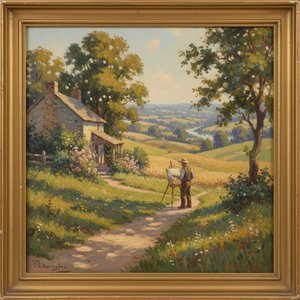
In the quiet transition between day and night, there exists a fleeting moment where the world seems to hold its breath, caught in the amber glow of a descending sun. It is this precise, ephemeral atmosphere that Julian Alden Weir masterfully captures in his 1887 masterpiece, Lengthening Shadows. As a quintessential example of Tonalism, the painting transcends mere landscape depiction to become an emotional experience. Rather than relying on sharp outlines or jarring contrasts, Weir employs a sophisticated palette of muted, harmonious tones that wrap the viewer in a sense of profound tranquility. The scene unfolds across a gentle hillside, where a winding dirt road invites the eye to wander through grassy undulations and scattered groves of trees, leading toward a solitary house nestled within the landscape. This subtle inclusion of human presence does not disrupt the solitude; instead, it provides a poignant anchor, suggesting a life lived in quiet harmony with the rhythms of the natural world.

The technical brilliance of this work lies in Weir’s ability to manipulate light and shadow to evoke texture and depth. Through delicate brushwork on canvas, he achieves a soft-focus effect that is characteristic of the Tonalist movement, where the atmosphere itself feels like a tangible element of the composition. The shadows do not merely represent the absence of light; they are rich, velvety layers that add weight and mystery to the foreground trees. As the sun retreats, the lengthening shadows stretch across the path, creating a rhythmic interplay between the illuminated grasses and the cooling earth. For the discerning collector or interior designer, this painting offers more than just visual beauty; it provides a focal point of contemplative stillness, making it an ideal centerpiece for spaces designed for relaxation, reflection, and sophisticated elegance.

To understand Lengthening Shadows is to understand the artistic evolution of Julian Alden Weir himself. Born into a legacy of American excellence, Weir’s journey from the rigorous academic training in Paris under Jean-Léon Gérôme to the atmospheric explorations of American Impressionism allowed him to bridge the gap between classical precision and modern emotion. This painting stands as a testament to his deep connection with the American landscape, reflecting a period when artists sought to find the spiritual essence within the rural countryside. The work resonates with a timeless nostalgia, evoking a sense of peace that remains as relevant in a modern, bustling world as it was in the late nineteenth century. Owning a high-quality reproduction of this piece allows one to bring this enduring sense of pastoral serenity into the home, transforming any room into a sanctuary of light and shadow.

Questions & Answers

Does "Lengthening Shadows" have an augmented reality preview?

The AR Preview page of "Lengthening Shadows" by Julian Alden Weir uses augmented reality to show the artwork in your own space, on a compatible device.

What placement suits the format of "Lengthening Shadows" by Julian Alden Weir?

Format (landscape) and recommended space (wellness center) are the two placement facts recorded for "Lengthening Shadows" by Julian Alden Weir.

What color intensity does "Lengthening Shadows" by Julian Alden Weir have?

The colors in "Lengthening Shadows" by Julian Alden Weir have a balanced intensity.

More about this painting

Preview AR preview Switch to Print Switch to Digital Image Send
Details Guide Add to favorites Download Similars X-Ray Diaporama Q&A Stats

In numbers

  • 1887the year it was painted
  • 29frames to choose from
  • standard sizes, in its own proportions
  • 5weeks to paint and deliver it
Julian Alden Weir

Julian Alden Weir

1852 - 1919, United States of America

Quick facts about Julian Alden Weir

  • Full Name: Julian Alden Weir
  • Nationality: American
  • Date Of Birth: 1852
  • Date Of Death: 1919
  • Place Of Birth: West Point, United States of America
  • Notable Artworks:
    • On the Shore

    • New England Barnyard
    • Upland Pasture
  • Artistic Movement Or Style: Impressionism, Tonalism
  • Artists Who Influenced This Artist:
    • Jean-Léon Gérôme
    • Jules Bastien-Lepage
  • Artists Or Movements Influenced By This Artist: ['The Ten American Painters']

Artist Biography

Early Life and Artistic Foundations

Julian Alden Weir, born August 30, 1852, at West Point, New York, inherited an artistic lineage that profoundly shaped his path. His father, Robert Walter Weir, was a respected painter and drawing professor at the United States Military Academy, instilling in young Julian a deep appreciation for art from an early age. The home itself was a vibrant studio, filled with the tools and inspiration of a creative life. This nurturing environment extended to his elder brother, John Ferguson Weir, who also became a notable landscape artist. Julian’s initial formal training began at the National Academy of Design in New York City around 1870, providing him with a solid grounding in traditional techniques. However, it was his journey to Paris in 1873 that truly ignited his artistic development. Studying under Jean-Léon Gérôme at the École des Beaux-Arts exposed him to academic rigor and meticulous detail, while friendships forged with artists like Jules Bastien-Lepage broadened his perspective on painting’s possibilities. Initially, Weir harbored a strong aversion to the emerging Impressionist movement, dismissing its perceived lack of form and structure as “horrible.” This early resistance would prove pivotal, as his eventual embrace of Impressionism came not from immediate acceptance but through a gradual evolution of understanding.

The Connecticut Years and Artistic Transformation

A turning point in Weir’s life arrived with his marriage to Anna Dwight Baker in 1883 and their subsequent move to Branchville, Connecticut. He purchased a farm there, seeking respite from the bustling art world of New York City. This rural setting became more than just a retreat; it was a wellspring of inspiration. The tranquil landscapes, the rhythms of farm life, and the intimate connection with nature began to subtly shift his artistic focus. While initially continuing to produce portraits and still lifes in a traditional style, Weir found himself increasingly drawn to capturing the fleeting effects of light and atmosphere. Around 1891, this inclination blossomed into a full-fledged embrace of Impressionism. Influenced by fellow artists like John Twachtman and Theodore Robinson, he began experimenting with broken brushstrokes, vibrant color palettes, and an emphasis on subjective perception. This wasn’t a wholesale abandonment of his earlier training; rather, it was a synthesis of academic skill with the innovative spirit of the new movement. His style often oscillated between pure Impressionistic expression and a more subdued tonalism, creating a unique visual language that distinguished him from his contemporaries. He also demonstrated considerable talent as an engraver, particularly through his skillful use of aquatint techniques.

A Leading Voice in American Art

By the late 19th century, Julian Alden Weir had established himself as a prominent figure in the American art scene. He was instrumental in forming “The Ten,” a group of ten independent-minded painters who sought to exhibit their work outside the constraints of traditional institutions like the National Academy of Design. This collective—including artists such as Childe Hassam, Willard Leroy Metcalf, and Edmund Tarbell—represented a significant step towards artistic autonomy and helped shape the direction of American painting. In 1912, Weir was elected the first president of the Association of American Painters and Sculptors, further solidifying his leadership role within the art community. He later served as president of the National Academy of Design itself, demonstrating the respect he had earned from both progressive and conservative factions of the art world. His key works from this period—such as *On the Shore* (1892), a vibrant coastal scene; *New England Barnyard* (1904), a charming depiction of rural life; and *Upland Pasture* (1905)—exemplify his mastery of Impressionistic techniques and his ability to capture the essence of American landscapes.

Legacy and Enduring Influence

Julian Alden Weir’s contributions extend far beyond his individual paintings. He played a crucial role in bridging the gap between traditional academic painting and the innovative spirit of Impressionism, paving the way for future generations of American artists. His dedication to fostering artistic independence through “The Ten” challenged established norms and helped create a more vibrant and diverse art landscape. Today, Weir Farm National Historic Site in Branchville, Connecticut, stands as a testament to his life and work. Preserved as it was during his time, the farm offers visitors a glimpse into the world that inspired him—the rolling hills, the weathered barns, and the quiet beauty of rural New England. The site serves not only as a historical landmark but also as a continuing source of inspiration for artists today. His family’s artistic legacy – stemming from his father Robert Walter Weir, a Hudson River School painter – further cements Julian Alden Weir's place within the broader narrative of American art history. He died in New York City on December 8, 1919, leaving behind a body of work that continues to captivate and inspire, reminding us of the power of art to capture the beauty and essence of the world around us.
  • Key Works: *On the Shore* (1892), *New England Barnyard* (1904), *Upland Pasture* (1905)
  • Artistic Style: Impressionism, Tonalism
  • Associations: “The Ten,” National Academy of Design

Quick Facts

  • Subject or theme: Rural landscape and nature
  • Artist: Julian Alden Weir
  • Year: 1887
  • Artistic style: Tonalism
  • Medium: Oil on canvas