- Home

- Print on canvas
- Joy St Clair Hester
- Mujer y el mar

 Preview
 Send
Send Share
Share
 Details

 Download
 Similars
 X-Ray
X-Ray Diaporama
Mujer y el mar
 Expressionism
 1956
1956 57.0 x 39.0 cm
 National Gallery of Victoria
 Read More
Giclée / Art Print
Museum-quality giclée or canvas print with fast production and flexible finish options. ( Switch to hand made Painting Switch to Image)




P118B $10

P118H $10

P118W $10

P438Z $10

P508JH $12

P508YH $12

P805H $10

P805Z $10

P919BZ $10

P919G $10

P919XJ $10

P959ZH $10

P968JZ $12

W106C $8

W218G $10

W218JH $8

W218Y $10

W307PJ $10

W316G $10

W316PJ $8

W316Y $10

W398PJ $8

W4111J $10

W500HY $15

W500JH $15

W692G $12

W849H $8

W940BG $15

W953PJ $8




Pick from our preset sizes that match the artwork's original proportions.

You may enter your own dimensions to fit a specific frame or space. If your selected size does not match the original image's proportions, we will either crop the artwork or extend the image with a mirrored or solid-fill edge. A digital mockup will be sent for your approval before production begins.
Please note that the on-screen preview does not reflect the actual cropping or extension. Only the mockup will accurately show the final composition.
While custom sizes are available, we recommend selecting a dimension from the predefined list to preserve the original proportions.
Worldwide Delivery () in 2 weeks instead of standard 4/5 weeks. (31 July)

Free Worldwide Express Shipping

High-Quality Linen Canvas

Full Shipping Insurance

Customs Tax Refund Guarantee

True Color Matching Guarantee

60-Day Return Policy (Defects Only)

100% Money-Back Guarantee

Bulk Discount Offer
 Glass option is only available in size under 110 CM

Mujer y el mar
Giclée / Art Print
Reproduction Size
-


Total Price
$ 81
Collectible Description
A Portrait of Quiet Intensity: Joy St Clair Hester’s “Mujer y el Mar”
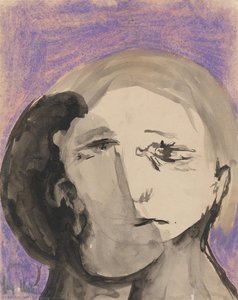
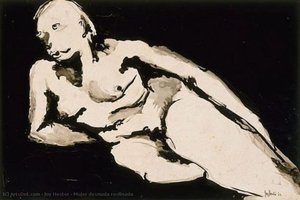
Joy St Clair Hester's "Mujer y el mar" (Woman and the Sea) is not merely a depiction of a female figure; it’s an immersion into a realm of introspective melancholy, rendered with a masterful command of ink and charcoal. Completed in 1956, this work stands as a poignant testament to Hester's signature style – a deeply emotive exploration of human experience, often tinged with a subtle undercurrent of sadness and solitude. The painting immediately draws the viewer in with its monochromatic palette, dominated by shades of gray, black, and white, creating an atmosphere both stark and profoundly intimate. It’s a deliberate choice that strips away superficiality, forcing us to confront the raw emotion conveyed through form and texture.
Composition and Technique: A Dance of Lines and Shadows
The composition is strikingly centered around the woman's face, her gaze directed slightly off-camera – a subtle gesture that invites the viewer into her private world. The horizontal line bisecting the image acts as a grounding element, providing structure without disrupting the overall sense of unease or contemplation. Hester’s technique is characterized by loose, gestural brushstrokes, particularly evident in the delineation of the face and hair. These aren't precise renderings; instead, they are expressive marks that convey movement and feeling. Thick layers of ink build up a rich surface texture, punctuated by softer washes that create subtle gradations of tone – a masterful manipulation of value to suggest depth and form. The use of layering is crucial, building an illusion of space and adding to the painting’s tactile quality; it feels as though you could reach out and trace the contours of her face with your fingertips.
Symbolism and Emotional Resonance: Woman, Sea, and the Unspoken
The title itself, “Mujer y el mar,” immediately establishes a powerful symbolic connection. The sea has long been a potent metaphor for both life’s vastness and its inherent uncertainties – a space of mystery, danger, and profound beauty. The woman's posture, her averted gaze, suggests a quiet contemplation, perhaps even a yearning or a sense of isolation. There’s an undeniable vulnerability in her expression, hinting at unspoken emotions and hidden depths. Hester was deeply influenced by the Expressionist movement, prioritizing emotional impact over strict realism. This is evident in the painting’s raw intensity and its willingness to confront difficult themes – loneliness, loss, and the complexities of human relationships. The monochromatic palette further amplifies this sense of introspection, stripping away distractions and focusing solely on the core emotions at play.
Historical Context: Joy Hester and the Australian Modernist Scene
To fully appreciate “Mujer y el mar,” it’s essential to understand the context in which it was created. Joy St Clair Hester emerged as a significant figure within Australia's burgeoning modernist art scene during the mid-20th century. She was part of the Heide Circle, a group of artists associated with the Heide Museum complex in Melbourne, and also connected to the “Angry Penguins,” a notoriously rebellious collective known for challenging artistic conventions. Her work reflects this spirit of experimentation and her willingness to explore unconventional themes. Hester’s life itself was marked by personal hardship – the early loss of her father profoundly shaped her artistic vision. Her exploration of female subjects, particularly in works like "Mujer y el mar," offered a rare and powerful voice within a male-dominated art world. The painting's creation coincided with a period of significant social change in Australia, mirroring the growing awareness of gender roles and identity.
Today, “Mujer y el mar” remains a compelling example of Hester’s artistic talent and her ability to evoke profound emotional responses. It is a work that invites contemplation, prompting viewers to consider themes of solitude, introspection, and the enduring power of human emotion. High-quality reproductions capture the painting's rich texture and evocative atmosphere, making it an ideal addition to any art collection or interior space.
Artist Biography
A Life Etched in Ink: The World of Joy St Clair Hester
Joy St Clair Hester, a pivotal figure in Australian Modernism, lived a life marked by both artistic fervor and personal hardship. Born in Elwood, Australia, in 1920, her early years were shadowed by the loss of her father, an event that would subtly yet profoundly influence the emotional depth of her later work. From her formative studies at St Michael's Grammar School and Brighton Technical School, Hester demonstrated a clear artistic inclination, culminating in recognition at the National Gallery School in Melbourne where she won the Drawing Head from Life prize in 1938. This early success signaled not just technical skill but an emerging ability to capture the essence of human form—a talent that would become her signature. It was also during this period that Hester began to break free from traditional artistic constraints, seeking a more expressive and personal visual language.The Heide Circle and the Angry Penguins
Hester’s trajectory took a defining turn in 1938 with her meeting of Albert Tucker, initiating both a significant romantic relationship and an important artistic partnership. This connection led her into the orbit of Sunday Reed, a crucial patron of the arts, and subsequently into the vibrant heart of the Heide Circle. Alongside artists like Sidney Nolan, Arthur Boyd, and Charles Blackman, Hester found herself immersed in an environment of radical experimentation and collaborative spirit. The atmosphere at Heide was one of intellectual ferment, encouraging artists to challenge conventions and forge new paths. Simultaneously, she became a founding member of the Contemporary Art Society (CAS) and, notably, the sole female participant in the groundbreaking Angry Penguins movement. This association wasn’t merely circumstantial; Hester's work embodied the group’s rebellious spirit and commitment to modernism, pushing against the prevailing conservative artistic norms of Australia at the time. Her inclusion challenged the male-dominated art world and signaled a growing recognition of women’s contributions to Australian Modern Art.A Distinctive Style: From Observation to Emotion
Hester's artistic development was characterized by a bold shift in both subject matter and technique. Initially, her work reflected traditional influences, but she quickly moved towards bolder forms and more expressive lines. The 1940s saw a focus on depicting everyday life—street scenes and factory workers rendered with an increasingly personal touch. However, it was her decision to abandon oil painting in favor of watercolor and inks that truly defined her style. This choice allowed for a fluidity and immediacy that perfectly suited her exploration of psychological states. Her lines became charged with emotion, often dark and sinuous, creating images that were both haunting and compelling. The shadow of World War II loomed large over this period, infusing her work with a sense of anxiety and existential questioning. This era marked the beginning of Hester’s signature style—a raw, intensely personal expressionism conveyed through the evocative power of ink.Themes of Mortality, Love, and Loss
Joy St Clair Hester is perhaps best known for her series *Face, Sleep,* and *Love* (1948–49), a profound exploration of human emotion and relationships. These works are not merely portraits; they are psychological studies, delving into the complexities of inner life with unflinching honesty. Recurring motifs—faces rendered with haunting intensity, symbolic floral elements—appear throughout her oeuvre, acting as visual anchors for her emotional explorations. The awareness of mortality, deeply rooted in personal experiences – the early loss of her father and later diagnosis with Hodgkin's disease – became a central theme in her art. Later works like *The Lovers* (1956–58) continued this exploration, portraying love not as idyllic romance but as a fragile and often painful experience. Her work doesn’t shy away from the darker aspects of human existence; instead, it confronts them with courage and vulnerability. Hester's art is a testament to her ability to transform personal suffering into universal statements about the human condition.Legacy and Enduring Influence
Despite facing challenges in gaining widespread recognition during her lifetime, Joy St Clair Hester’s work has experienced a significant resurgence of interest in recent decades. Influenced by artists like Ailsa O'Connor and Danila Vassilieff, who shared her commitment to psychological depth and the integration of art and life, she forged a unique path that paved the way for future generations of Australian artists. Her bold use of line, expressive style, and unflinching exploration of difficult themes continue to resonate with audiences today. Hester’s legacy lies not only in her artistic achievements but also in her courage to challenge conventions and express her inner world with such raw honesty. Diagnosed with Hodgkin's lymphoma in 1947, she continued to create art even as her health declined, holding solo exhibitions in 1950, 1955, and 1956. She passed away in December 1960, leaving behind a powerful body of work that stands as a testament to the enduring power of human expression. Her contribution to Australian Modernism is now firmly established, ensuring her place among the most important artists of her generation.
Joy St Clair Hester
1920 - 1960 , Australia
Quick Facts
- Artistic Movement Or Style: Modernism, Expressionism
- Artists Or Movements Influenced By This Artist: ['Australian Modernism']
- Artists Who Influenced This Artist:
- Ailsa O'Connor
- Danila Vassilieff
- Date Of Birth: August 21, 1920
- Date Of Death: December 4, 1960
- Full Name: Joy St Clair Hester
- Nationality: Australian
- Notable Artworks:
- Face series
- Love series
- The Lovers
- Hombre con sombrero de corcho
- Untitled
- Place Of Birth: Elwood, Australia
Related Articles

Penny Diane Wolin: Navigating Memory, Identity & Place Through Abstract Expressionism
Explore the profound work of Penny Diane Wolin, a master of abstract expressionism & documentary photography. Discover her explorations of memory, identity, and cultural heritage – a compelling investment for discerning art collectors.

German Expressionism's 10 Defining Masterpieces | Art for Your Home
Explore 10 defining German Expressionism masterpieces – from Munch's 'The Scream' to Kandinsky’s abstracts. Discover the artists, stories & bold colors behind this powerful art movement. Find museum-quality reproductions at OriginalUniqueArt.com.
Egon Schiele's Masterpieces: 25 Paintings That Define Expressionism | OriginalUniqueArt
Delve into the haunting world of Egon Schiele with our curated selection of his 25 most iconic Expressionist paintings. Explore the artist's life, technique & emotional depth. Find museum-quality Schiele reproductions and elevate your home decor on OriginalUniqueArt.com.

Paula Modersohn-Becker: Pioneering Expressionism & the Intimate Self
Explore the groundbreaking work of Paula Modersohn-Becker, a pioneer of Expressionism. Discover her intimate self-portraits & poignant depictions of motherhood – shaping early 20th-century art with emotional depth and innovation.

Ephemeral Expressions: Exploring the Nuances of Ink on Paper Through History & Contemporary Art
Explore the captivating world of ink wash painting – from its ancient origins to contemporary masters. Discover techniques, symbolism & conservation insights with OriginalUniqueArt.com.