Preview
 Send
Send Share
Share
 Details
 Guide
Guide

 Download
 Similars
 X-Ray
X-Ray Diaporama
 Stats
Statsenterrada viva


 Read More
Hand Made Oil Reproduction
Hand-painted oil on canvas in your size and frame, made to order by our artists. ( Switch to Print Switch to Digital Image)




P118B $10

P118H $10

P118W $10

P438Z $10

P508JH $12

P508YH $12

P805H $10

P805Z $10

P919BZ $10

P919G $10

P919XJ $10

P959ZH $10

P968JZ $12

W106C $8

W218G $10

W218JH $8

W218Y $10

W307PJ $10

W316G $10

W316PJ $8

W316Y $10

W398PJ $8

W4111J $10

W500HY $15

W500JH $15

W692G $12

W849H $8

W940BG $15

W953PJ $8




Pick from our preset sizes that match the artwork's original proportions.

Type the width and the height you need, to fit your frame or your wall. This is hand-painted, so for a size with a different shape the artist can paint a bit more around the picture, or cut a bit — you choose. We send you a digital mockup to approve before the painting starts. The picture shown on this page does not show the real result — only the mockup does.
After order, OriginalUniqueArt.com team will email client for instructions and provide a mockup preview
Worldwide Delivery () in 3/4 weeks instead of standard 5 weeks. (25 October). No compromise on quality.

Free Worldwide Express Shipping

High-Quality Linen Canvas

Full Shipping Insurance

Customs Tax Refund Guarantee

True Color Matching Guarantee

100-Day Return Policy (Defects Only)

100% Money-Back Guarantee

Bulk Discount Offer
 Glass option is only available in size under 110 CM

enterrada viva
Reproduction Medium
Reproduction Size
-


Total Price
$ 300
A Melancholic Vision in Watercolor
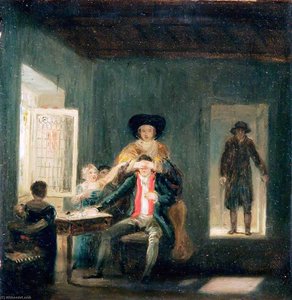
In the evocative watercolor "enterrada viva," the viewer is transported into a poignant, circular world that feels less like a window and more like a dreamscape of profound isolation. Created in 2020, this piece serves as a hauntingly beautiful exploration of vulnerability and confinement. At its heart lies a clown, trapped within the rigid geometry of a cage, set against a backdrop where a stylized cityscape meets an abstract, natural landscape. The composition is masterfully layered, using the circular format to create a sense of a self-contained universe—a miniature stage where the drama of sorrow unfolds in silence. The soft, blended edges characteristic of watercolor techniques lend the work a spectral quality, as if the scene is emerging from a fading memory or a heavy mist.
The artistry of Joseph Clover, a figure rooted in the traditions of the Norwich School, manifests here through a delicate balance of line and wash. While the cage is defined by precise, structural lines that suggest an inescapable reality, the surrounding environment is rendered with a looser, more organic approach. This juxtaposition between the geometric prison and the fluid, atmospheric landscape creates a tension that is central to the work's emotional resonance. The use of light is notably diffused, evoking the somber mood of an overcast day, which prevents any harsh shadows from breaking the delicate, melancholic atmosphere. For collectors and designers, this piece offers a sophisticated interplay of texture and tone, where the graininess of the watercolor washes adds a tactile depth that invites close, contemplative inspection.
Symbolism and the Weight of Solitude
Beyond its visual beauty, "enterradamente viva" is a deeply symbolic work that speaks to the universal human experience of alienation. The clown, traditionally a figure of joy and performance, is here stripped of his purpose, transformed into a symbol of the hidden sadness that exists beneath the surface of societal roles. The cage acts as a powerful metaphor for the psychological or societal restrictions that stifle the spirit, while the urban elements in the background hint at the crushing pressures of modern existence. The elegant script of the word 'Tristona' positioned below the image serves as a final, lyrical anchor to the theme of sorrow, guiding the viewer toward an understanding of the piece as an elegy for lost happiness.
For those looking to integrate art into a curated interior, this painting offers more than mere decoration; it provides a focal point for emotional reflection. Its muted palette and surrealist undertones make it an ideal centerpiece for spaces designed for quiet contemplation, such as a study, a library, or a sophisticated gallery wall. The artwork’s ability to convey complex narratives through subtle color shifts and evocative shapes ensures that it remains a captivating subject of conversation, bridging the gap between historical painterly traditions and contemporary emotional expression.
Questions & Answers
Where can I buy a print of "enterrada viva" by Joseph Clover?
A print of "enterrada viva" by Joseph Clover can be ordered directly on its Fine Art Print page: a fine art print on cotton canvas or archival canvas paper.
What does "enterrada viva" by Joseph Clover depict?
"enterrada viva" by Joseph Clover depicts: melancholy clown, urban isolation, cage symbolism, stylized cityscape, watercolor landscape, sadness & loss, symbolic imagery, norwich school art.
What space is suggested for "enterrada viva" by Joseph Clover?
The recommended space for "enterrada viva" by Joseph Clover is a living room. The suggestion can of course be adapted to your interior.
Artist Biography
A Quiet Observer of Norfolk Landscapes and Dignified Portraits
Joseph Clover (1779-1853) stands as a pivotal figure within the Norwich School, an artistic movement that flourished in rural Norfolk during the Victorian era. Unlike his contemporaries who often embraced dramatic narratives or grand historical subjects, Clover cultivated a distinctive style characterized by understated elegance and meticulous observation of the natural world alongside portraits imbued with quiet dignity. His canvases rarely shout for attention; instead, they invite contemplation, capturing fleeting moments of beauty and conveying an inner stillness that reflects the sensibilities of his time.
Born in Norwich, Clover’s formative years were shaped by a family steeped in Quaker traditions—beliefs which instilled a profound appreciation for simplicity and moral integrity. This foundational respect for the unadorned truth would later manifest in his artistic approach. Crucially, he absorbed considerable artistic influence from John Opie, whose landscapes championed naturalism and humanist ideals. Opie's emphasis on depicting ordinary subjects with sensitivity and honesty resonated deeply within Clover’s artistic vision, guiding him toward a way of seeing that prioritized the authentic over the theatrical.
The Mastery of Light and Landscape
Clover’s contribution to the Norwich School is undeniable. He eschewed flamboyant brushstrokes and theatrical compositions in favor of a technique rooted in careful tonal gradations and subtle modeling—methods honed through diligent study and practice. His landscapes, particularly those depicting Norfolk countryside scenes, are imbued with an atmospheric quality that captures the very essence of place. One might find himself lost in his depictions of fields bathed in golden light or tranquil rivers meandering through meadows, where the air itself seems to possess a tangible weight.
His ability to render the shifting moods of the English sky and the soft textures of the rural terrain allowed him to create works that felt both intimate and eternal. Through his eyes, the Norfolk landscape was not merely a backdrop but a living, breathing protagonist. This mastery of light and atmosphere served to elevate the mundane aspects of nature into something profoundly spiritual, echoing the quietude found in his personal heritage.
Portraiture and Psychological Depth
Beyond the rolling hills and pastoral serenity, Clover’s portraits distinguished themselves by their psychological depth and understated realism. He skillfully rendered his subjects—often members of the landed gentry—with remarkable accuracy, capturing not merely physical likeness but also conveying a sense of character and inner life. There is a certain gravitas in his portraiture; he possessed a rare ability to look past the finery of clothing and the status of the sitter to find the human soul beneath.
His approach to the human form was marked by:
- Subtle Modeling: Using light and shadow to create a sense of three-dimensional presence.
- Emotional Restraint: Avoiding exaggerated expressions in favor of a dignified, thoughtful composure.
- Naturalistic Detail: A commitment to the true textures of skin, fabric, and hair that grounded his subjects in reality.
Through this combination of landscape sensitivity and portraitist precision, Joseph Clover left an indelible mark on British art. His legacy remains a testament to the power of observation and the beauty found in the quiet, the simple, and the sincere.

Joseph Clover
1779 - 1853
Quick Facts
- Artistic Movement Or Style: Norwich School
- Artists Or Movements Influenced By This Artist: British Romanticism
- Artists Who Influenced This Artist: John Opie
- Date Of Birth: 1779
- Date Of Death: 1853
- Full Name: Joseph Clover
- Nationality: English
- Notable Artworks:
- The Shepherdess
- Portrait of Lady Mary Wortley Montagu
- Place Of Birth: England
Related Articles

Ephemeral Visions: Exploring the Artistic Legacy & Nuances of Watercolor Painting
Explore the captivating world of watercolor painting! Discover its rich history, essential techniques, influential artists & collecting tips from art experts. A comprehensive guide for enthusiasts.

Ephemeral Visions: Exploring the Artistic Legacy & Contemporary Practice of Watercolor Painting
Explore the captivating world of watercolor painting! Discover its rich history, essential techniques, influential artists & collecting tips. A comprehensive guide for art enthusiasts from OriginalUniqueArt.

The Enduring Appeal of Watercolor: History, Techniques & Contemporary Practice
Explore the captivating world of watercolor painting! Discover its rich history, essential techniques, influential artists, and collecting tips. A comprehensive guide for art enthusiasts.

Watercolor Wonders: 10 Masterpieces That Redefined Art History | OriginalUniqueArt
Journey through 10 legendary watercolor masterpieces by Sargent, Turner & Homer! Explore iconic landscapes, portraits & floral art that redefined history. Find museum-quality reproductions and curated decor ideas at OriginalUniqueArt.com.

Ephemeral Visions: Exploring the History & Emotional Resonance of Watercolor Painting
Explore the captivating history of watercolor painting, from ancient techniques to modern masters like Kandinsky & Blake. Discover essential artists, collecting tips & the emotional power of this luminous medium. Expert insights for art enthusiasts.