Send
Send Share
Share
 Details
 Guide
Guide

 Download
 Similars
 Diaporama
 Stats
StatsBathtub
 Other-None
- Fluxus
 1977
1977 86.0 x 102.0 cm
 Städtische Galerie im Lenbachhaus
 Read More
The artwork displayed on this page is protected by copyright law, which means we cannot legally create or sell an identical reproduction. This protection is enforced under international agreements such as the Berne Convention and by national laws, including those outlined by the U.S. Copyright Law - Title 17.
This method fully complies with copyright regulations because it does not involve copying or duplicating the protected artwork. Instead, it is a creative reinterpretation - a new painting that is influenced by the original but not identical to it.
Giclée / Art Print
Museum-quality giclée or canvas print with fast production and flexible finish options. ( Buy Hand Made Painting Switch to Digital Image)




































Pick from our preset sizes that match the artwork's original proportions.

Type the width and the height you need, to fit your frame or your wall. A print can only be cut, never made bigger than the picture, so a size with a different shape loses a part of the image. We send you a digital mockup to approve before we print anything. The picture shown on this page does not show the real cut — only the mockup does.
Worldwide Delivery () in 2 weeks instead of standard 4/5 weeks. (27 October)

Free Worldwide Express Shipping

High-Quality Linen Canvas

Full Shipping Insurance

Customs Tax Refund Guarantee

True Color Matching Guarantee

100-Day Return Policy (Defects Only)

100% Money-Back Guarantee

Bulk Discount Offer
 Glass option is only available in size under 110 CM

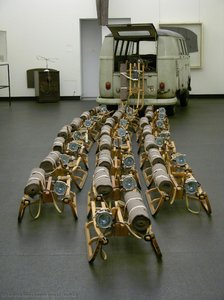
Bathtub
Giclée / Art Print
Reproduction Size
-


Total Price
$ 81
A Silent Echo of Cleansing: Joseph Beuys’s “Bathtub”
Joseph Beuys's "Bathtub," created in 1977, isn't merely a photograph of an antique claw-foot tub; it’s a carefully orchestrated meditation on the cyclical nature of existence, the potential for renewal, and the inherent dignity within the commonplace. This seemingly simple image—a white bathtub resting on its metal frame against a muted grey backdrop—holds a profound depth that speaks to Beuys's core artistic philosophy: the belief that art could be a powerful tool for social transformation and healing. The work’s power lies not in grand gestures or overt symbolism, but in its quiet contemplation of an object deeply intertwined with human experience – bathing, a ritual both physical and psychological.
Beuys's artistic trajectory was shaped by the turbulent years following World War II in Germany. He emerged from this period with a fervent desire to challenge established systems and explore alternative modes of communication. His work frequently incorporated unconventional materials—felt, wax, animal skins—and employed performance art alongside traditional painting and sculpture. “Bathtub” reflects this broader approach, elevating an everyday object to the status of a significant artistic statement. The choice of a bathtub itself is deliberate; it’s a vessel associated with cleansing, purification, and rebirth – themes central to Beuys's work.
The Language of Form and Texture
Technically, “Bathtub” is a straightforward documentary photograph, capturing the object in its entirety. The composition is meticulously centered, drawing immediate attention to the tub’s form. Its aged enamel surface—chipped and revealing patches of rust beneath—is rendered with remarkable detail, hinting at a history of use and perhaps even neglect. This deliberate imperfection adds a layer of poignant beauty, suggesting that value resides not in pristine perfection but in the evidence of lived experience.
The metal frame supporting the tub is equally important. Its white color provides a stark contrast to the aged enamel, while subtle signs of wear—corrosion and slight bends—speak to its own history and resilience. The interplay between these materials – smooth enamel against rough metal – creates a tactile tension that invites the viewer to consider the object’s physical presence. Lines are defined by both the tub's graceful curves and the angularity of the frame, offering a subtle balance between organic form and geometric structure.
Symbolism and Conceptual Weight
Beyond its aesthetic qualities, “Bathtub” is rich in symbolic meaning. The act of bathing has long been associated with ritual cleansing, both physical and spiritual. In Beuys’s context, the tub becomes a metaphor for confronting one's past—the scars of war and societal upheaval—and emerging renewed. The rust beneath the enamel could represent the decay of old systems, while the white frame symbolizes a potential for new beginnings. The image subtly evokes ideas of healing, transformation, and the inherent dignity of the human condition.
Furthermore, the placement of the tub on its metal stand elevates it from a domestic object to an almost sculptural presence. It’s as if Beuys is suggesting that even the most ordinary things can hold profound significance when presented with careful consideration and artistic intent. The neutral background serves to amplify this effect, allowing the bathtub to command the viewer's attention without distraction.
A Legacy of Radical Art
“Bathtub” stands as a testament to Joseph Beuys’s radical approach to art – an artist who sought to bridge the gap between the visual and the social. It’s a work that invites contemplation, prompting viewers to consider not only the object itself but also its connection to broader themes of history, memory, and human experience. Reproductions of this piece offer a powerful way to engage with Beuys's vision, bringing his ideas into contemporary spaces and reminding us of the transformative potential inherent in art.
The photograph’s dimensions (86 x 102 cm) provide a sense of scale, while its creation date (1977) places it firmly within Beuys's most prolific period. It is a piece that resonates with collectors and interior designers alike – a quiet yet potent statement about the beauty of simplicity and the enduring power of symbolism.
Questions & Answers
When was "Bathtub" made?
The creation of "Bathtub" by Joseph Beuys is dated 1977.
What space is suggested for "Bathtub" by Joseph Beuys?
The recommended space for "Bathtub" by Joseph Beuys is a living room. The suggestion can of course be adapted to your interior.
Is "Bathtub" by Joseph Beuys in the public domain?
"Bathtub" by Joseph Beuys is still protected by copyright. This status governs how the image of the work may be reproduced.
Artist Biography
A Life Sculpted in Society
Joseph Beuys, a name synonymous with the expansion of artistic boundaries, was more than just an artist; he was a visionary who believed creativity held the key to societal transformation. Born in Krefeld, Germany, in 1921, his life unfolded against a backdrop of immense political and social upheaval, profoundly shaping his artistic philosophy. From a childhood marked by relocation and early exposure to both natural sciences and the burgeoning darkness of Nazism—an event crystallized by rescuing Carl Linnaeus’s *Systema Naturae* from a book burning—Beuys developed a sensitivity to the fragility of existence and the power of symbolic action. His formative years were steeped in an intellectual curiosity that spanned music, mythology, and history, laying the groundwork for his later multidisciplinary approach. Though briefly involved with the Hitler Youth as a teenager – a common experience for German youth at the time – Beuys’s trajectory would ultimately lead him to challenge established norms and advocate for radical social change through art.The Crucible of War and the Birth of an Iconography
World War II proved a pivotal, almost mythic, turning point in Beuys's life. Volunteering for the Luftwaffe in 1941, he experienced a near-fatal plane crash in Crimea in 1944. The story that emerged from this event—his rescue by Tatar tribesmen who wrapped his broken body in felt and fat to preserve warmth and aid healing—became central to his artistic identity. While historical accounts dispute the details of this narrative, Beuys embraced it as a foundational myth, imbuing these materials with profound symbolic weight. Felt, representing protection, insulation, and connection to nature; and fat, symbolizing energy, healing, and transformation—these became recurring motifs in his work, acting as potent metaphors for the human condition and the potential for renewal. Following the war, Beuys formally studied sculpture at the Düsseldorf Academy of Fine Arts, but it was his engagement with anthroposophy, the spiritual philosophy developed by Rudolf Steiner, that truly ignited his artistic vision.Social Sculpture: Art as a Revolutionary Force
Beuys’s most significant contribution to art history is arguably his concept of “Social Sculpture” (*Soziale Plastik*). This wasn't merely about creating physical objects; it was a holistic vision where creativity played a vital role in shaping society and politics. He believed that every individual possessed creative potential, and that this potential could be unlocked through participation—blurring the lines between artist, artwork, and audience. Social Sculpture wasn’t confined to galleries or museums; it extended into everyday life, encompassing political activism, educational initiatives, and public performances. He envisioned a “Gesamtkunstwerk”—a total work of art—where all aspects of human existence could be creatively engaged to foster positive social change. This philosophy underpinned his numerous actions, installations, and pedagogical endeavors, challenging the traditional role of the artist as a solitary creator and positioning them instead as a catalyst for collective transformation.Performance, Materials, and Political Engagement
Beuys’s artistic practice was remarkably diverse, encompassing performance art, installations, drawings, sculptures, and political activism. His performances were often ritualistic, involving direct engagement with the public and unconventional materials. Iconic works like his felt suits, which he wore during numerous actions, symbolized warmth, protection, and a primal connection to nature. Fat Installations explored themes of energy, healing, and transformation, while performances such as “I Like to Learn” (1965), where he sat in a gallery window with stones and honey inviting dialogue, emphasized the importance of knowledge sharing and open communication. Sculptures like “Lightning with Stag in Its Glare” represented primal forces and human consciousness. Beyond his artistic creations, Beuys actively participated in political debates, founding the Free International Zone (FIZ) at documenta 7—a space for artistic experimentation and social dialogue—and becoming a vocal supporter of the German Green Party.A Lasting Legacy
Joseph Beuys died in 1986, leaving behind a legacy that continues to inspire artists, activists, and thinkers today. He radically challenged conventional notions of creativity and authorship, emphasizing participation and social engagement. His work expanded the definition of art beyond aesthetic concerns to encompass political, environmental, and spiritual dimensions. His concept of Social Sculpture remains profoundly relevant, urging us to recognize the creative potential within ourselves and to actively participate in shaping a more just and sustainable future. Beuys wasn’t simply an artist; he was a prophet of possibility, reminding us that art has the power not only to reflect society but also to transform it.
Joseph Beuys
1921 - 1986 , Germany
Quick Facts
- Artistic Movement Or Style: Fluxus, Performance Art
- Artists Or Movements Influenced By This Artist:
- Performance Art
- Social Sculpture
- Artists Who Influenced This Artist:
- Rudolf Steiner
- Achilles Moortgat
- Date Of Birth: 1921
- Date Of Death: 1986
- Full Name: Joseph Beuys
- Nationality: German
- Notable Artworks:
- Seminar with Joseph Beuys
- A True Story About...
- I Like to Learn
- Lightning with Stag
- Felt Suits
- Fat Installations
- Place Of Birth: Krefeld, Germany
Related Articles
The Enduring Legacy of Bronze Sculpture: History, Techniques & Contemporary Interpretations
Explore the rich history & enduring appeal of bronze sculpture. Learn about casting techniques, iconic artists, collecting tips, & contemporary interpretations. Expert insights for discerning art collectors.

The Enduring Form: Sculpture Across History, Technique & Emotional Resonance
Explore the rich history of sculpture with OriginalUniqueArt. Discover key techniques, influential artists & investment potential for discerning collectors. Expert insights into valuing and collecting timeless masterpieces.

The Enduring Form: Exploring Themes & Techniques in Sculpture Across Historical Periods
Explore the rich history of sculpture from ancient masterpieces to contemporary innovations. Discover key techniques, influential artists & investment potential for discerning art collectors.

Bronze Sculptures That Defined Art History | OriginalUniqueArt
Journey through art history with our Top 10 bronze sculptures! Explore masterpieces by Rodin, Michelangelo & more. Discover stories behind iconic statues and find museum-quality reproductions for your home decor at OriginalUniqueArt.com.

Bronze Age to Modern Masters: 10 Sculptures That Redefined Art | OriginalUniqueArt
Journey through art history with 10 legendary bronze sculptures – from Michelangelo's David to Rodin’s Thinker. Explore the stories, techniques & timeless beauty of these masterpieces. Find museum-quality reproductions & elevate your home decor on OriginalUniqueArt.com.