Preview
 Send
Send Share
Share
 Details
 Guide
Guide

 Download
 Similars
 X-Ray
X-Ray Diaporama
 Q&A
Q&A Stats
StatsStudy for a female nude

- 50.0 x 61.0 cm


 Read More
The artwork displayed on this page is protected by copyright law, which means we cannot legally create or sell an identical reproduction. This protection is enforced under international agreements such as the Berne Convention and by national laws, including those outlined by the U.S. Copyright Law - Title 17.
This method fully complies with copyright regulations because it does not involve copying or duplicating the protected artwork. Instead, it is a creative reinterpretation - a new painting that is influenced by the original but not identical to it.
Giclée / Art Print
Museum-quality giclée or canvas print with fast production and flexible finish options. ( Buy Hand Made Painting Switch to Digital Image)




P118B $10

P118H $10

P118W $10

P438Z $10

P508JH $12

P508YH $12

P805H $10

P805Z $10

P919BZ $10

P919G $10

P919XJ $10

P959ZH $10

P968JZ $12

W106C $8

W218G $10

W218JH $8

W218Y $10

W307PJ $10

W316G $10

W316PJ $8

W316Y $10

W398PJ $8

W4111J $10

W500HY $15

W500JH $15

W692G $12

W849H $8

W940BG $15

W953PJ $8




Pick from our preset sizes that match the artwork's original proportions.

Type the width and the height you need, to fit your frame or your wall. A print can only be cut, never made bigger than the picture, so a size with a different shape loses a part of the image. We send you a digital mockup to approve before we print anything. The picture shown on this page does not show the real cut — only the mockup does.
Worldwide Delivery () in 2 weeks instead of standard 4/5 weeks. (4 November)

Free Worldwide Express Shipping

High-Quality Linen Canvas

Full Shipping Insurance

Customs Tax Refund Guarantee

True Color Matching Guarantee

100-Day Return Policy (Defects Only)

100% Money-Back Guarantee

Bulk Discount Offer
 Glass option is only available in size under 110 CM

Study for a female nude
Giclée / Art Print
Reproduction Size
-


Total Price
$ 81
A Moment of Quietude: Exploring "Study for a Female Nude" by Josep Mompou Dencausse
This intimate study, rendered in 1929 by Catalan artist Josep Mompou Dencausse, offers a poignant glimpse into the burgeoning artistic landscape of early 20th-century Spain. Measuring 50 x 61 cm, the artwork depicts a woman reclining on her side within what appears to be a bed, an arrangement that immediately evokes a sense of vulnerability and quiet contemplation. The subject’s relaxed posture and prominent breasts – a deliberate choice reflecting the influence of Impressionistic ideals – draw the viewer's eye with a directness that speaks to the era’s evolving attitudes towards the female form in art.
Impressionistic Roots and Catalan Vision
Josep Mompou Dencausse’s artistic journey was deeply rooted in the Impressionist movement, particularly the techniques championed by Claude Monet and Camille Pissarro. This influence is strikingly evident in "Study for a Female Nude," where light and color are used not to represent reality with photographic precision, but rather to capture fleeting moments of atmosphere and emotion. The dim lighting of the room, creating a cozy ambiance, further reinforces this Impressionistic sensibility. Born in Barcelona in 1888, Mompou’s work reflects his connection to the Catalan landscape and rural life, yet he was not confined by regionalism; instead, he embraced a broader European artistic dialogue.
Technical Details and Artistic Process
The painting's execution reveals a meticulous attention to detail. The artist skillfully employs loose brushstrokes, characteristic of Impressionism, to build up layers of color and texture. The subtle gradations in tone suggest a deep understanding of light’s effects on the human form – a hallmark of Mompou’s approach. While labeled a "study," the work possesses a finished quality, hinting at a deliberate exploration of composition and technique rather than a preliminary sketch. The presence of two indistinct figures in the background adds to the narrative ambiguity, perhaps representing the woman's domestic sphere or simply contributing to the overall sense of intimacy.
Symbolism and Emotional Resonance
"Study for a Female Nude" transcends a simple portrait; it’s an exploration of vulnerability, repose, and perhaps even a touch of melancholy. The reclining pose is universally associated with rest, contemplation, and a surrender to the moment. The woman's exposed form, while undeniably sensual, feels more like an honest depiction of human experience than a purely decorative one. Mompou’s work speaks to the broader artistic concerns of his time – the questioning of traditional representations of the female nude and the embrace of subjective perception. The painting’s quietude invites viewers to pause and reflect on themes of beauty, intimacy, and the passage of time.
Questions & Answers
What is the overall mood of "Study for a female nude" by Josep Mompou Dencausse?
The overall mood of "Study for a female nude" by Josep Mompou Dencausse is romantic. The mood describes the general atmosphere of the work.
How was "Study for a female nude" made, and how big is it?
"Study for a female nude" was made in acrylic on canvas and measures 50 x 61 cm in its original form.
Is a download available for "Study for a female nude"?
A download is available for "Study for a female nude": the artwork's Download page offers a high-resolution digital image download.
Artist Biography
The Lyrical Vision of Josep Mompou Dencausse
Born in the vibrant cultural cradle of Barcelona in 1888, Josep Mompou Dencausse emerged as a profound voice within the Catalan art scene, weaving together the delicate light of Impressionism with the raw, emotive power of Fauvism. His journey into the heart of visual expression was deeply personal, rooted in a lineage of creativity; as the son of a painter, his eyes were trained from childhood to perceive the subtle shifts in atmosphere and the rhythmic dance of color across the Spanish landscape. This early immersion allowed him to develop a technique that did not merely replicate reality but sought to capture its very soul, transforming the rural vistas of Catalonia into poetic meditations on light and existence.
As his artistic identity matured, Mompoc Dencausse navigated the shifting tides of early 20th-century modernism with remarkable fluidity. While he drew significant inspiration from the French Impressionist masters—learning to master the art of capturing fleeting moments through a soft, luminous touch—he was not content to remain within the bounds of naturalism. He found a kindred spirit in the Fauvist movement, embracing the radical liberation of color championed by Henri Matisse. This evolution brought a newfound intensity to his canvases, where bold, unapologetic hues of crimson, azure, and sun-drenched yellow began to pulse with an almost visceral energy, breaking away from traditional constraints to evoke deeper emotional resonances.
A Mastery of Subject and Medium
The breadth of Mompou Dencausse’s oeuvre reflects a restless curiosity and a deep reverence for the textures of life. While he is most celebrated for his sweeping landscapes—those tranquil, sun-soaked depictions of olive groves, vineyards, and rugged coastal vistas—his talent extended into the intimate realms of still life and illustration. In works such as Lemons, Bananas and Eucalyptus, one can witness his ability to blend impressionistic light with a tactile, textural beauty that celebrates the simple elegance of nature. His approach to still life often transcended mere arrangement, turning everyday objects into vibrant studies of form and color.
Beyond the landscape, Mompou Dencausse explored more complex and sometimes unsettling territories through his diverse use of media:
- Oil Paintings: His primary medium for large-scale explorations of light, atmosphere, and the bold, expressive brushwork characteristic of his Fauvist period.
- Watercolors and Etchings: Used to capture more delicate, ephemeral qualities of the Catalan countryside with a sense of lightness and transparency.
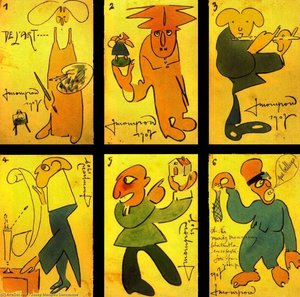
- Illustrations: A fascinating facet of his later work, where he utilized lines to explore themes of exoticism and power, as seen in the captivatingly eerie Monologue From Bass.
- Abstract Expressionist Tendencies: In his later years, particularly during the 1960s, his work embraced a more dynamic, textured approach, exemplified by pieces like Rabbit And Partridge, which showcase a masterful command of color and movement.
Legacy and Historical Significance
The historical significance of Josep Mompou Dencausse lies in his role as a bridge between the traditional landscape traditions of Spain and the avant-garde movements of Europe. He successfully synthesized the observational rigor of the 19th century with the emotional liberation of the 20th, creating a body of work that feels both timeless and modern. His ability to move from the serene, light-filled landscapes of his youth to the more textured, abstract compositions of his later years mirrors the broader evolution of modern art itself.
Today, his legacy is preserved through his presence in prestigious institutions, most notably the Reina Sofía, ensuring that his unique vision of Catalonia continues to inspire. Mompou Dencausse remains a vital figure for students and connoisseurs alike, offering a window into a period of intense artistic transformation where the boundaries of color, light, and emotion were being perpetually redefined.

Josep Mompou Dencausse
1888 - 1968 , Spain
Quick Facts
- Full Name: Josep Mompou Dencausse
- Nationality: Spanish
- Date Of Birth: 1888
- Date Of Death: 1968
- Place Of Birth: Barcelona, Spain
- Notable Artworks:
- Paisatge De Torrelles
- Calella
- Swimming
- Artistic Movement Or Style: Post-Impressionism & Fauvism
- Artists Who Influenced This Artist:
- Vincent van Gogh
- Henri Matisse
Related Articles

Giclée Prints: Archival Quality & Aesthetic Nuances for the Discerning Collector
Explore the world of giclée prints with OriginalUniqueArt. Learn about archival quality, aesthetic nuances & investment potential. Expert guidance for discerning art collectors seeking museum-quality reproductions and lasting value.
Josep Mompou Dencausse: Exploring Intimacy & Catalan Identity Through Minimalist Expression
Explore the captivating world of Josep Mompou Dencausse, a master of Post-Impressionism whose intimate paintings reflect Catalan identity and minimalist beauty. Discover his life, style & legacy.

Echoes of Time: Exploring the Enduring Appeal & Historical Context of Vintage Art Prints
Explore the captivating world of vintage art prints! Discover their history, collecting tips & enduring appeal. Expert insights on chromolithography and building a legacy collection with OriginalUniqueArt.

The Enduring Allure of the Nude: A Historical & Artistic Exploration of the Human Form
Explore the captivating history of nude art! Discover iconic paintings & artists from classical to modern eras. Uncover symbolism, techniques & find museum-quality reproductions at OriginalUniqueArt.

The Enduring Legacy of Fine Art Prints: Technique, History & Aesthetic Impact
Explore the rich history & techniques of fine art prints. Discover investment potential, assess authenticity, and learn how to preserve your collection with expert guidance. Trusted insights for discerning collectors.