Romanticism · 1845
Ca d (John Ruskin, 1845)
John Ruskin (1819–1900) made Ca d. It dates from 1845. It belongs to the Romanticism movement. It is made in painting. It measures 33 × 47 cm.
- 1845
- Painting
- 33 × 47 cm

 Preview

 Hand Made Oil Painting
 Send
 Share
 Fact sheet


 Download
 Similars
 X-Ray
 Diaporama
 Q&A

 Stats
Ca d, in brief
- Title
- Ca d
- Artist
- John Ruskin (1819–1900)
- Artist born in
- London, United Kingdom
- Date
- 1845
- Medium
- Painting
- Dimensions
- 33 × 47 cm
- Movement
- Romanticism
- Period
- 19th Century
- Subject
- architecture, clock tower, windows, people, building facade, ornate details
What does Ca d depict?
The Architecture of Devotion
In this 1845 work, the eye is immediately drawn to the verticality of a structure that commands the space. It is a building defined by its many windows, a facade that suggests the quiet gravity of a church or a significant civic monument. A large clock tower rises prominently, anchoring the composition and providing a sense of scale against the surrounding atmosphere. Small figures are scattered throughout the scene, some gathered near the base of the structure, others appearing as mere accents within the larger architectural landscape. The scale of the windows creates a rhythmic pattern across the surface, suggesting a space designed for light and communal gathering.
Details of the Facade
The artist focuses heavily on the intricate details that adorn the building's exterior. There is a clear interest in the way light interacts with the ornate decorations and the complex geometry of the masonry. The composition relies on several key visual elements:
- The prominent verticality of the clock tower.
- The repetitive, rhythmic placement of large windows.
- The presence of human figures that provide a sense of scale.
- The detailed ornamentation across the building's facade.
A Study in Form and Light
The painting captures a specific moment of architectural splendor, focusing on the grandeur of the structure through a careful application of detail. There is a sense of permanence in the heavy, decorated walls, contrasted by the lightness suggested by the numerous openings. The work reflects a deep interest in the relationship between human construction and the space it occupies. It is a quiet observation of how stone and light combine to create a sense of importance and permanence in a changing landscape.
High-resolution images of Ca d

John Ruskin, Ca d (1845). Public domain.
Questions on Ca d, answered
What is the creation date of "Ca d" by John Ruskin?
"Ca d" by John Ruskin was created in 1845.
What medium is "Ca d" by John Ruskin executed in?
The medium of "Ca d" by John Ruskin is painting. Reproductions aim to render the appearance of this technique.
What size is "Ca d" by John Ruskin in real life?
The original "Ca d" by John Ruskin measures 33 x 47 cm.
What is "Ca d" about?
The themes present in "Ca d" by John Ruskin include architecture, clock tower, windows, people, building facade, ornate details. Together they summarize the artwork's subject matter.
Can the image of "Ca d" by John Ruskin be freely reproduced?
"Ca d" by John Ruskin is in the public domain - its copyright has expired. This status governs how the image of the work may be reproduced.
Who is the artist behind "Ca d"?
"Ca d" was created by John Ruskin. The information on this page describes John Ruskin's original work.
What art movement does "Ca d" by John Ruskin belong to?
"Ca d" by John Ruskin belongs to the Romanticism movement. This movement provides the stylistic context of the work.
Where does "Ca d" fall in John Ruskin's career?
Within John Ruskin's career, "Ca d" falls in the Early Period. The phase helps compare it with the artist's other works.
How old was John Ruskin when creating "Ca d" in 1845?
John Ruskin made "Ca d" at the age of 26. The artist was born in 1819 and the work is dated 1845.
About the artist, John Ruskin
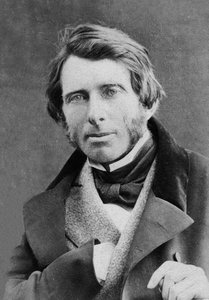
1819–1900, United Kingdom
John Ruskin
A Polymath of Vision: The Life and Legacy of John Ruskin John Ruskin, born in London on February 8, 1819, was far more than simply an art critic; he was a Victorian polymath whose influence permeated the realms of aesthetics, social reform, political economy, and environmentalism. His life was shaped by a fascinating duality – the pragmatic commercial world of his father, John James Ruskin, a successful sherry merchant, and the fervent evangelical piety of his mother, Margaret Cock. This contrasting upbringing instilled in him both a keen observational eye for detail and a deeply moral sensibility that would define his entire oeuvre. From an early age, Ruskin’s education was meticulously curated at home, steeped in biblical study and exposure to Romantic literature, particularly the works of Byron and Walter Scott.
Also by John Ruskin
 Trevi Fountain1841
 Ravine at Maglans, Valley of Cluse1849
 Aiguille Charmoz, Chamounix1849
 The Casa Loredan, Venice1850

Essays around Ca d
 Light and Scale: Distinguishing Venetian and French RococoMaster the differences between Venetian and French Rococo art. Learn to identify these iconic styles now.
 Vedute and Capriccio: Distinguishing Topographical Views from Architectural FantasyMaster the difference between veduta and capriccio through expert art history analysis. Explore the masters of Italian landscape art today.