1788
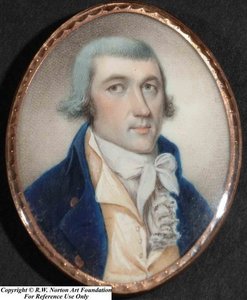
James Bleecker (John Ramage, 1788)
John Ramage (1748–1802) made James Bleecker. It dates from 1788. It is kept at Metropolitan Museum of Art in new york, United States of America.

 Preview

 Hand Made Oil Painting
 Send
 Share
 Guide


 Download
 Similars
 X-Ray
 Diaporama
 Q&A

 Stats
James Bleecker: the essentials
- Title
- James Bleecker
- Artist
- John Ramage (1748–1802)
- Artist born in
- Dublin, Ireland
- Date
- 1788
- Where to see it
- Metropolitan Museum of Art, new york, United States of America
What does James Bleecker depict?
Which museum holds James Bleecker?
Metropolitan Museum of Art
new york, United States of America
Origins and History of the Metropolitan Museum of Art The Metropolitan Museum of Art began with a vision shared by a group of businessmen, financiers, and leading artists and thinkers. Following its incorporation in 1870, the institution sought a permanent home to house its growing acquisitions. Before settling into its current location, the museum briefly resided in the Douglas Mansion estate on West 14th Street.


James Bleecker in high resolution

John Ramage, James Bleecker (1788), Metropolitan Museum of Art. Public domain.
A digital expert checks the colors against the original painting and retouches the file, faithful to the artist's brushwork.
Buy the high-resolution imageQuestions about James Bleecker
Where can I find a guide to "James Bleecker"?
The guide to "James Bleecker" is the artwork's Guide page - a printable factsheet showing the artwork with its caption, credit line and identity table (artist, dates, medium, original size, collection).
Where do the visitors of "James Bleecker" by John Ramage come from?
The Stats page of "James Bleecker" by John Ramage presents public visit statistics: monthly visits of this artwork, a comparison with the artist's most viewed works, and where its visitors come from.
How do I download the image of "James Bleecker" by John Ramage?
The image of "James Bleecker" by John Ramage can be downloaded from the artwork's Download page: a high-resolution digital image download.
How do contrast and harmony combine in "James Bleecker"?
The color composition of "James Bleecker" by John Ramage combines a statement contrast with a unified palette harmony.
Are the colors of "James Bleecker" by John Ramage saturated or muted?
The palette of "James Bleecker" is muted in saturation.
Can I examine "James Bleecker" in more detail?
The X-Ray view of "James Bleecker" by John Ramage is on the artwork's X-Ray page: an interactive examination of the image through eleven optical layers.
Is "James Bleecker" held in the country of its creator?
No - the artwork is kept abroad. "James Bleecker" is held in United States of America, while John Ramage was born in Ireland.
Does the copyright of "James Bleecker" by John Ramage allow reproductions?
The copyright status of "James Bleecker" by John Ramage is clear: the work is in the public domain - its copyright has expired. Its presence at the Metropolitan Museum of Art does not change that status.
What level of contrast does "James Bleecker" by John Ramage show?
The light-dark contrast of "James Bleecker" is recorded as statement. Contrast describes how strongly light and dark areas differ.
About the artist, John Ramage
1748–1802, Ireland
John Ramage
A Life Bridging Worlds: The Story of John Ramage Born in Dublin, Ireland, in 1748, John Ramage’s life was one of remarkable transition and artistic dedication, a journey that carried him from the refined world of Irish goldsmithing to the burgeoning art scene of colonial America. Details surrounding his early family life remain elusive, yet it is known he received formal training at the Dublin Society of Artists in 1763, laying a foundation in drawing and painting techniques that would serve as the bedrock for his future endeavors. Ramage’s initial career path was notably versatile; he skillfully combined the precision of a goldsmith with the delicate artistry of a miniaturist—a testament to his inherent talent for detail and decorative arts. This early period instilled within him not only technical proficiency but also an appreciation for craftsmanship that would distinguish his work throughout his life.
 Major Greene, B.A1777
 Portrait of a Gentleman1780
 Gilbert Van Cortlandt1785
 Governor George Clinton1785
