Switch to Print
 Read More







































 For artworks or reproductions larger than 105 cm (approximately 41 inches) on any side, the frame will be shipped as a kit, disassembled. This method ensures safe delivery and prevents damage during transport.


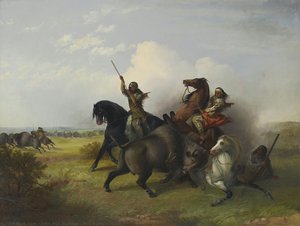
A Warrior’s Gaze: John Mix Stanley's “Black Knife”
John Mix Stanley’s “Black Knife,” painted in 1846, is more than just a portrait; it’s a window into the complex and often fraught relationship between American expansionism and the indigenous peoples of the American West. This arresting depiction of Baishan, also known as Black Knife, an Apache chief, transcends simple representation to become a poignant study of power, resilience, and the enduring spirit of a vanishing culture. The painting captures a moment of quiet intensity – a seasoned warrior, identified by his name and the distinctive blade he carries (hence “Black Knife”), seated calmly before a backdrop of rugged Arizona terrain. Stanley’s choice of palette—earthy browns, ochre yellows, and deep greens—mirrors the landscape itself, grounding Baishan within his ancestral territory while simultaneously emphasizing his isolation as an individual confronting the encroaching forces of American settlement.
Stanley's artistic approach is distinctly Romantic, influenced by the prevailing fascination with the “noble savage” archetype. However, he moves beyond mere exoticism, imbuing Baishan with a palpable sense of dignity and authority. The composition is carefully balanced; the warrior’s direct gaze meets the viewer’s head-on, creating an immediate connection. Note the subtle details: the intricate beadwork on his clothing, the weathered lines etched onto his face – each element speaks to a life lived in harmony with nature and steeped in tradition. Stanley's meticulous attention to detail, particularly in rendering the horse and its rider’s posture, reflects a deep respect for the subject and an understanding of the warrior’s role within his community.
The Context of Conflict: 1846 and the Mexican-American War
“Black Knife” was created during a pivotal period in American history – the tumultuous years following the Mexican-American War (1846–48). The conflict dramatically reshaped the map of North America, leading to significant territorial expansion for the United States. Baishan’s story is inextricably linked to this era; he was a prominent Apache leader who engaged in raids on Mexican settlements, aligning himself with U.S. army battalions seeking to suppress Mexican resistance. This strategic alliance, though temporary and fraught with complexities, secured Baishan's place in historical records as a key figure during the conflict. Stanley’s decision to paint him amidst this backdrop underscores the painting’s layered significance – it is not simply a portrait of an individual but a visual document of a specific moment in a larger narrative of conquest and displacement.
Stanley's involvement with Colonel Stephen Watts Kearny's expedition further illuminates the painting's historical context. The artist accompanied the military campaign, documenting both the landscape and its inhabitants. This experience undoubtedly influenced his portrayal of Baishan, shaping his understanding of Apache culture and contributing to a nuanced depiction that transcends simplistic stereotypes. The inclusion of the Rio Gila in the background—a vital waterway for the Apache—highlights Stanley’s keen observational skills and his commitment to accurately representing the environment within which Baishan lived.
Symbolism and the Weight of Tradition
Beyond its historical context, “Black Knife” is rich with symbolic meaning. The warrior's name itself – "Black Knife" – carries significant weight, referencing both his formidable fighting skills and the traditional Apache practice of using obsidian blades for hunting and warfare. The headdress, a powerful symbol of leadership and spiritual authority within Apache society, further emphasizes Baishan’s status as a respected figure. The horse, an integral part of Apache life, represents freedom, mobility, and connection to the land – values deeply ingrained in their culture.
Stanley's choice to depict Baishan seated rather than mounted suggests a deliberate attempt to portray him not merely as a warrior but as a thoughtful individual contemplating his role within his community. The stillness of his gaze invites introspection, prompting viewers to consider the complexities of his situation and the profound impact of historical forces on his life. The painting ultimately serves as a poignant reminder of a culture facing imminent change and the enduring legacy of its traditions.
A Reproduction for Today: Bringing History Home
Reproductions of “Black Knife” offer a remarkable opportunity to bring this compelling artwork into contemporary homes and spaces. The high-quality prints, meticulously crafted using archival inks on museum-grade canvas, faithfully capture the painting’s rich colors, intricate details, and evocative atmosphere. Whether displayed in a study, living room, or gallery, this reproduction serves as a powerful reminder of American history, indigenous culture, and the enduring beauty of the West. It's more than just a print; it’s a conversation starter—a window into a pivotal moment in time and a testament to the artistic vision of John Mix Stanley.
Questions & Answers
How do I discover artworks close to "Black Knife, an Apache Warrior" by John Mix Stanley?
The Similars page of "Black Knife, an Apache Warrior" by John Mix Stanley presents related artworks.
Did "Black Knife, an Apache Warrior" stay in its artist's homeland?
Yes - the artwork is kept in the artist's home country. John Mix Stanley was born in United States of America, and the original "Black Knife, an Apache Warrior" is held in a museum in United States of America.
How do the colors of "Black Knife, an Apache Warrior" by John Mix Stanley relate to its emotion?
"Black Knife, an Apache Warrior" by John Mix Stanley combines an earthy palette with a reflective tone.
More about this painting
 Preview
 Send
Send Share
Share
 Details
 Guide
Guide

 Download
 Similars
 X-Ray
X-Ray Diaporama
 Q&A
Q&A Stats
Stats