Preview
 Send
Send Share
Share
 Details
 Guide
Guide

 Download
 Similars
 X-Ray
X-Ray Diaporama
 Stats
Stats28.5.66


 Read More
The artwork displayed on this page is protected by copyright law, which means we cannot legally create or sell an identical reproduction. This protection is enforced under international agreements such as the Berne Convention and by national laws, including those outlined by the U.S. Copyright Law - Title 17.
This method fully complies with copyright regulations because it does not involve copying or duplicating the protected artwork. Instead, it is a creative reinterpretation - a new painting that is influenced by the original but not identical to it.
Giclée / Art Print
Museum-quality giclée or canvas print with fast production and flexible finish options. ( Buy Hand Made Painting Switch to Digital Image)




P118B $10

P118H $10

P118W $10

P438Z $10

P508JH $12

P508YH $12

P805H $10

P805Z $10

P919BZ $10

P919G $10

P919XJ $10

P959ZH $10

P968JZ $12

W106C $8

W218G $10

W218JH $8

W218Y $10

W307PJ $10

W316G $10

W316PJ $8

W316Y $10

W398PJ $8

W4111J $10

W500HY $15

W500JH $15

W692G $12

W849H $8

W940BG $15

W953PJ $8




Pick from our preset sizes that match the artwork's original proportions.

Type the width and the height you need, to fit your frame or your wall. A print can only be cut, never made bigger than the picture, so a size with a different shape loses a part of the image. We send you a digital mockup to approve before we print anything. The picture shown on this page does not show the real cut — only the mockup does.
Worldwide Delivery () in 2 weeks instead of standard 4/5 weeks. (24 October)

Free Worldwide Express Shipping

High-Quality Linen Canvas

Full Shipping Insurance

Customs Tax Refund Guarantee

True Color Matching Guarantee

100-Day Return Policy (Defects Only)

100% Money-Back Guarantee

Bulk Discount Offer
 Glass option is only available in size under 110 CM

28.5.66
Giclée / Art Print
Reproduction Size
-


Total Price
$ 81
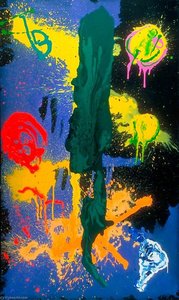
28.5.66: A Minimalist Dialogue Between Color and Geometry
The artwork “28.5.66,” by John Hoyland, embodies the spirit of minimalist abstract art—a movement that flourished in the 1960s—characterized by its reductive approach to visual language. At first glance, it presents a deceptively simple composition: three vertical rectangles dominating a vast expanse of crimson pigment. Yet, beneath this apparent austerity lies a profound exploration of color theory and spatial relationships, reflecting Hoyland’s enduring fascination with the expressive potential of paint itself.- Composition & Structure: The central rectangle—a muted grey-blue—serves as anchor, flanked by a darker olive green on the right. These rectangles aren't perfectly aligned; subtle irregularities introduce an element of organic imperfection into what would otherwise be a rigorously geometric framework. This deliberate asymmetry speaks to Hoyland’s rejection of rigid formalism and hints at a deeper consideration of visual balance.
- Color Palette & Contrast: The dominant red background immediately establishes a powerful emotional resonance—passion, urgency, perhaps even vulnerability—contrasting sharply with the cooler hues of the rectangles. Hoyland meticulously calibrated these tones to heighten the impact of color itself, prioritizing luminosity and saturation over representational accuracy.
- Technique & Materiality: Likely executed in acrylic paint on canvas or paper, “28.5.66” demonstrates a straightforward yet masterful application of pigment. The surface appears smooth, suggesting careful layering and blending—a technique Hoyland championed throughout his career—resulting in an almost velvety texture that invites contemplation.
- Historical Context: Hoyland’s work emerged during the height of Color Field painting, a movement spearheaded by artists like Mark Rothko and Barnett Newman who sought to convey profound emotional states through expansive canvases filled with unbroken blocks of color. “28.5.66” aligns seamlessly with this aesthetic tradition, mirroring its emphasis on pure sensation and spiritual contemplation.
- Symbolic Resonance: The stark geometric forms—the rectangles—can be interpreted as symbols of stability and containment against the turbulent backdrop of red. Simultaneously, they represent a deliberate simplification of visual experience, prompting viewers to focus on fundamental elements of perception—color and shape—and inviting introspection about their own emotional responses.
Questions & Answers
How can I view "28.5.66" by John Hoyland as a slideshow?
"28.5.66" by John Hoyland can be viewed as a slideshow on the artwork's Diaporama page.
What does "28.5.66" by John Hoyland bring to an interior?
The minimalist atmosphere of "28.5.66" by John Hoyland matches its recommended space: a living room.
Where does "28.5.66" sit within John Hoyland's body of work?
"28.5.66" belongs to John Hoyland's Color Field Abstraction work, whose recorded themes include american expressionism impact, color theory exploration, minimalist aesthetic vision, geometric composition style, bold color field practice.
Artist Biography
A Life Immersed in Color: The Journey of John Hoyland
John Hoyland, born in Sheffield in 1934, emerged as one of Britain’s most significant abstract painters, a figure whose canvases vibrated with an audacious use of color and a profound commitment to the expressive potential of paint. His path wasn't one of immediate acceptance; rather, it was forged through a determined exploration of artistic language, punctuated by moments of challenge and ultimately, resounding recognition. Growing up in a working-class family, Hoyland’s early exposure to art came through formal training at Sheffield School of Art and Crafts, followed by studies at Sheffield College of Art. These formative years were rooted in figurative work, but a pivotal shift began during his education at the Royal Academy Schools in London. It was there, amidst the traditional curriculum, that he encountered the burgeoning world of abstract art – first through the works of Nicholas de Staël and then, with electrifying force, the American Abstract Expressionists showcased at the Tate Gallery in 1959. This encounter proved transformative, igniting a passion for non-representational painting that would define his life’s work. A notorious incident during his time at the Royal Academy – the removal of his abstract paintings by Sir Charles Wheeler, who questioned Hoyland's ability to “paint properly” – underscored the prevailing resistance to abstraction within the British art establishment. The intervention of Peter Greenham ultimately secured their reinstatement, a small victory signaling a growing openness to new artistic directions.
Forging an Abstract Voice: Influences and Development
The 1960s proved crucial in Hoyland’s artistic development as he began to establish his distinctive style. He wasn't interested in merely replicating the American abstract expressionists, but rather absorbing their spirit of freedom and applying it to his own unique sensibility. A turning point arrived with a bursary from the Peter Stuyvesant Foundation that enabled him to travel to New York in 1964. This journey brought him into direct contact with key figures like Robert Motherwell, Mark Rothko, and Barnett Newman, fostering lasting friendships and profoundly influencing his artistic philosophy. Hoyland’s work began to coalesce around bold color, simplified shapes, and a flat picture surface – characteristics that aligned him with movements such as Post-Painterly Abstraction, Color Field painting, and Lyrical Abstraction. However, he resisted easy categorization, famously disliking the label “abstract” painter, preferring simply to be known as a "painter." He believed the term imposed unnecessary geometric constraints, hindering the organic flow of his creative process. Instead, Hoyland found inspiration in natural forms, particularly the circle, which he perceived as a powerful and inherently organic shape. His artistic lineage was broad, encompassing admiration for masters like Matisse, Van Gogh, Rouault, and Chaïm Soutine alongside the American giants who had so captivated him.
Career Highlights and Artistic Evolution
Hoyland’s career gained momentum throughout the late 1960s and 70s. His first solo exhibition at Marlborough New London Gallery in 1964 was followed by a significant museum show at the Whitechapel Art Gallery in 1967, curated by Bryan Robertson. He became involved with the influential Situation group, exhibiting large-scale abstract paintings designed to immerse viewers in color and form. In 1969, he achieved international recognition representing Great Britain alongside Anthony Caro at the São Paulo Biennale in Brazil. The 1970s witnessed a shift in his technique; his paintings grew more textured as he experimented with impasto and various materials. He exhibited extensively at Waddington Galleries in London and also found representation in New York with Robert Elkon Gallery and André Emmerich Gallery, expanding his reach to an international audience. Recognition continued to accrue throughout the following decades, culminating in prestigious awards such as the John Moores Painting Prize in 1982 and the Royal Academy’s Wollaston Award in 1998. Major retrospectives at the Serpentine Gallery (1979), the Royal Academy (1999), and Tate St Ives (2006) cemented his position as a leading figure in British art.
Legacy and Enduring Significance
John Hoyland’s contribution to British abstraction is undeniable. He played a vital role in championing non-representational painting within the UK art scene, challenging conventional norms and paving the way for future generations of artists. His bold use of color, dynamic compositions, and unwavering commitment to painterly expression have left an indelible mark on contemporary art. Hoyland’s works are now held in numerous public and private collections, including the Tate and even Damien Hirst's Murderme collection, a testament to his enduring artistic importance. In 1991, he was elected to the Royal Academy, and in 1999, appointed Professor of Painting at the Royal Academy Schools – positions that further solidified his influence within the art establishment. Though he passed away in 2011, his legacy continues to resonate. Hoyland’s paintings remain powerful statements about the expressive potential of color and form, inviting viewers to engage with art on a purely emotional and visceral level. He wasn't simply painting abstractions; he was creating worlds – vibrant, dynamic, and deeply personal realms that continue to captivate and inspire.
Key Characteristics of Hoyland’s Work
- Bold Color Palettes: Hoyland was renowned for his fearless use of color, often employing high-key hues and contrasting tones to create visually arresting compositions.
- Simplified Forms: His paintings typically feature simplified shapes and forms, emphasizing the interplay between color and space rather than representational detail.
- Textural Surfaces: Particularly in his later work, Hoyland experimented with texture, incorporating impasto and various materials to create richly layered surfaces.
- Emphasis on Painterly Expression: He prioritized the act of painting itself, allowing the physicality of the medium to become an integral part of the artwork’s meaning.
- Rejection of Geometric Constraints: Hoyland actively resisted rigid geometric structures, preferring organic and fluid compositions that reflected his intuitive approach.

John Hoyland
1934 - 2011 , United Kingdom
Quick Facts
- Full Name: John Hoyland
- Nationality: British
- Date Of Birth: 1934
- Date Of Death: 2011
- Place Of Birth: Sheffield, United Kingdom
- Notable Artworks:
- Italian Etchings La Manga
- 29.3.69
- Captive Circle
- Artistic Movement Or Style: Abstract Expressionism
- Artists Who Influenced This Artist:
- Matisse
- Van Gogh
- De Staël
- Rothko
- Newman
- Artists Or Movements Influenced By This Artist: British abstractionists
Related Articles

Neo-Abstract Art: The High-Impact Evolution of Modern Visual Energy and Geometric Sophistication
Discover the power of Neo-Abstract art. Explore how bold geometric forms and high-impact visual energy are redefining modern design. Learn to curate sophisticated, high-energy spaces with the latest trends in contemporary abstraction and structural color.

Geometric Abstraction's 10 Defining Masterpieces | Art for Your Home - OriginalUniqueArt
Explore 10 defining masterpieces of Geometric Abstraction! Discover Kandinsky, Mondrian & Malevich’s iconic works. Find museum-quality art reproductions and curated decor ideas to elevate your home at OriginalUniqueArt.com.
Color Field Painting: The Emotional Power of Pure Abstraction and Chromatic Depth
Explore the profound emotional depth of Color Field painting. Discover the history of mid-century abstraction, from Rothko to Newman, and learn how pure color transforms the viewer's experience through our expert art history guide.

John Singer Sargent's 25 Masterpieces: Portraits & Beyond | OriginalUniqueArt
Explore 25 iconic John Singer Sargent paintings – from dazzling portraits to Impressionist landscapes. Discover the stories behind Madame X, El Jaleo & more! Find museum-quality art reproductions and elevate your home decor with OriginalUniqueArt.com.

John Constable's Masterpieces: Explore 25 Iconic Landscapes for Your Home
Journey through John Constable's 25 most celebrated landscapes. Explore Romanticism, Dedham Vale & his masterful use of light in iconic paintings like 'Hay Wain'. Find museum-quality art reproductions and elevate your home decor on OriginalUniqueArt.com.