
 Preview
 Send
Send Share
Share
 Details
 Guide
Guide

 Download
 Similars
 X-Ray
X-Ray Diaporama
 Stats
StatsHumber Docks, Hull


 Read More
Giclée / Art Print
Museum-quality giclée or canvas print with fast production and flexible finish options. ( Buy Hand Made Painting Switch to Digital Image)




P118B $10

P118H $10

P118W $10

P438Z $10

P508JH $12

P508YH $12

P805H $10

P805Z $10

P919BZ $10

P919G $10

P919XJ $10

P959ZH $10

P968JZ $12

W106C $8

W218G $10

W218JH $8

W218Y $10

W307PJ $10

W316G $10

W316PJ $8

W316Y $10

W398PJ $8

W4111J $10

W500HY $15

W500JH $15

W692G $12

W849H $8

W940BG $15

W953PJ $8




Pick from our preset sizes that match the artwork's original proportions.

You may enter your own dimensions to fit a specific frame or space. If your selected size does not match the original image's proportions, we will either crop the artwork or extend the image with a mirrored or solid-fill edge. A digital mockup will be sent for your approval before production begins.
Please note that the on-screen preview does not reflect the actual cropping or extension. Only the mockup will accurately show the final composition.
While custom sizes are available, we recommend selecting a dimension from the predefined list to preserve the original proportions.
Worldwide Delivery () in 2 weeks instead of standard 4/5 weeks. (11 October)

Free Worldwide Express Shipping

High-Quality Linen Canvas

Full Shipping Insurance

Customs Tax Refund Guarantee

True Color Matching Guarantee

100-Day Return Policy (Defects Only)

100% Money-Back Guarantee

Bulk Discount Offer
 Glass option is only available in size under 110 CM

Humber Docks, Hull
Giclée / Art Print
Reproduction Size
-


Total Price
$ 81
A Nocturnal Symphony of Light and Shadow
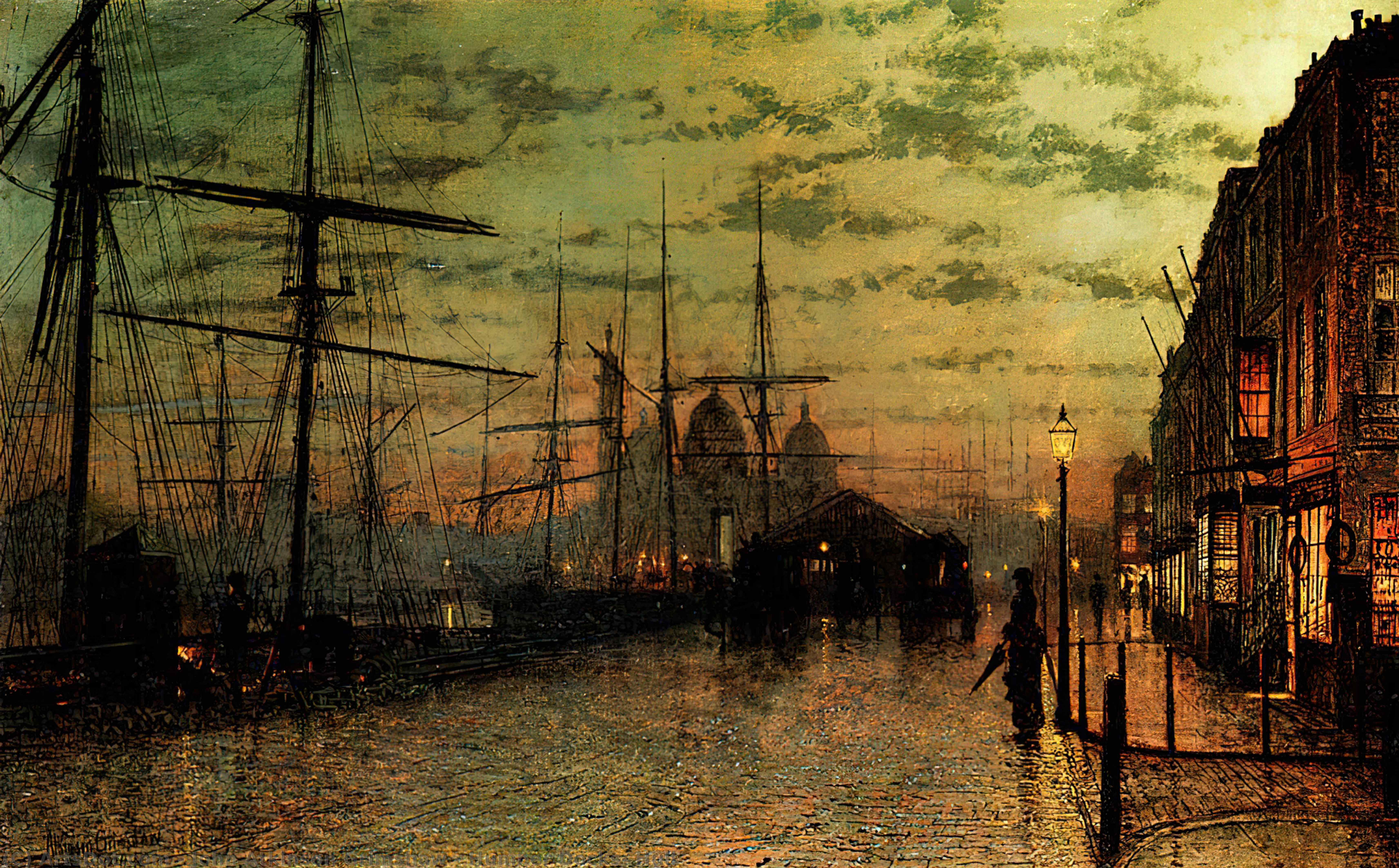
In the evocative masterpiece Humber Docks, Hull, painted in 1884, John Atkinson Grimshaw invites the viewer into a world where the boundaries between reality and dream dissolve. This quintessential work captures the essence of a Victorian harbor at the delicate transition of dusk, a moment when the fading daylight surrenders to the burgeoning glow of gas lamps and moonlight. The painting is far more than a mere topographical record of a bustling port; it is a poetic meditation on atmosphere, utilizing a masterful command of chiaroscroll to create a sense of profound mystery and tranquility. As the eye wanders across the canvas, one is struck by the way Grimshaw transforms the industrial reality of a working dock into a romanticized, almost ethereal landscape, where every reflection on the damp cobblestones tells a story of a bygone era.
The technical brilliance of the piece lies in its ability to manipulate light to evoke deep emotional responses. Grimshaw, often associated with the Romantic movement, employs a delicate palette of warm ambers and soft yellows that bleed into the cool, misty blues of the twilight sky. The artist’s skill is particularly evident in the foreground, where a wet street acts as a dark mirror, capturing the shimmering reflections of illuminated storefronts and the silhouettes of passing figures. This interplay of light and shadow does not merely provide depth; it creates a rhythmic movement that draws the viewer deeper into the composition, toward the distant, spectral masts of sailing ships moored in the harbor. The use of soft, diffused light suggests a recent rainfall, adding a tactile, sensory dimension to the scene that makes the atmosphere feel almost palpable.
The Pulse of Victorian Industry and Human Connection
Beyond its aesthetic splendor, Humber Docks, Hull serves as a poignant historical window into the late 19th century. During this period, cities like Hull were undergoing rapid industrial transformation, becoming vital hubs of global trade. Grimshaw captures this economic vitality through the intricate details of the maritime vessels—the complex rigging and sturdy hulls of the ships that represent the lifeblood of British commerce. Yet, amidst this grand scale of industry, the artist maintains a tender focus on the human element. A solitary figure, seen walking with an umbrella, provides a sense of scale and a touch of quiet intimacy. This small, transient presence amidst the monumental architecture and massive ships reminds us of the individual lives intertwined with the great movements of history.
For the discerning collector or interior designer, this painting offers a unique opportunity to introduce a sense of timeless elegance and contemplative calm into a space. The artwork’s ability to balance the heavy, dark tones of nocturnal urban life with the luminous, ethereal qualities of the sky makes it a versatile centerpiece for sophisticated decor. Whether placed in a study, a grand hallway, or a contemporary living area, a high-quality reproduction of this work brings with it an aura of historical depth and artistic prestige. It is a piece that does not merely decorate a wall but enriches the very soul of a room, offering a window into a romanticized past where every shadow holds a secret and every light tells a tale of hope and endurance.
Questions & Answers
Does "Humber Docks, Hull" show strong light-dark contrasts?
"Humber Docks, Hull" by John Atkinson Grimshaw shows a bold contrast between its light and dark areas.
When was "Humber Docks, Hull" made?
"Humber Docks, Hull" by John Atkinson Grimshaw was created in 1884.
Is "Humber Docks, Hull" typical of what John Atkinson Grimshaw usually created?
John Atkinson Grimshaw's recurring themes include pre-raphaelitism and impressionism, industrialization of victorian britain, mastery of light and shadow, nocturnal urban landscapes, economic life of ports; "Humber Docks, Hull" focuses on harbor, nocturnal, urban landscape, maritime, victorian era, twilight, ships, reflections.
What subjects appear in "Humber Docks, Hull" by John Atkinson Grimshaw?
The subjects of "Humber Docks, Hull" are harbor, nocturnal, urban landscape, maritime, victorian era, twilight, ships, reflections.
Is there a factsheet about "Humber Docks, Hull" by John Atkinson Grimshaw for students?
The Guide page of "Humber Docks, Hull" by John Atkinson Grimshaw offers a printable two-sheet factsheet: the artwork with its identity table, a decade band placing it in the artist's lifetime, other works by the artist, the measured color palette, and ready-to-copy citations in four styles.
What was John Atkinson Grimshaw's age when "Humber Docks, Hull" was created?
John Atkinson Grimshaw was 48 years old when creating "Humber Docks, Hull" in 1884. The age is computed from the artist's birth year, 1836.
Which artist is "Humber Docks, Hull" attributed to?
"Humber Docks, Hull" is attributed to John Atkinson Grimshaw.
Artist Biography
A Master of Moonlight: The Life and Art of John Atkinson Grimshaw
John Atkinson Grimshaw, born in Leeds in 1836, occupies a unique and evocative space within the pantheon of Victorian artists. He wasn’t merely a painter of landscapes; he was a chronicler of atmosphere, a poet of light and shadow, and a keen observer of the burgeoning industrial world around him. His journey from railway clerk to celebrated artist is a testament to his unwavering dedication and artistic vision—a story often recounted as an inspiring example of pursuing passion against societal expectations. Initially met with familial disapproval when he abandoned a stable career at age twenty-four to dedicate himself to painting, Grimshaw persevered, fueled by an innate talent that would ultimately define his legacy. His early exhibitions showcased modest still lifes – birds, fruit, blossoms – presented under the patronage of the Leeds Philosophical and Literary Society in 1862, but it was his later exploration of nocturnal scenes that truly set him apart, establishing a style instantly recognizable and deeply affecting.Influences and Artistic Development
Grimshaw’s artistic foundations were firmly rooted in the aesthetic currents of his time, yet he synthesized these influences into something distinctly his own. The Pre-Raphaelite movement exerted a significant impact, evident in his meticulous attention to detail, realism, and vibrant color palettes. He shared their commitment to capturing the beauty of the natural world with unwavering accuracy, but Grimshaw wasn’t simply an imitator. He forged his own path by embracing innovative techniques, most notably his open use of tools like the camera obscura or lenses to project scenes onto canvas. This practice, considered controversial by some contemporaries who questioned its artistic merit, allowed him to achieve remarkable precision in perspective and detail, creating images that possessed an almost photographic quality. James McNeill Whistler himself acknowledged Grimshaw’s mastery of nocturnal effects, famously conceding that he had believed himself the “inventor of nocturnes” until encountering Grimshaw's moonlit paintings. Beyond Pre-Raphaelite ideals, influences from artists like James Tissot and the broader Aesthetic Movement can be seen in his interior scenes, showcasing richly decorated rooms and a focus on capturing mood and emotion through light and shadow. He wasn’t afraid to experiment, blending traditional techniques with modern tools to achieve his desired effects—a boldness that set him apart from many of his peers.Major Achievements and Notable Works
The 1870s marked a period of significant success for Grimshaw. He established homes in both Leeds and Scarborough, the latter becoming a frequent subject of his art. It was during this time that he developed his signature style – atmospheric urban scenes rendered under twilight or the warm glow of gaslight. Liverpool from Wapping (1875) exemplifies this period, showcasing the industrial energy of the port city with a blend of realism and impressionistic brushwork. The painting captures not just the physical structures of the docks but also the bustling activity and the sense of constant motion that characterized Victorian Liverpool. Endymion on Mount Latmus (1879), inspired by Keats’ poem, demonstrates his ability to translate literary themes into visually stunning dreamscapes—a testament to his intellectual curiosity and artistic versatility. Dulce Domum (1885) is a particularly compelling example of his interior scenes, inviting the viewer into a world of quiet intimacy and refined elegance. On Hampstead Hill, another celebrated work, perfectly captures the transition from twilight to night, showcasing Grimshaw’s exceptional skill in manipulating light and shadow. His paintings were regularly exhibited at the Royal Academy between 1874 and 1885, solidifying his reputation within the established art world. These works weren't simply representations of places; they were emotional landscapes, imbued with a sense of mystery and quiet contemplation.Legacy and Historical Significance
Despite a period of relative obscurity following his death in 1893, John Atkinson Grimshaw’s work experienced a significant revival during the latter half of the twentieth century. A retrospective exhibition, “Atkinson Grimshaw – Painter of Moonlight,” held at the Mercer Art Gallery in Harrogate and the Guildhall Art Gallery in London in 2011, brought renewed attention to his captivating landscapes. Grimshaw’s enduring legacy lies in his ability to evoke a powerful sense of atmosphere and mood through his masterful use of light and detail. He wasn't merely documenting scenes; he was capturing emotions – the quiet solitude of a moonlit street, the bustling energy of a port city, the cozy warmth of a domestic interior. His work offers a unique window into Victorian life, revealing both its grandeur and its underlying sense of alienation. He remains an important figure in Victorian art history, celebrated for his distinctive style and his ability to transform ordinary scenes into extraordinary works of art. The influence of his atmospheric techniques can be seen in later artists who sought to capture the mood and emotion of a scene rather than simply its physical appearance. His willingness to embrace new technologies, like the camera obscura, also paved the way for future artistic experimentation. Grimshaw’s paintings continue to resonate with audiences today, reminding us of the beauty that can be found in the everyday and the power of art to transport us to another time and place.
John Atkinson Grimshaw
1836 - 1893 , United Kingdom
Quick Facts
- Full Name: John Atkinson Grimshaw
- Nationality: British
- Date Of Birth: 1836
- Date Of Death: 1893
- Place Of Birth: Leeds, United Kingdom
- Notable Artworks:
- Liverpool from Wapping
- Endymion on Mount Latmus
- Dulce Domum
- On Hampstead Hill
- Artistic Movement Or Style: Victorian, Pre-Raphaelite
- Artists Who Influenced This Artist:
- Pre-Raphaelites
- James Tissot
- Whistler
- Artists Or Movements Influenced By This Artist: ['Aesthetic Movement']
Related Articles

Dante Gabriel Rossetti's 25 Masterpieces: A Journey Through Victorian Art & Symbolism | OriginalUniqueArt
Explore 25 iconic artworks by Dante Gabriel Rossetti, a leading Pre-Raphaelite artist. Discover the stories behind masterpieces like 'Proserpine' & 'Beata Beatrix'. Find museum-quality art reproductions and elevate your home decor with OriginalUniqueArt.com.

The Refined Aesthetic of Victorian Illustration: A Study in Narrative & Technique
Explore the captivating world of Victorian illustration! Discover Pre-Raphaelite influences, key artists like Rossetti & Stephens, and the era's rich narrative detail. A deep dive for art enthusiasts.

John Atkinson Grimshaw: Atmospheric Realism & the Victorian Nocturne
Explore the captivating world of John Atkinson Grimshaw, Victorian master of atmospheric nightscapes. Discover his iconic paintings, unique techniques & enduring legacy. Learn about collecting Grimshaw's art today!

The Pre-Raphaelite Brotherhood: Rediscovering Romanticism, Mythological Depth, and Vivid Detail in Victorian Art
Explore the breathtaking world of the Pre-Raphaelite Brotherhood. Discover how this movement redefined Victorian art through vivid detail, mythological depth, and romanticism. An expert guide for classic art enthusiasts seeking to rediscover these timeless masterpieces.

Embrace the Drama: A Curated Guide to Victorian Romanticism for Sophisticated Home Decor
Transform your space with the dramatic elegance of Victorian Romanticism. Discover expert tips on incorporating Pre-Raphaelite art, rich textures, and moody palettes into your home decor to create a sophisticated, soulful sanctuary that celebrates historical grandeur.


