

 Send
Send Share
Share
 Details

 Download
 Similars
 Diaporama
Vivre


 Read More
Hand Made Oil Reproduction
Hand-painted oil on canvas in your size and frame, made to order by our artists. ( Buy Print Buy Image)




































Pick from our preset sizes that match the artwork's original proportions.

You may enter your own dimensions to fit a specific frame or space. If your selected size does not match the original image's proportions, we will either crop the artwork or extend the painting with additional hand-painted elements. A digital mockup will be sent for your approval before production begins.
Please note that the on-screen preview does not reflect the actual cropping or extension. Only the mockup will accurately show the final composition.
While custom sizes are available, we recommend selecting a dimension from the predefined list to preserve the original proportions.
After order, OriginalUniqueArt.com team will email client for instructions and provide a mockup preview
Worldwide Delivery () in 3/4 weeks instead of standard 5 weeks. (22 August). No compromise on quality.

Free Worldwide Express Shipping

High-Quality Linen Canvas

Full Shipping Insurance

Customs Tax Refund Guarantee

True Color Matching Guarantee

60-Day Return Policy (Defects Only)

100% Money-Back Guarantee

Bulk Discount Offer
 Glass option is only available in size under 110 CM

Vivre
Reproduction Medium
Reproduction Size
-


Total Price
$ 300
Artwork Description
A Whispering Floor: The Poetic Resonance of Vivre
In the quiet intersection where architecture meets existential inquiry, Jochen Christian Gerz’s 1974 work, Vivre, emerges as a profound meditation on presence and the passage of time. At first glance, the viewer is drawn into an intimate, almost voyeuristic encounter with a wooden surface, where the grain of the floor meets a rhythmic, checkered pattern. Yet, beneath this structural stability lies a layer of restless energy. The floor is not merely a foundation but a canvas for a delicate, cursive script that dances across the wood. The repeated inscription of the word "vivre"—French for "to live"—acts as a rhythmic pulse, transforming a mundane architectural element into a site of deep, philosophical contemplation.
< Permeable Boundaries: Technique and Visual TextureThe visual allure of Vivre lies in its masterful manipulation of texture and pattern. The interplay between the organic warmth of the wooden floor and the geometric precision of the checkered design creates a tension that is both visually stimulating and intellectually grounding. Gerz utilizes the medium of text not as a mere label, but as a textural component of the art itself. The flowing, difficult-to-decipher script weaves through the composition, blurring the lines between calligraphy and abstract mark-making. For the collector or interior designer, this piece offers a sophisticated layering of detail; it invites the eye to linger on the subtle nuances of the wood grain while simultaneously challenging the mind to decode the lyrical repetitions that define its surface.
The Architecture of Memory and Life
To understand Vivre, one must look toward the radical spirit of Jochen Christian Gerz. Emerging from the transformative social upheavals of the late 1960s, Gerz’s practice has always been an exploration of public memory and the dialogue between the individual and society. In this work, the act of writing on a floor—a space meant to be walked upon and often ignored—serves as a powerful metaphor for the traces we leave behind in our daily existence. The repetition of "to live" serves as both a celebration of vitality and a haunting reminder of the ephemeral nature of life. It suggests that living is an ongoing process of inscription, a continuous marking of our path through the structures of history and habit.
An Inspiration for Modern Spaces
For those seeking to curate a space that speaks to depth and intellectual curiosity, Vivre offers unparalleled inspiration. As a high-quality reproduction, this piece brings a sense of quiet drama and narrative complexity to any interior. It is particularly suited for environments that value minimalist elegance paired with profound meaning—such as contemporary studies, sophisticated galleries, or curated living areas. The artwork does not merely decorate a wall; it anchors a room, providing a focal point that encourages reflection. Owning a piece of Gerz’s legacy means inviting a conversation about existence into one's home, ensuring that the very foundation of your space is imbued with the poetic command to live.
Artist Biography
Jochen Christian Gerz: Architect of Public Memory
Born in Berlin in 1940, Jochen Christian Gerz’s artistic journey is a profound exploration of the relationship between art and life, history and memory – a dialogue constantly conducted within the public sphere. Initially drawn to literature and languages, culminating in studies at Cologne and Basle, Gerz’s trajectory shifted dramatically in the late 1960s, fueled by his experiences during the tumultuous events surrounding May ’68 in Paris. This pivotal moment marked a decisive break from traditional artistic conventions, leading him to embrace a radical approach that viewed the viewer, the public, and society itself as integral components of the creative process. His work, spanning performance art, installation, photography, text-based pieces, and meticulously crafted artist books, consistently challenges established notions of art’s boundaries and its role in shaping collective consciousness.
Gerz's early career was marked by a deliberate rejection of conventional poetic forms, a decision rooted in his belief that modern poetry had become stagnant. He subsequently turned to the visual arts, developing a distinctive methodology characterized by a meticulous layering of image and text. This approach, exemplified in his series of photographic panels – grids of seemingly unremarkable images accompanied by fragments of text – invites viewers into a contemplative space, prompting them to question their own assumptions about meaning and representation. The deliberate ambiguity inherent in these works forces a re-evaluation of the relationship between observation and interpretation, challenging the passive role typically assigned to the viewer.
The Language of Place: Public Authorship and Monumental Interventions
A defining characteristic of Gerz’s practice is his sustained engagement with public space. Rather than confining his work to galleries or museums, he actively seeks out sites within the urban landscape – squares, streets, and forgotten corners – transforming them into platforms for participatory art projects. This commitment to public authorship extends beyond mere installation; it involves a deliberate disruption of established narratives, inviting citizens to become active participants in shaping collective memory. His monumental interventions, such as the “Bremen Questionnaire” (1990-95), exemplify this approach, demonstrating how the very act of asking questions – and responding to them – can contribute to the formation of a shared understanding of history and identity.
The project in Bremen, where citizens were tasked with formulating their own ideas for a monument against racism, stands as a powerful testament to Gerz’s belief that memory is not a fixed entity but rather a dynamic process constantly negotiated through collective action. Similarly, his “Memorial against Fascism” in Saarbrücken (1991-93), involving the removal and reinstallation of paving stones bearing the names of Jewish cemeteries, powerfully illustrates how art can confront uncomfortable truths and challenge dominant historical narratives. These interventions are not simply aesthetic gestures; they are deliberate acts of social critique, prompting reflection on issues of power, responsibility, and the enduring legacy of trauma.
Influences and Artistic Style
Gerz’s artistic development has been profoundly shaped by a diverse range of influences. Early in his career, he was drawn to the work of figures like Ezra Pound and Richard Aldington, exploring the possibilities of language as both a tool for expression and a site of disruption. The Dada movement, with its embrace of irony, chance operations, and a critical stance towards established norms, served as an important precedent, informing Gerz’s own willingness to challenge conventional artistic practices. Furthermore, his work resonates with the ideas of Marcel Duchamp, particularly his exploration of readymades and the deconstruction of traditional notions of art objecthood. The influence of Max Ernst is also evident in Gerz's use of collage and assemblage techniques, creating layered compositions that invite multiple interpretations.
Gerz’s artistic style is characterized by a deliberate juxtaposition of seemingly disparate elements – photography, text, wood, stone – often combined with meticulous attention to detail. His photographic works, frequently employing black-and-white imagery, are notable for their stark realism and subtle shifts in perspective. The “Vivre” series (1974), featuring a grid of wooden planks overlaid with handwritten script, exemplifies this approach, blending the tactile qualities of wood with the ephemeral nature of language. His use of public space as a medium is particularly striking, transforming ordinary locations into sites of critical reflection and collective engagement.
Notable Works and Legacy
Among Gerz’s most significant works are “Vivre” (1974), a photographic grid that explores the relationship between image and text; his series of “Photo-Texts,” which juxtapose photographs with fragments of narrative, inviting viewers to construct their own interpretations; and his monumental interventions in public space, such as the “Bremen Questionnaire” and the “Memorial against Fascism.” These projects have been exhibited extensively throughout Europe and North America, garnering critical acclaim for their innovative approach to art and social engagement. His work has also found a home on platforms like OriginalUniqueArt.com, extending its reach to a global audience.
Jochen Gerz’s legacy lies not only in his individual artworks but also in his pioneering spirit as a conceptual artist who redefined the boundaries of art and its relationship to society. His commitment to public authorship, his willingness to challenge established narratives, and his profound engagement with memory have left an enduring mark on the contemporary art landscape, inspiring generations of artists to explore the potential of art as a tool for social transformation.

jochen christian gerz
1940 - , Germany
Quick Facts
- Artistic Movement Or Style: Conceptual art, public authorship
- Artists Or Movements Influenced By This Artist: ['Dada Movement']
- Artists Who Influenced This Artist:
- Marcel Duchamp
- Max Ernst
- Date Of Birth: 1940 Berlin, Germany
- Full Name: Jochen Christian Gerz
- Nationality: German
- Notable Artworks:
- Vivre
- Participation & Public Authorship
- Place Of Birth: Berlin, Germany
Related Articles

Grant Wood & American Regionalism: Identity, Myth & the Rural Landscape
Explore the world of Grant Wood & American Regionalism with OriginalUniqueArt. Discover the symbolism behind 'American Gothic', recurring themes, and the movement's lasting impact on art history. High-quality reproductions available.

American Regionalism: The Soul of the Heartland and the Mastery of Grant Wood
Explore the profound history of American Regionalism. Discover how Grant Wood captured the heart of the Midwest through masterpieces like American Gothic. An expert guide to the movement, its cultural impact, and the enduring beauty of American Realism.

F.A.Q.: Acrylic vs. Wood Framing – A Collector's Guide to Timeless Elegance
Explore framing options for your art collection with . Discover the differences between acrylic & wood frames – expert guidance on preservation, style & investment value.

The Timeless Beauty of Chinese Calligraphy: An Exploration of Ink, Spirit, and the Art of the Brush
Embark on a profound journey through the soul of Chinese calligraphy. Explore the historical mastery of ink, brush, and script, from ancient Zhuanshu to elegant running script, and discover how this timeless art form reflects the enduring spirit of classical East Asian aesthetics.
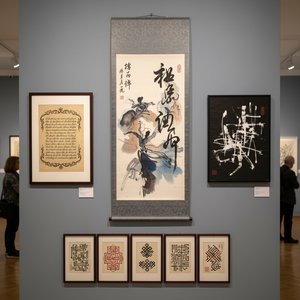
The Elegance of Line: Discovering the Timeless Beauty of Calligraphy Artworks
Explore the profound beauty of calligraphy art. From the fluid running script of Chinese masters to historical ink masterpieces, discover how the elegance of line transforms spaces with timeless grace and scholarly sophistication.


