Text size

() ·

A painting made for you, by hand

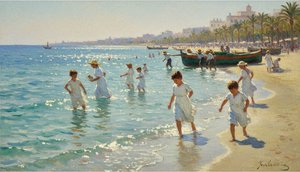
Swimmers, Jávea

Hand Made Oil Reproduction

Hand-painted oil on canvas in your size and frame, made to order by our artists. ( Switch to Print Switch to Digital Image)

Collectible Description

Joaquin Sorolla's 'Swimmers, Jávea' (1905) captures the vibrant Mediterranean light and movement with stunning brushstrokes. Explore this iconic Spanish Impressionist masterpiece.

Artist Biography

Joaquín Sorolla: A Spanish master of light and color! Witness his vibrant portraits & beach scenes capturing the essence of Mediterranean life. Explore his legacy today!

from ·

Chapter 1

How large should it be?

Slide to change the size; the picture on the left shows the frame at its real width. The proportions of the original are kept.

Standard
custom
CM
INCH

Pick from our preset sizes that match the artwork's original proportions.

width
height

Type the width and the height you need, to fit your frame or your wall. This is hand-painted, so for a size with a different shape the artist can paint a bit more around the picture, or cut a bit — you choose. We send you a digital mockup to approve before the painting starts. The picture shown on this page does not show the real result — only the mockup does.

Chapter 2

How should it arrive?

Choose the edges of the stretched canvas

Choose your frame

Corner sample of the WhiteWrap canvas edge finish, stretched on solid wood bars
White $1
Corner sample of the BlurSideWrap canvas edge finish, stretched on solid wood bars
Blurside $1
Corner sample of the ExtendedWrap canvas edge finish, stretched on solid wood bars
Extended $1
Corner sample of the P118B picture frame: moulded polystyrene, 5 cm wide and 3 cm thick
P118B $10
Corner sample of the P118H picture frame: moulded polystyrene, 5 cm wide and 3 cm thick
P118H $10
Corner sample of the P118W picture frame: moulded polystyrene, 5 cm wide and 3 cm thick
P118W $10
Corner sample of the P438Z picture frame: moulded polystyrene, 5.5 cm wide and 3.5 cm thick
P438Z $10
Corner sample of the P508JH picture frame: moulded polystyrene, 7 cm wide and 3.5 cm thick
P508JH $12
Corner sample of the P508YH picture frame: moulded polystyrene, 7 cm wide and 3.5 cm thick
P508YH $12
Corner sample of the P805H picture frame: moulded polystyrene, 5 cm wide and 3.5 cm thick
P805H $10
Corner sample of the P805Z picture frame: moulded polystyrene, 5 cm wide and 3.5 cm thick
P805Z $10
Corner sample of the P919BZ picture frame: moulded polystyrene, 7 cm wide and 3.5 cm thick
P919BZ $10
Corner sample of the P919G picture frame: moulded polystyrene, 7 cm wide and 3.5 cm thick
P919G $10
Corner sample of the P919XJ picture frame: moulded polystyrene, 7 cm wide and 3.5 cm thick
P919XJ $10
Corner sample of the P959ZH picture frame: moulded polystyrene, 5 cm wide and 3 cm thick
P959ZH $10
Corner sample of the P968JZ picture frame: moulded polystyrene, 6 cm wide and 4 cm thick
P968JZ $12
Corner sample of the W106C picture frame: solid wood, 5 cm wide and 3 cm thick
W106C $8
Corner sample of the W218G picture frame: solid wood, 5 cm wide and 3 cm thick
W218G $10
Corner sample of the W218JH picture frame: solid wood, 5 cm wide and 3 cm thick
W218JH $8
Corner sample of the W218Y picture frame: solid wood, 5 cm wide and 3 cm thick
W218Y $10
Corner sample of the W307PJ picture frame: solid wood, 6 cm wide and 3 cm thick
W307PJ $10
Corner sample of the W316G picture frame: solid wood, 6 cm wide and 3 cm thick
W316G $10
Corner sample of the W316PJ picture frame: solid wood, 6 cm wide and 3 cm thick
W316PJ $8
Corner sample of the W316Y picture frame: solid wood, 6 cm wide and 3 cm thick
W316Y $10
Corner sample of the W398PJ picture frame: solid wood, 5 cm wide and 3 cm thick
W398PJ $8
Corner sample of the W4111J picture frame: solid wood, 6.5 cm wide and 3.5 cm thick
W4111J $10
Corner sample of the W500HY picture frame: solid wood, 7 cm wide and 5 cm thick
W500HY $15
Corner sample of the W500JH picture frame: solid wood, 7 cm wide and 5 cm thick
W500JH $15
Corner sample of the W692G picture frame: solid wood, 8 cm wide and 4 cm thick
W692G $12
Corner sample of the W849H picture frame: solid wood, 5 cm wide and 3 cm thick
W849H $8
Corner sample of the W940BG picture frame: solid wood, 7.5 cm wide and 4.5 cm thick
W940BG $15
Corner sample of the W953PJ picture frame: solid wood, 6 cm wide and 3.5 cm thick
W953PJ $8
Corner sample of the H24-GOLD picture frame: carved wood with gesso, 10 cm wide and 6 cm thick
H24-GOLD $30
Corner sample of the H24-SILVER picture frame: carved wood with gesso, 10 cm wide and 6 cm thick
H24-SILVER $30
Corner sample of the H36-GOLD picture frame: carved wood with gesso, 15 cm wide and 6.5 cm thick
H36-GOLD $45
Corner sample of the H36-SILVER picture frame: carved wood with gesso, 15 cm wide and 6.5 cm thick
H36-SILVER $45
Frame preview
Framed

Moulding: . Overall size with the frame: .

Chapter 3

Who paints it, and should anything change?

Examples of what can be changed: Replace face with customer photo; Add pet (e.g., replace cat with dog); Include hidden message in background; Change background landscape or elements.
After order, OriginalUniqueArt.com team will email client for instructions and provide a mockup preview

Worldwide Delivery () in 3/4 weeks instead of standard 5 weeks. (1 November). No compromise on quality.

Chapter 4

The finishing touches

A nameplate, as in a museum?

Engraved Bronze Plaque Details

This elegant plaque features the artist's name and the title of the artwork, finely engraved for a timeless presentation.

It is made from bronze with a refined, elegant finish. The text is precisely laser-engraved for a sharp and permanent result. Measuring 9x2 cm, the plaque is compact yet easy to read. It's built to be durable and scratch-resistant, offering a professional, museum-quality look. Mounting is simple thanks to the included adhesive backing.

Transparent Acrylic Plaque Details

The plaque includes essential engraved details such as the artist's name, the title of the artwork, the date it was created, the type of media used-like oil on canvas or watercolor-a brief description of the piece, and a QR code that links to the complete artwork information.

It is crafted from clear acrylic, offering a sleek, modern appearance. The text is UV-engraved in black to ensure strong visual contrast. With a size of 10x15 cm, it ensures optimal readability. It comes equipped with two metal hooks for secure wall mounting. The plaque is designed to be weather-resistant, making it suitable for various environments, and it includes interactive features that work seamlessly with smartphone scanning.

Black Acrylic Plaque Details

This elegant plaque includes engraved information such as the artist's name, the title of the artwork, the date it was created, the type of media used (like oil on canvas or watercolor), a short description of the artwork, and a QR code for quick access to more information.

The plaque itself is made from refined black acrylic with a premium finish. The text is laser-engraved in white for high contrast and readability. Its size is 10x15 cm, designed to be easy to read. It comes with two metal hooks for professional mounting. The design is sleek and fits any interior style. It is also weather-resistant and durable, with built-in digital integration for mobile compatibility.

A protective varnish?

When do you need it?

Chapter 5

Your painting, as you ordered it

Swimmers, Jávea

Reproduction Medium

Reproduction Size

-

Elite Senior Artist

More detail, finesse, and extra production time

-

Reproduction Frame

-

-

For artworks or reproductions larger than 105 cm (approximately 41 inches) on any side, the frame will be shipped as a kit, disassembled. This method ensures safe delivery and prevents damage during transport.

Professional assembly required - this is not a DIY product.
The kit must be assembled and the canvas stretched by an experienced professional framer, using wood glue (not supplied), a canvas stretching plier and clamps to hold the bars square while the glue dries. Incorrect assembly or uneven canvas tension can permanently damage the artwork and is not covered by our warranty.

  • All solid wood bars are included, precisely cut to size.

  • Assembled with the screws provided, plus wood glue for the corner joints, which is not supplied and must be sourced by your framer.

  • Professional tools are required and not included: a canvas stretching plier (tensioner) and clamps to hold the bars square while the glue dries.

Important:
The corner joints require wood glue, the bars must be held with clamps until the glue is fully dry, and tightening the canvas on the assembled frame requires a canvas stretching plier. None of these are included in the kit. Please arrange an experienced professional framer before ordering this size.

Nameplate

-

-

Protective Varnish

Glossy Varnish (enhances colors, protects against light/moisture)

-

Customize My Artwork

Examples of what can be changed: Replace face with customer photo; Add pet (e.g., replace cat with dog); Include hidden message in background; Change background landscape or elements.

-

Urgent

Worldwide Delivery () in 3/4 weeks instead of standard 5 weeks. (1 November). No compromise on quality.

-

Express Shipping

Worldwide Delivery () in 5 weeks. (8 November).

Included

Total Price

$ 300

Total Price $ 300

Glass option is only available in size under 110 CM

Included with every order

  • Free Worldwide Express Shipping
  • High-Quality Linen Canvas
  • Full Shipping Insurance
  • Customs Tax Refund Guarantee
  • True Color Matching Guarantee
  • 100-Day Return Policy (Defects Only)
  • 100% Money-Back Guarantee
  • Bulk Discount Offer

Joaquín Sorolla’s “Swimmers, Jávea”: A Dance of Light and Movement

Joaquin Sorolla y Bastida's "Swimmers, Jávea," painted in 1905, isn’t merely a depiction of two women enjoying the Mediterranean Sea; it’s an exquisite distillation of light, movement, and the very essence of Spanish summer. Captured with his signature loose brushwork and vibrant palette, the canvas transports us to the sun-drenched coastline of Javea (Jávea), a region that profoundly influenced the artist's work during this period. Sorolla, deeply attuned to the ephemeral qualities of light and atmosphere, sought to capture not just what he saw, but how it *felt* – the warmth on skin, the shimmering heat haze above the water, and the joyous abandon of youth in its purest form.

The scene unfolds with a remarkable sense of immediacy. Sorolla masterfully employs *contre-jour*, placing the figures against a brilliant, almost blinding light source—likely the sun reflecting off the sea. This technique isn’t simply for dramatic effect; it serves to deconstruct the forms of the swimmers, dissolving their outlines into fragmented strokes of green, orange, blue, and purple. The water itself becomes an animated surface, fractured by the movement of the waves and the dappled light filtering through its depths. Notice how the artist doesn’t attempt a precise rendering of anatomy; instead, he prioritizes capturing the *impression* of form—the suggestion of bodies in motion, rather than their literal representation.

A Study in Color and Technique

Sorolla's technique is characterized by its remarkable speed and confidence. He worked outdoors, directly on the canvas, embracing the fleeting effects of natural light. This *plein air* approach resulted in a remarkably fresh and spontaneous quality to his paintings. The brushstrokes are loose and expressive, often applied with rapid, rhythmic movements—a testament to Sorolla’s ability to capture the dynamism of the scene. He utilized broken color – applying small strokes of pure pigment side-by-side rather than blending them together – creating a shimmering effect that mimics the way light reflects off water. The use of complementary colors – particularly the juxtaposition of orange and blue – intensifies the vibrancy and creates a sense of visual excitement.

The color palette is remarkably bright and optimistic, dominated by shades of turquoise, emerald green, and warm yellows and oranges. These hues evoke the intense heat of the Mediterranean sun and the dazzling beauty of the coastal landscape. Sorolla’s choice of colors isn't merely decorative; they contribute significantly to the painting’s overall mood—a feeling of carefree joy and boundless energy.

Symbolism and Context

While seemingly a simple depiction of swimmers, "Swimmers, Jávea" is imbued with symbolic resonance. Javea itself held a special significance for Sorolla, who spent several productive summers there in the early 1900s. The painting reflects his deep appreciation for the region’s natural beauty and its vibrant culture. The two women swimming represent not just leisure but also a celebration of youth, vitality, and the simple pleasures of life. They embody a sense of freedom and abandon—a feeling that is particularly poignant given Sorolla's own personal experiences with loss and hardship.

Furthermore, the painting can be viewed as an exploration of light itself – a central theme in Sorolla’s oeuvre. He was fascinated by the way light transforms surfaces, creating illusions of depth and movement. “Swimmers, Jávea” is therefore not just a landscape; it's a meditation on the ephemeral nature of beauty and the power of light to capture our senses.

A Timeless Masterpiece

"Swimmers, Jávea" remains one of Sorolla’s most celebrated works. Its vibrant colors, dynamic composition, and masterful handling of light continue to captivate viewers today. Reproductions of this painting offer a wonderful opportunity to bring the warmth and energy of the Spanish coast into any space. Whether you're an art collector seeking a piece of Spanish heritage or simply someone who appreciates beautiful artwork, "Swimmers, Jávea" is a timeless masterpiece that embodies the spirit of Sorolla’s artistic vision.

Questions & Answers

What is a reproduction of "Swimmers, Jávea" by Joaquín Sorolla y Bastida recommended for?

The suggested use for "Swimmers, Jávea" by Joaquín Sorolla y Bastida is accent. It can serve other purposes as well.

Where can I find statistics about "Swimmers, Jávea" by Joaquín Sorolla y Bastida?

The Stats page of "Swimmers, Jávea" by Joaquín Sorolla y Bastida presents public visit statistics: monthly visits of this artwork, a comparison with the artist's most viewed works, and where its visitors come from.

What is "Swimmers, Jávea" made with?

"Swimmers, Jávea" is executed in oil on canvas.

More about this painting

Preview AR preview Switch to Print Switch to Digital Image Send
Details Guide Add to favorites Download Similars X-Ray Diaporama Q&A Stats

In numbers

  • 1905the year it was painted
  • 29frames to choose from
  • standard sizes, in its own proportions
  • 5weeks to paint and deliver it
Joaquín Sorolla y Bastida

Joaquín Sorolla y Bastida

1863 - 1923, Spain

Quick facts about Joaquín Sorolla y Bastida

  • Full Name: Joaquín Sorolla y Bastida
  • Nationality: Spanish
  • Date Of Birth: 1863
  • Date Of Death: 1923
  • Place Of Birth: Valencia, Spain
  • Notable Artworks:
    • Italian Girl with Flowers
    • Bathing Time
    • White Slave Trade
    • Typical Sorianos
    • Children on the Seashore

    • Sewing the Sail
  • Artistic Movement Or Style: Realism, Luminism, Impressionism
  • Artists Who Influenced This Artist:
    • Francisco Pradilla
    • Jules Bastien-Lepage
    • Adolph von Menzel

Artist Biography

A Life Bathed in Light: The World of Joaquín Sorolla

Joaquín Sorolla y Bastida, a name synonymous with the radiant light and vibrant energy of Spain, was more than just a painter; he was a chronicler of his nation’s soul. Born in Valencia in 1863, Sorolla's early life was marked by tragedy. Orphaned at the tender age of two following a cholera epidemic that claimed both parents, young Joaquín and his sister were raised by their maternal aunt and uncle. This early experience with loss perhaps instilled within him a profound appreciation for the fleeting beauty of life – a sentiment that would permeate his art. Though hardship shadowed his beginnings, it did not dim the spark of artistic talent that quickly became apparent. He received initial instruction in Valencia, demonstrating an aptitude that led to studies under established artists like Cayetano Capuz and José Benlliure, eventually culminating in a four-year grant to study in Rome. It was there, amidst the classical grandeur of Italy, that Sorolla began to forge his unique artistic path, absorbing influences while simultaneously developing a style distinctly his own.

From Historical Narratives to Sun-Drenched Realism

Sorolla’s early work reflected the prevailing academic trends of the time – large-scale historical and mythological scenes. However, a pivotal shift occurred as he returned to Spain and began to truly observe the world around him. He found himself captivated by the everyday lives of his countrymen, particularly those along the Valencian coast. The intense Mediterranean sunlight, the shimmering sea, and the vibrant energy of the people became his primary subjects. This transition wasn’t immediate; Sorolla continued to explore social realism with works like Sad Inheritance (1899), a powerful depiction of children afflicted by polio bathing in the sea – a painting that garnered significant acclaim but also revealed a darker, more compassionate side to his artistic vision. Sad Inheritance, exhibited at the Universal Exhibition in Paris, brought him widespread recognition and cemented his position as a leading figure in Spanish art. Yet, it was his increasingly focused exploration of light and color, inspired by Impressionism though never fully embracing its tenets, that would define his legacy. He wasn’t merely *depicting* light; he was attempting to *capture* its very essence, the way it danced on water, illuminated skin, and transformed ordinary moments into scenes of extraordinary beauty.

Master of Luminism: A Unique Artistic Voice

Sorolla's technique became instantly recognizable – a bravura display of brushwork, characterized by loose, energetic strokes that conveyed movement and atmosphere. He worked *en plein air* whenever possible, directly confronting the challenges of capturing fleeting light conditions. This dedication to painting outdoors resulted in canvases brimming with life and immediacy. His beach scenes, perhaps his most iconic works, are not simply picturesque representations of leisure; they are studies in luminosity, reflections, and the joyful interaction between people and their environment. Paintings like Children on the Seashore and Sewing the Sail exemplify this mastery – figures bathed in golden light, rendered with a remarkable sense of spontaneity and vitality. He wasn’t interested in meticulous detail; rather, he sought to convey the *impression* of reality, prioritizing atmosphere and emotion over precise representation. This approach earned him comparisons to Impressionists like Monet and Renoir, but Sorolla's work possessed a unique Spanish character – a warmth, intensity, and emotional depth that set it apart.

Legacy and Enduring Influence

By the early 20th century, Joaquín Sorolla was internationally renowned. He exhibited widely throughout Europe and the United States, receiving numerous accolades and commissions. His most ambitious undertaking, Vision of Spain, a series of fourteen monumental murals commissioned by the Hispanic Society of America, remains a testament to his artistic vision and technical skill. Though he suffered a stroke in 1920 that curtailed his painting activity, Sorolla’s influence continued to grow after his death in 1923. His work inspired generations of artists, not only in Spain but around the world. Today, his paintings are held in major museums globally, including the Museo Sorolla in Madrid – a former home transformed into a dedicated space for showcasing his art. Sorolla’s legacy extends beyond his technical brilliance; he captured a specific moment in Spanish history and culture, immortalizing the beauty of its landscapes and the spirit of its people. He remains a master of light, color, and emotion—a painter whose work continues to resonate with audiences today, reminding us of the power of art to illuminate our world.

Key Achievements & Recognition

  • 1892: Gold medal at the National Exhibition in Madrid for Another Marguerite.
  • 1894: Acclaimed for The Return from Fishing: Hauling the Boat, acquired by the Musée du Luxembourg.
  • 1899: Grand Prix and medal of honor at the Universal Exhibition in Paris for Sad Inheritance.
  • 1900-1923: Extensive exhibitions throughout Europe and the United States, establishing international recognition.
  • 1912-1928: Commissioned to create Vision of Spain for the Hispanic Society of America (completed posthumously).
  • Present Day: Works held in major museums worldwide, including the Museo Sorolla in Madrid.

Quick Facts

  • Location: Private collection
  • Artistic style: Luminous, dynamic
  • Year: 1905
  • Subject or theme: Beach scene, swimmers
  • Notable elements: Light study, brushwork

Art Quiz

There is only one correct answer for each question.

Question 1:
What is the primary subject of Joaquín Sorolla’s ‘Swimmers, Jávea’?
Question 2:
According to the description, what artistic technique did Sorolla employ to represent the swimmers’ bodies?
Question 3:
In what year was ‘Swimmers, Jávea’ painted?
Question 4:
The description highlights that Sorolla was fascinated by which element of the scene?
Question 5:
Joaquín Sorolla was known for his work in which artistic style?