

 Preview
 Send
Send Share
Share
 Details
 Guide
Guide

 Download
 Similars
 X-Ray
X-Ray Diaporama
 Stats
StatsLandscape
 Acrylic On Canvas
- WallArt
- Catalan Modernisme
 1928
1928 85.0 x 110.0 cm
 Vil·la Casals-Museu Pau Casals
 Read More
Giclée / Art Print
Museum-quality giclée or canvas print with fast production and flexible finish options. ( Buy Hand Made Painting Switch to Digital Image)




P118B $10

P118H $10

P118W $10

P438Z $10

P508JH $12

P508YH $12

P805H $10

P805Z $10

P919BZ $10

P919G $10

P919XJ $10

P959ZH $10

P968JZ $12

W106C $8

W218G $10

W218JH $8

W218Y $10

W307PJ $10

W316G $10

W316PJ $8

W316Y $10

W398PJ $8

W4111J $10

W500HY $15

W500JH $15

W692G $12

W849H $8

W940BG $15

W953PJ $8




Pick from our preset sizes that match the artwork's original proportions.

Type the width and the height you need, to fit your frame or your wall. A print can only be cut, never made bigger than the picture, so a size with a different shape loses a part of the image. We send you a digital mockup to approve before we print anything. The picture shown on this page does not show the real cut — only the mockup does.
Worldwide Delivery () in 2 weeks instead of standard 4/5 weeks. (27 October)

Free Worldwide Express Shipping

High-Quality Linen Canvas

Full Shipping Insurance

Customs Tax Refund Guarantee

True Color Matching Guarantee

100-Day Return Policy (Defects Only)

100% Money-Back Guarantee

Bulk Discount Offer
 Glass option is only available in size under 110 CM

Landscape
Giclée / Art Print
Reproduction Size
-


Total Price
$ 81
A Catalan Soulscape: Joaquim Mir’s “Landscape” (1928)
Joaquim Mir y Trinxet's "Landscape," painted in 1928, isn’t merely a depiction of a mountainous vista; it’s a profound distillation of the Catalan spirit – its melancholic beauty, its yearning for something beyond the tangible, and its deeply rooted connection to the land. Born in Barcelona during a period of intense cultural ferment, Mir was a pivotal figure in the Modernisme movement, a force dedicated to forging a distinctly Catalan artistic identity. This particular work embodies that ethos, offering a glimpse into his unique visual poetry – a language built not on representation but on feeling and atmosphere.
The painting immediately draws the eye with its vibrant yet restrained palette. Deep blues and purples dominate the sky, suggesting both the grandeur of the mountains and an underlying sense of mystery. These cool tones are punctuated by flashes of ochre, burnt sienna, and a surprising burst of crimson in the distant building – details that hint at human presence without overwhelming the landscape’s inherent solitude. Mir's technique is characterized by loose, expressive brushstrokes, creating a textured surface that seems to shimmer with light. He eschewed meticulous detail, opting instead for an impressionistic approach, prioritizing the overall mood and emotional resonance of the scene.
The Roots of Catalan Modernisme
To understand “Landscape,” one must consider the historical context in which it was created. Catalonia at the turn of the 20th century was grappling with questions of national identity following the loss of its independence. The rise of Modernisme, spearheaded by figures like Antoni Gaudí and Santiago Rusiñol, sought to reclaim Catalan traditions and express a distinctly local sensibility through art. Mir’s work is deeply intertwined with this movement, reflecting a desire to capture the essence of Catalonia – its rugged mountains, its ancient forests, and its enduring spirit.
Mir's artistic journey began within the *Colla del Safrà*, a group of young Catalan artists who experimented with new forms of expression. This collective fostered an environment of collaboration and innovation, allowing Mir to develop his unique style – one that blended influences from various sources while remaining firmly rooted in Catalan tradition. His early travels to Mallorca, particularly his encounter with the Belgian painter William Degouve de Nuncques, profoundly impacted his approach to color and atmosphere, shaping his later work.
Symbolism and Emotional Resonance
“Landscape” is far more than a simple depiction of a mountain scene; it’s imbued with layers of symbolism. The solitary building in the distance – often identified as a representation of Vila Casals-Museu Pau Casals, a significant cultural center in Catalonia – suggests both human presence and a sense of isolation. The vastness of the landscape evokes feelings of awe, humility, and perhaps even melancholy. Mir’s use of color is particularly evocative, conveying not just visual information but also emotional states.
The painting's power lies in its ability to transport the viewer to another realm – a place where the boundaries between reality and imagination blur. It’s a testament to Mir’s skill as an artist, his capacity to capture the essence of a landscape and imbue it with profound emotional resonance. The work invites contemplation, prompting viewers to consider their own relationship to nature and the world around them.
A Timeless Masterpiece for Collectors & Designers
Reproductions of “Landscape” offer a remarkable opportunity to bring Mir’s evocative vision into any space. OriginalUniqueArt offers high-quality reproductions in various sizes, allowing you to experience the painting's beauty firsthand. Consider framing options that complement the artwork's rich colors and textures – a simple wooden frame can enhance the painting's rustic charm, while a more contemporary design might provide a striking contrast.
Beyond its aesthetic appeal, “Landscape” is a significant work of art that reflects the cultural heritage of Catalonia. Adding this piece to your collection or incorporating it into your interior design scheme is an investment in beauty, history, and artistic expression. It’s a reminder of the power of art to transcend time and connect us to something larger than ourselves.
Questions & Answers
Where can I find statistics about "Landscape" by Joaquim Mir?
Statistics about "Landscape" by Joaquim Mir are on the artwork's Stats page: monthly visits of the artwork, visits of the artist's works, and country and language breakdowns of recent visitors.
Who created "Landscape" and in what year?
The author of "Landscape" is Joaquim Mir, and the work is dated 1928.
Is there a slideshow for "Landscape" by Joaquim Mir?
A slideshow is available: the Diaporama page of "Landscape" by Joaquim Mir.
Artist Biography
A Catalan Visionary: The Life and Art of Joaquim Mir
Joaquim Mir y Trinxet, born in Barcelona in 1873, was more than a painter; he was the visual poet of Catalonia during a period brimming with social and artistic change. He didn’t simply record his time—he *embodied* its vibrant energy and underlying melancholy, translating it onto canvas with a uniquely expressive palette. Mir's life unfolded against the backdrop of burgeoning Catalan nationalism and the rise of Modernisme, an artistic movement striving to forge a distinct cultural identity for the region. Born into a comfortably situated family – his father represented foreign firms, including those from Nuremberg – Mir enjoyed opportunities that allowed him full dedication to his artistic pursuits. His formal training began at the Llotja school in Barcelona, where he quickly found kinship with a group of like-minded artists—Canals, Nonell, and Pichot—forming the influential *Colla del Safrà*. This collective fostered an environment of experimentation and mutual support crucial to Mir’s early development.
Early Explorations and the Influence of Mallorca
Mir's artistic journey was marked by a restless search for his own visual language. A pivotal moment arrived in 1899 when he traveled with Santiago Rusiñol to Mallorca. This sojourn proved transformative, introducing him to the Belgian mystic painter William Degouve de Nuncques, whose work deeply resonated with Mir’s burgeoning interest in capturing atmosphere and emotion rather than precise representation. Isolated amidst the Mallorcan landscape, Mir began painting “odd landscapes” where form dissolved into a swirling interplay of chromatic colors—a radical departure from prevailing artistic norms. These early works, initially met with incomprehension at his 1901 Barcelona exhibition, signaled the emergence of a truly original voice. He embarked on a solitary process, driven by color and light, an exploration abruptly interrupted in 1905 by an accident. This period represents a crucial turning point; it was here, away from the established art world, that Mir began to distill his artistic vision, prioritizing subjective experience over objective reality. The landscapes he created weren’t merely depictions of places but emotional responses *to* them, imbued with a sense of mystery and spiritual longing.
A Mystic Realism: Maturation and Recognition
Following his recovery, Mir's style underwent a gradual evolution. By 1913, he had returned to more recognizable forms, yet the essence of his earlier explorations remained. His paintings from this period are characterized by a mystical quality, evoking nature not as it *is*, but as it *feels*. They became less topographical depictions and more abstract evocations—highly colored impressions imbued with an almost spiritual resonance. Throughout his career, Mir drew inspiration from a diverse range of artists: Laureà Barrau, Santiago Rusiñol, Eugène Carrière, Pierre Puvis de Chavannes, and Ignacio Zuloaga all left their mark on his work. Notably, he resisted the pull of Paris, choosing instead to cultivate his artistic identity within Catalonia. He frequented the bohemian circles surrounding Ramon Casas i Carbó and Rusiñol in Montmartre, absorbing the atmosphere but ultimately forging a path distinct from French Impressionism. Mir’s commitment to Barcelona and its artistic community solidified his role as a key figure in defining Catalan Modernisme. His paintings weren't simply about what he saw; they were about how he felt when seeing it.
Casa Trinxet and a Legacy of Light
Mir’s contributions extended beyond canvas; he also left an indelible mark on the architectural landscape of Barcelona through his murals for Casa Trinxet, commissioned by his uncle Avelino Trinxet Casas between 1903 and 1904. Designed by Josep Puig i Cadafalch, Casa Trinxet is a jewel of Catalan Modernisme, standing alongside other iconic buildings on Barcelona’s “Block of Discord.” Mir's murals within the house are particularly striking—impressionistic scatterings of color that contrast with his more structured work elsewhere. They create an immersive environment, a "blur of colored vision," where flowers glow like lamps and dew clings to leaves in a crisp, pale green. This project demonstrates Mir’s interest in *decorativisme* and his ability to translate his artistic sensibilities into a three-dimensional space. He summed up his artistic philosophy succinctly in 1928: “all I want is for my works to lighten the heart and flood the eyes and the soul with light.” This desire permeated every aspect of his art, from his landscapes of Tarragona and Mallorca to his later works created in Vilanova i la Geltrú. He sought not merely to represent beauty but to evoke it.
A Lasting Influence
Joaquim Mir died in 1940, leaving behind a body of work that continues to captivate and inspire. His paintings are not merely representations of the natural world; they are deeply personal expressions of emotion, light, and color. He possessed an innate ability to capture the essence of a place—its atmosphere, its mood, its very soul—and translate it onto canvas with breathtaking beauty. While he may not have achieved the same international renown as some of his contemporaries, Mir’s contribution to Catalan art is undeniable. His legacy lies in his unwavering commitment to artistic innovation, his unique vision of nature, and his ability to create works that truly “lighten the heart and flood the eyes and the soul with light.” The personal papers preserved in the Biblioteca de Catalunya serve as a testament to his enduring influence, ensuring that his vibrant spirit will continue to resonate for generations to come.
- Born: Barcelona, Spain (1873)
- Died: Barcelona, Spain (1940)
- Movement: Catalan Modernisme
- Key Influences: William Degouve de Nuncques, Santiago Rusiñol

Joaquim Mir
1879 - 1940 , Spain
Quick Facts
- Full Name: Joaquim Mir y Trinxet
- Nationality: Spanish
- Date Of Birth: 1879
- Date Of Death: 1940
- Place Of Birth: Barcelona, Spain
- Notable Artworks:
- Durancamps
- Gold and azure
- Lanscape
- Artistic Movement Or Style: Modernisme, Impressionism
- Artists Who Influenced This Artist:
- Degouve de Nuncques
- Rusiñol
- Carrière
- Zuloaga
Related Articles
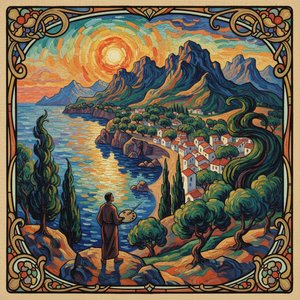
Joaquim Mir: A Catalan Visionary – Exploring Symbolism, Landscape & Modernist Aesthetic
Explore the captivating world of Joaquim Mir, a pivotal Catalan Modernisme painter. Discover his vibrant landscapes, symbolic depth & lasting influence on Spanish art history. Learn more at OriginalUniqueArt.

Abstract Expressionism's 10 Defining Masterpieces |
Explore 10 defining Abstract Expressionism masterpieces by Pollock, Rothko & de Kooning. Discover the stories behind these iconic paintings and find museum-quality art reproductions to elevate your home decor on .
Beyond the Lines: Mastering the High-Impact World of Contemporary Abstraction
Master the high-impact world of contemporary abstraction. Discover how bold colors, textures, and modern movements like Abstract Expressionism can transform your space with premium, high-energy art curated for the design-conscious professional.

Geometric Abstraction's 10 Defining Masterpieces | Art for Your Home - OriginalUniqueArt
Explore 10 defining masterpieces of Geometric Abstraction! Discover Kandinsky, Mondrian & Malevich’s iconic works. Find museum-quality art reproductions and curated decor ideas to elevate your home at OriginalUniqueArt.com.

Kandinsky's Masterpieces: 25 Paintings That Define Abstract Art | OriginalUniqueArt
Journey through Wassily Kandinsky's 25 most iconic abstract paintings. Explore his revolutionary use of color, form & spiritual expressionism. Find museum-quality Kandinsky reproductions and elevate your home decor with OriginalUniqueArt.com. Discover all masterpieces on OriginalUniqueArt.com!


