() ·

A painting made for you, by hand

At

Hand Made Oil Reproduction

Hand-painted oil on canvas in your size and frame, made to order by our artists. ( Switch to Print Switch to Digital Image)

Collectible Description

This photograph depicts Jean Vuillard's 1898 painting, 'At the Café-Concert,' showcasing an intimate interior scene characteristic of Impressionism and the Nabis movement. The artwork features loose brushwork, warm tones, and focuses on a contemplative woman amidst a café setting. It exemplifies Vuillard’s stylistic innovation and contribution to early modern art.

Artist Biography

A Nabis member known for intimate interior scenes like The Yellow Curtain. Explore his unique decorative art today.

from ·

Chapter 1

How large should it be?

Slide to change the size; the picture on the left shows the frame at its real width. The proportions of the original are kept.

Standard
custom
CM
INCH

Pick from our preset sizes that match the artwork's original proportions.

width
height

Type the width and the height you need, to fit your frame or your wall. This is hand-painted, so for a size with a different shape the artist can paint a bit more around the picture, or cut a bit — you choose. We send you a digital mockup to approve before the painting starts. The picture shown on this page does not show the real result — only the mockup does.

Chapter 2

How should it arrive?

Choose the edges of the stretched canvas

Choose your frame

Corner sample of the WhiteWrap canvas edge finish, stretched on solid wood bars
White $1
Corner sample of the BlurSideWrap canvas edge finish, stretched on solid wood bars
Blurside $1
Corner sample of the ExtendedWrap canvas edge finish, stretched on solid wood bars
Extended $1
Corner sample of the P118B picture frame: moulded polystyrene, 5 cm wide and 3 cm thick
P118B $10
Corner sample of the P118H picture frame: moulded polystyrene, 5 cm wide and 3 cm thick
P118H $10
Corner sample of the P118W picture frame: moulded polystyrene, 5 cm wide and 3 cm thick
P118W $10
Corner sample of the P438Z picture frame: moulded polystyrene, 5.5 cm wide and 3.5 cm thick
P438Z $10
Corner sample of the P508JH picture frame: moulded polystyrene, 7 cm wide and 3.5 cm thick
P508JH $12
Corner sample of the P508YH picture frame: moulded polystyrene, 7 cm wide and 3.5 cm thick
P508YH $12
Corner sample of the P805H picture frame: moulded polystyrene, 5 cm wide and 3.5 cm thick
P805H $10
Corner sample of the P805Z picture frame: moulded polystyrene, 5 cm wide and 3.5 cm thick
P805Z $10
Corner sample of the P919BZ picture frame: moulded polystyrene, 7 cm wide and 3.5 cm thick
P919BZ $10
Corner sample of the P919G picture frame: moulded polystyrene, 7 cm wide and 3.5 cm thick
P919G $10
Corner sample of the P919XJ picture frame: moulded polystyrene, 7 cm wide and 3.5 cm thick
P919XJ $10
Corner sample of the P959ZH picture frame: moulded polystyrene, 5 cm wide and 3 cm thick
P959ZH $10
Corner sample of the P968JZ picture frame: moulded polystyrene, 6 cm wide and 4 cm thick
P968JZ $12
Corner sample of the W106C picture frame: solid wood, 5 cm wide and 3 cm thick
W106C $8
Corner sample of the W218G picture frame: solid wood, 5 cm wide and 3 cm thick
W218G $10
Corner sample of the W218JH picture frame: solid wood, 5 cm wide and 3 cm thick
W218JH $8
Corner sample of the W218Y picture frame: solid wood, 5 cm wide and 3 cm thick
W218Y $10
Corner sample of the W307PJ picture frame: solid wood, 6 cm wide and 3 cm thick
W307PJ $10
Corner sample of the W316G picture frame: solid wood, 6 cm wide and 3 cm thick
W316G $10
Corner sample of the W316PJ picture frame: solid wood, 6 cm wide and 3 cm thick
W316PJ $8
Corner sample of the W316Y picture frame: solid wood, 6 cm wide and 3 cm thick
W316Y $10
Corner sample of the W398PJ picture frame: solid wood, 5 cm wide and 3 cm thick
W398PJ $8
Corner sample of the W4111J picture frame: solid wood, 6.5 cm wide and 3.5 cm thick
W4111J $10
Corner sample of the W500HY picture frame: solid wood, 7 cm wide and 5 cm thick
W500HY $15
Corner sample of the W500JH picture frame: solid wood, 7 cm wide and 5 cm thick
W500JH $15
Corner sample of the W692G picture frame: solid wood, 8 cm wide and 4 cm thick
W692G $12
Corner sample of the W849H picture frame: solid wood, 5 cm wide and 3 cm thick
W849H $8
Corner sample of the W940BG picture frame: solid wood, 7.5 cm wide and 4.5 cm thick
W940BG $15
Corner sample of the W953PJ picture frame: solid wood, 6 cm wide and 3.5 cm thick
W953PJ $8
Corner sample of the H24-GOLD picture frame: carved wood with gesso, 10 cm wide and 6 cm thick
H24-GOLD $30
Corner sample of the H24-SILVER picture frame: carved wood with gesso, 10 cm wide and 6 cm thick
H24-SILVER $30
Corner sample of the H36-GOLD picture frame: carved wood with gesso, 15 cm wide and 6.5 cm thick
H36-GOLD $45
Corner sample of the H36-SILVER picture frame: carved wood with gesso, 15 cm wide and 6.5 cm thick
H36-SILVER $45
Frame preview
Framed

Moulding: . Overall size with the frame: .

Chapter 3

Who paints it, and should anything change?

Examples of what can be changed: Replace face with customer photo; Add pet (e.g., replace cat with dog); Include hidden message in background; Change background landscape or elements.
After order, OriginalUniqueArt.com team will email client for instructions and provide a mockup preview

Worldwide Delivery () in 3/4 weeks instead of standard 5 weeks. (9 November). No compromise on quality.

Chapter 4

The finishing touches

A nameplate, as in a museum?

Engraved Bronze Plaque Details

This elegant plaque features the artist's name and the title of the artwork, finely engraved for a timeless presentation.

It is made from bronze with a refined, elegant finish. The text is precisely laser-engraved for a sharp and permanent result. Measuring 9x2 cm, the plaque is compact yet easy to read. It's built to be durable and scratch-resistant, offering a professional, museum-quality look. Mounting is simple thanks to the included adhesive backing.

Transparent Acrylic Plaque Details

The plaque includes essential engraved details such as the artist's name, the title of the artwork, the date it was created, the type of media used-like oil on canvas or watercolor-a brief description of the piece, and a QR code that links to the complete artwork information.

It is crafted from clear acrylic, offering a sleek, modern appearance. The text is UV-engraved in black to ensure strong visual contrast. With a size of 10x15 cm, it ensures optimal readability. It comes equipped with two metal hooks for secure wall mounting. The plaque is designed to be weather-resistant, making it suitable for various environments, and it includes interactive features that work seamlessly with smartphone scanning.

Black Acrylic Plaque Details

This elegant plaque includes engraved information such as the artist's name, the title of the artwork, the date it was created, the type of media used (like oil on canvas or watercolor), a short description of the artwork, and a QR code for quick access to more information.

The plaque itself is made from refined black acrylic with a premium finish. The text is laser-engraved in white for high contrast and readability. Its size is 10x15 cm, designed to be easy to read. It comes with two metal hooks for professional mounting. The design is sleek and fits any interior style. It is also weather-resistant and durable, with built-in digital integration for mobile compatibility.

A protective varnish?

When do you need it?

Chapter 5

Your painting, as you ordered it

At

Reproduction Medium

Reproduction Size

-

Elite Senior Artist

More detail, finesse, and extra production time

-

Reproduction Frame

-

-

For artworks or reproductions larger than 105 cm (approximately 41 inches) on any side, the frame will be shipped as a kit, disassembled. This method ensures safe delivery and prevents damage during transport.

Professional assembly required - this is not a DIY product.
The kit must be assembled and the canvas stretched by an experienced professional framer, using wood glue (not supplied), a canvas stretching plier and clamps to hold the bars square while the glue dries. Incorrect assembly or uneven canvas tension can permanently damage the artwork and is not covered by our warranty.

  • All solid wood bars are included, precisely cut to size.

  • Assembled with the screws provided, plus wood glue for the corner joints, which is not supplied and must be sourced by your framer.

  • Professional tools are required and not included: a canvas stretching plier (tensioner) and clamps to hold the bars square while the glue dries.

Important:
The corner joints require wood glue, the bars must be held with clamps until the glue is fully dry, and tightening the canvas on the assembled frame requires a canvas stretching plier. None of these are included in the kit. Please arrange an experienced professional framer before ordering this size.

Nameplate

-

-

Protective Varnish

Glossy Varnish (enhances colors, protects against light/moisture)

-

Customize My Artwork

Examples of what can be changed: Replace face with customer photo; Add pet (e.g., replace cat with dog); Include hidden message in background; Change background landscape or elements.

-

Urgent

Worldwide Delivery () in 3/4 weeks instead of standard 5 weeks. (9 November). No compromise on quality.

-

Express Shipping

Worldwide Delivery () in 5 weeks. (16 November).

Included

Total Price

$ 350

Total Price $ 350

Glass option is only available in size under 110 CM

Included with every order

  • Free Worldwide Express Shipping
  • High-Quality Linen Canvas
  • Full Shipping Insurance
  • Customs Tax Refund Guarantee
  • True Color Matching Guarantee
  • 100-Day Return Policy (Defects Only)
  • 100% Money-Back Guarantee
  • Bulk Discount Offer

A Moment Frozen in Time: The Quiet Allure of Vuillard’s “At”

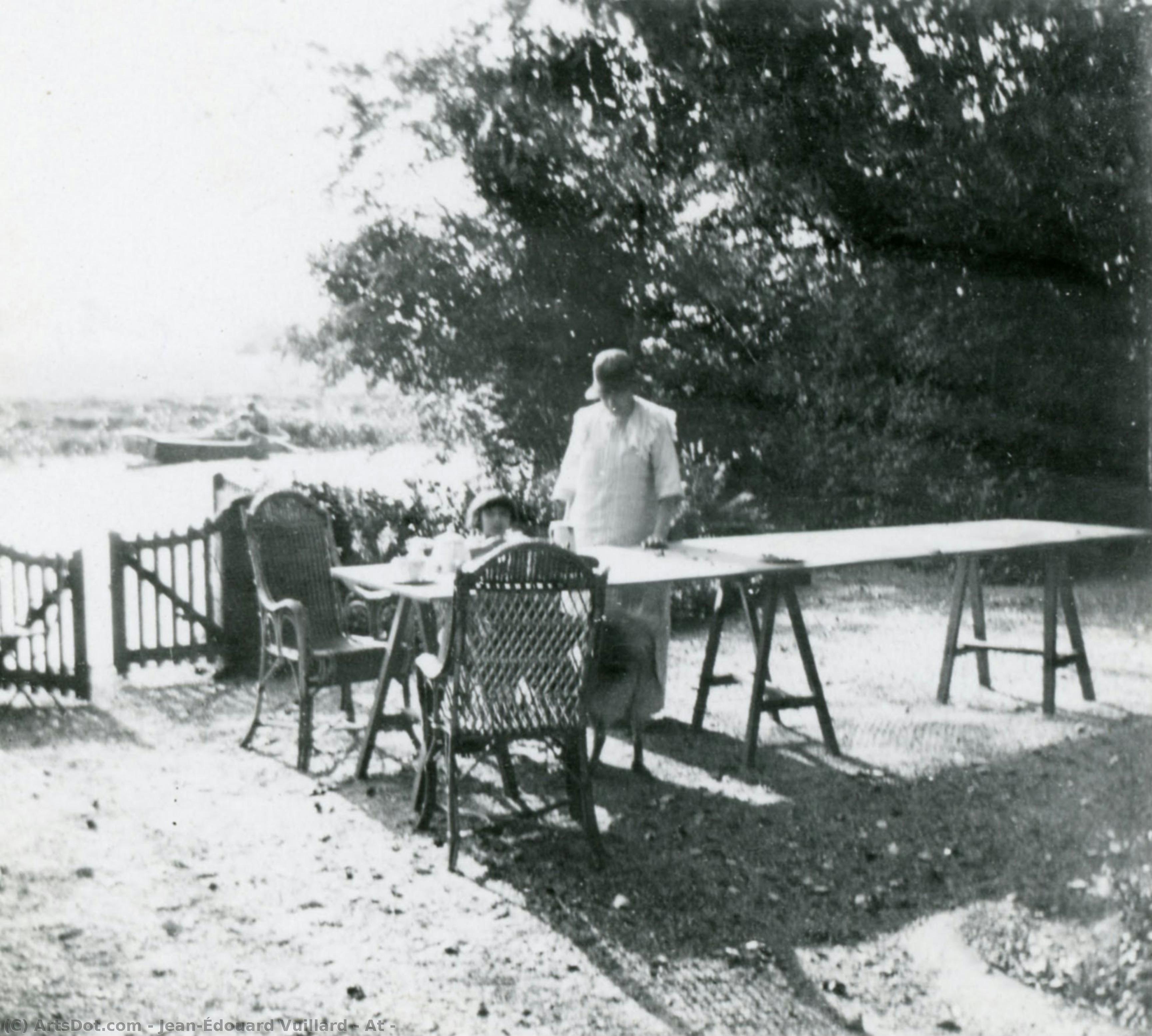
In the delicate tapestry of early 20th-century art, few works capture the ephemeral essence of a passing second as poignantly as Jean Vuillard’s 1913 masterpiece, “At.” This evocative scene serves as much more than a mere depiction of an outdoor gathering; it is a profound distillation of Impressionistic ideals filtered through the intimate, decorative lens of the Nabis movement. To gaze upon this work is to step into a world where time slows down, inviting the viewer to inhabit a space of quiet contemplation and subtle emotional resonance. The composition centers around a solitary figure seated at a table beneath an overcast sky, surrounded by the silent presence of empty chairs that suggest both companionship and the lingering traces of a shared moment.

The atmosphere is one of profound serenity, established through a masterful use of landscape and setting. Lush foliage frames the scene, hinting at a lakeside or coastal retreat where the air is still and the world feels momentarily paused. This deliberate choice of environment echoes the tranquil, pastoral landscapes favored by Vuillard’s contemporaries, yet he imbues it with a unique, psychological depth. There is a sense of domesticity brought into the wild, an intimate pocket of human existence carved out from the vastness of nature, making the piece particularly captivating for those who seek art that offers a sanctuary of peace within the home.

Technique and the Language of Color

Vuillard’s technical prowess is on full display through his signature approach to form and surface. Influenced heavily by the flattened perspectives of Japanese woodblock prints, the artist eschews traditional academic realism in favor of a more modern, sensory experience. He utilizes flattened planes of color and loose, rhythmic brushstrokes to build a sense of texture and movement. While the historical photograph of this work presents a monochrome view, the original artistic vision is rooted in the Nabis' revolutionary use of color to convey feeling rather than mere fact.

The composition is a sophisticated dance of lines and shapes. Strong horizontal planes, established by the table’s surface and the distant horizon, provide a grounding stability to the piece, while vertical elements like the chairs and trees create a rhythmic structure. These geometric foundations are softened by the organic, flowing shapes of the foliage and the human figures, creating a balanced tension between order and nature. For the discerning collector or interior designer, this interplay of structure and softness makes the artwork an incredibly versatile element, capable of anchoring a room with its classical weight while adding a layer of organic grace.

Historical Significance and Emotional Resonance

Created during a period of immense artistic upheaval in Europe, “At” stands as a pivotal contribution to the development of modern art. It reflects the burgeoning interest in abstraction and the rejection of rigid representational styles that defined the early 1900s. As a prominent member of Les Nabis, Vuillard helped bridge the gap between the fleeting light of Impressionism and the structured symbolism of the coming decades. His ability to transform an ordinary, everyday moment into something deeply symbolic—where a seated man might represent focused introspection or the quietude of the soul—is what gives this work its enduring power.

For those looking to bring a piece of art history into their personal spaces, a high-quality reproduction of “At” offers more than just aesthetic beauty; it offers an emotional connection to a bygone era. The painting evokes a sense of nostalgia and a longing for the stillness that is so often lost in our modern, frenetic lives. It is a piece designed for deep looking, rewarding the viewer with new layers of meaning and texture upon every encounter, making it an exquisite choice for any curated collection or thoughtfully designed interior.

Questions & Answers

What is "At" made with?

Jean-Édouard Vuillard used the black and white photography technique for "At". The technique defines the material nature of the original work.

Can "At" by Jean-Édouard Vuillard, held at the Musée des impressionnismes Giverny, be legally reproduced?

The original "At" is at the Musée des impressionnismes Giverny, and the work is in the public domain - its copyright has expired.

Where can I see a preview of "At"?

The Preview page of "At" lets you preview the artwork before ordering.

More about this painting

Switch to Print Switch to Digital Image Send
Details Guide Add to favorites Download Similars Diaporama Q&A Stats

In numbers

  • 1913the year it was painted
  • 29frames to choose from
  • standard sizes, in its own proportions
  • 5weeks to paint and deliver it
Jean-Édouard Vuillard

Jean-Édouard Vuillard

1868 - 1940, France

Quick facts about Jean-Édouard Vuillard

  • Artistic Movement Or Style: Les Nabis, Intimism
  • Artists Or Movements Influenced By This Artist:
    • Cubism
    • Fauvism
    • Abstract art
  • Artists Who Influenced This Artist: ['Japanese prints']
  • Full Name: Jean-Édouard Vuillard
  • Nationality: French
  • Notable Artworks:
    • La Patrie en Danger
    • Jean de la Barre
    • Vuillard and Waroquy
    • Dinnertime
    • Man Reading
    • The Goose
    • The Flowered Dress
    • Sleep
    • Interior, Mother and Sister of the Artist
    • The Chat
    • The Yellow Curtain
    • The Artist's Sister with a Cup of Coffee
    • The Striped Blouse
    • Woman in a Striped Dress
    • The Album
    • Large Interior with Six Figures
    • Portrait of Thadée Natanson
    • At the Café-Concert
    • Woman in Blue with Child
    • Madame Hessel au Sofa
    • Landscape at Romanel
    • Woman Arranging Her Hair
    • In the Room
    • Madame Hessel in Her Boudoir
    • The Garden of
    • The Mantelpiece
    • The Gilded Chair
    • Woman Seated on a Sofa
    • Woman Reading in the Reeds
    • Marguerite Chapin in Her Apartment
    • Design for a wall painting
    • At
    • The Clos Cézanne at Vaucresson
    • Madame Vuillard at Roussel
    • La Salle Clarac
    • Madame Andre Wormser and her Children
    • Flowers on a fireplace in Clayes
  • Place Of Birth: Chesaux, France
  • Date Of Birth: 1868
  • Date Of Death: 1940

Artist Biography

Early Life, Family and Artistic Training

Jean-Édouard Vuillard was born on 11 November 1868 in Cuiseaux, France. His upbringing was shaped by the quiet, industrious rhythms of his household. His father, a retired naval captain, had transitioned into the role of a tax collector, while his mother, Marie Vuillard, worked as a seamstress. This domestic environment, defined by the textures of fabric and the focused labor of needlework, would later inform the intimate nature of his visual observations.

The path to professional artistry was not a sudden realization but a series of persistent efforts. After leaving the Lycée, he sought to escape a potential military career to pursue the life of a painter. He joined the studio of Diogène Maillart, located in the former workspace of Eugène Delacroix on Place Fürstenberg. This period of study was marked by a rigorous engagement with the academic traditions of the time. In 1885, he began taking courses at the Académie Julian, and he frequently frequented the studios of William-Adolphe Bouguereau and Robert-Fleury to refine his technique.

His formal training was characterized by both struggle and eventual success. He faced setbacks when he failed to enter the École des Beaux-Arts in both 1886 and 1887. However, his persistence eventually bore fruit when he passed the entrance exam in July 1887. This academic foundation provided the technical discipline that would eventually allow him to move beyond traditionalism into more experimental territories.

The Nabis Movement and Artistic Style

Between 1891 and 1900, Vuillard moved within the avant-garde circles of Les Nabis, a group of young painters seeking to redefine the visual language of their era. Within this collective, he was known by the nickname "Zouave." His work during this period moved away from traditional naturalism, favoring instead the assembly of areas of pure color. This approach allowed him to explore the spatial effects of flattened planes, where pattern and form often merged to create a sense of quiet, domestic intimacy.

His aesthetic was deeply shaped by the influence of Japanese prints and the post-impressionist ideas of Paul Gauguin. Rather than focusing on the grand spectacle of public life, Vuillard turned his attention to the muffled quiet of the interior. He sought to capture the textures of private existence, often using techniques such as peinture à la colle (distemper) or a la collie sur toile to achieve specific matte effects. In these scenes, figures often seemed to blend into their surroundings, becoming part of the very patterns of the wallpaper or the fabric of the furniture.

Later Career and Portraiture

Following the disbanding of Les Nabis after 1900, Vuillard’s aesthetic underwent a notable transition. He moved away from the flattened, decorative abstractions of his youth, adopting a more realistic style that sought to capture the nuances of his subjects. This shift saw him approaching both landscapes and interior scenes with a newfound attention to detail and a preference for vivid colors. The quiet, patterned spaces of his earlier work remained, but they were now rendered with a sharper clarity.

During the 1920s and 1930s, his focus turned toward the people who shaped French industry and the arts. Rather than painting formal, isolated figures, he preferred to place these prominent individuals within their familiar, lived-in settings. These portraits maintained a sense of intimacy, capturing the subjects amidst the objects and environments that defined their daily lives. This period of his life was marked by significant institutional recognition, as he was elected to the Institut de France in 1937 and subsequently to the Académie des Beaux Arts in February 1938.

Key Works and Notable Paintings

The evolution of Vuillard's vision is visible through the shifting textures of his subjects. In 1899, he produced Misia et Vallotton à Villeneuve, a work that captures the specific social and personal circles of his era. By 1905, his ability to translate the essence of everyday life was evident in Chez Maxime. This period saw him refining the way figures inhabit their environments, often blending them into the surrounding patterns of domesticity.

His later years brought a shift toward a more naturalistic approach, where the quietude of the interior met a more detailed observation of the world. The Salon of Madame Aron, painted in 1904 and later reworked in 1934, reflects this ongoing dialogue with his own compositions. Even in his final years, the artist remained focused on the human presence; he completed his last two portraits in 1940, just before his death.

Other significant compositions highlight his interest in the intersection of person and place. Theodore Duret presents a man seated within his office, a scene composed of books, vases, and a clock. This work exemplifies his capacity to transform a functional space into a psychological landscape. His output remains a record of the subtle shifts in French life, from the patterned fabrics of a sewing room to the formal settings of his later subjects.

  • Misia et Vallotton à Villeneuve (1899)
  • The Salon of Madame Aron (1904, reworked 1934)
  • Chez Maxime (1905)
  • Theodore Duret

Legacy and Artistic Influence

As a pioneer of modernism, Jean-Édouard Vuillard helped dismantle the rigid boundaries of academic tradition. His tenure as a prominent member of the Nabis, a group of post-impressionist artists, allowed him to experiment with a visual language that prioritized subjective experience over mere imitation. By assembling areas of pure color and exploring the spatial effects of flattened planes, he moved art toward a more symbolic and decorative direction. This departure from naturalism provided a necessary bridge between the nineteenth-century traditions and the radical shifts of the twentieth century.

The structural innovations found in his work had a profound effect on the trajectory of modern art. His specific approach to color and form would later influence the development of cubism, fauvism, and abstract art. He demonstrated how pattern and texture could be used to integrate a figure into its environment, creating a sense of psychological depth through the very way a subject was embedded in its surroundings. This ability to use abstraction to communicate complex human experiences ensured his relevance long after the Nabis disbanded.

His influence remains visible in the way subsequent movements handled the relationship between domestic space and the human form. By transforming the quiet, patterned textures of private life into a subject of serious inquiry, he expanded the possibilities of what a painter could capture. His work continues to inspire artists who seek to balance the decorative with the deeply personal.

Where to See His Works Today

The quiet, patterned interiors that defined his career are preserved in several major international collections. In Paris, his presence is felt within the Musée d'Orsay, where his explorations of domestic space remain central to the French collection. His reach extends to the Musée des impressionnismes in Giverny, a site that holds significant examples of his visual language. These works offer a glimpse into the textures and flattened planes that characterized his most influential years.

Across the Atlantic, his influence is maintained through several prominent American institutions. The Metropolitan Museum of Art in New York houses his paintings, while the National Gallery of Art in Washington holds pieces that reflect his evolving style. In the Midwest, the Art Institute of Chicago also maintains a collection of his work. These holdings allow for a continued study of how he transitioned from the decorative experiments of his youth toward a more detailed, realistic approach in his later years.

Beyond these major hubs, his paintings can be found in the Walker Art Gallery in Liverpool. Visitors to these various locations may encounter different stages of his development, from the early, color-focused compositions of the Nabis period to the more naturalistic portraits of the 1920s and 1930s. His presence in these galleries ensures that his specific method of blending figures into their environments remains accessible to those studying the evolution of modernism.

Quick Facts

  • Dimensions: 8 x 8 cm
  • Notable elements or techniques: Grainy print; Flat planes of color
  • Year: 1913
  • Medium: Photography
  • Location: Private Collection
  • Title: At

Art Quiz

There is only one correct answer for each question.

Question 1:
What artistic movement is Jean Vuillard associated with?
Question 2:
The photograph depicts a scene primarily featuring:
Question 3:
What is the dominant color palette of the image?
Question 4:
Which technique is most evident in capturing the photograph's textures?
Question 5:
The photograph’s perspective contributes to which visual effect?