Preview
 Send
Send Share
Share
 Details
 Guide
Guide

 Download
 Similars
 X-Ray
X-Ray Diaporama
 Q&A
Q&A Stats
StatsLE BARBIER NAPOLITAIN


 Read More
Giclée / Art Print
Museum-quality giclée or canvas print with fast production and flexible finish options. ( Buy Hand Made Painting Switch to Digital Image)




P118B $10

P118H $10

P118W $10

P438Z $10

P508JH $12

P508YH $12

P805H $10

P805Z $10

P919BZ $10

P919G $10

P919XJ $10

P959ZH $10

P968JZ $12

W106C $8

W218G $10

W218JH $8

W218Y $10

W307PJ $10

W316G $10

W316PJ $8

W316Y $10

W398PJ $8

W4111J $10

W500HY $15

W500JH $15

W692G $12

W849H $8

W940BG $15

W953PJ $8




Pick from our preset sizes that match the artwork's original proportions.

Type the width and the height you need, to fit your frame or your wall. A print can only be cut, never made bigger than the picture, so a size with a different shape loses a part of the image. We send you a digital mockup to approve before we print anything. The picture shown on this page does not show the real cut — only the mockup does.
Worldwide Delivery () in 2 weeks instead of standard 4/5 weeks. (7 November)

Free Worldwide Express Shipping

High-Quality Linen Canvas

Full Shipping Insurance

Customs Tax Refund Guarantee

True Color Matching Guarantee

100-Day Return Policy (Defects Only)

100% Money-Back Guarantee

Bulk Discount Offer
 Glass option is only available in size under 110 CM

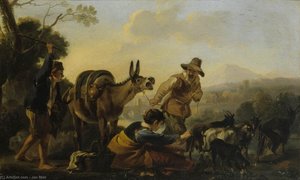
LE BARBIER NAPOLITAIN
Giclée / Art Print
Reproduction Size
-


Total Price
$ 81
A Glimpse into Neapolitan Daily Life
This evocative monochrome scene transports the viewer directly into the vibrant, yet subdued, rhythm of life in 17th-century Naples. It is more than just a depiction of a barber shop; it is a rich tapestry woven from human interaction and the enduring spirit of an urban community. The composition buzzes with implied activity—the careful ritual of a shave taking place on the right, contrasted by the quiet presence of a figure bearing a basket in the left foreground. Every corner seems occupied by life unfolding: scattered figures observe, rest, or simply exist within the flow of daily commerce. The overall impression is one of profound realism, capturing that fleeting moment when ordinary moments achieve an almost monumental quality.
Mastery in Tonal Contrast and Line Work
The technical brilliance of this piece lies in its masterful handling of tone. Executed entirely in grayscale, the artist eschews vibrant color for the sheer power of light and shadow. The technique relies heavily on expressive line work—noticeable hatching and cross-hatching that build up texture, suggesting everything from rough-hewn stone walls to the soft drape of clothing. This tonal variation creates a palpable sense of depth; while the perspective is somewhat rudimentary, the overlapping figures and the careful darkening of foreground elements pull the viewer into the scene. It speaks to an artist deeply skilled in rendering form through line alone, allowing texture and volume to emerge from nothing but graphite-like shadow.
Historical Echoes and Genre Painting Tradition
Stylistically, this work anchors itself firmly within the tradition of 17th-century genre painting. It shares a kinship with the observational genius of masters who found profound narratives in the mundane—artists whose gaze was fixed on the common person rather than mythological heroes. The atmosphere suggests an era where public life unfolded openly in the streets and squares. For the collector or designer, this piece offers an authentic connection to Baroque realism, providing an intellectual anchor that speaks to history without demanding deep academic knowledge; its narrative is immediately accessible.
Emotional Resonance for Modern Spaces
To bring such a scene into a contemporary interior is to infuse a space with quiet drama and timeless character. The emotional impact of the work is one of nostalgic authenticity—a feeling of witnessing a moment that time has preserved perfectly. Because it exists in monochrome, it possesses an inherent versatility; it complements rich mahogany tones as well as stark modern whites. It serves not merely as decoration, but as a contemplative focal point, inviting pause and reflection amidst the hustle of modern life.
Questions & Answers
In which movement and which era is "LE BARBIER NAPOLITAIN" by Jan Miel placed?
"LE BARBIER NAPOLITAIN" belongs to the Baroque Genre Painting movement, and its creator worked in the Early-Modern era.
Can I order an oil reproduction of "LE BARBIER NAPOLITAIN"?
You can order a hand-painted reproduction of "LE BARBIER NAPOLITAIN" by Jan Miel directly on its Hand-Painted Reproduction page: a hand-painted oil reproduction on linen canvas, made to order.
In what period was "LE BARBIER NAPOLITAIN" by Jan Miel made?
"LE BARBIER NAPOLITAIN" belongs to the Early-Modern era.
Artist Biography
Jan Miel: Bridging Dutch Realism and Baroque Grandeur
Jan Miel (1599–1663) stands as a pivotal figure in the artistic landscape of the seventeenth century, embodying the fascinating confluence of Flemish tradition and Italian innovation. Born in Beveren, Belgium—though Antwerp and ‘s-Hertogenbosch remain contenders for his birthplace—Miel’s early life remains shrouded in relative obscurity, leaving biographical details sparse. However, what emerges from scholarly research is a remarkable artistic journey marked by stylistic evolution and collaborative endeavors that cemented his place within the vibrant cultural milieu of Rome and Turin.
His formative years were spent honing his craft primarily in Antwerp, where he absorbed the influences of prominent Flemish masters like Anthony van Dyck. While the precise scope of his training remains elusive, it undoubtedly instilled within him an appreciation for meticulous observation and refined technique—qualities that would characterize much of his subsequent oeuvre. This foundational grounding in classical draughtsmanship and portraiture provided the essential toolkit for a career that would eventually transcend regional boundaries.
The Roman Transformation and the Bamboccianti Spirit
Miel’s arrival in Rome around 1636 signaled a transformative moment in his artistic trajectory. He swiftly joined the Bentvueghels, an influential association of Dutch and Flemish artists residing in the Eternal City. Within this brotherhood, he adopted the memorable moniker ‘bieco’, a nickname reflecting his distinctive squinting gaze—a characteristic that would become synonymous with his artistic persona. This affiliation fostered deep connections within a broader artistic community deeply impacted by Pieter van Laert’s Bamboccianti style.
This movement was dedicated to depicting scenes of everyday life amongst the lower classes in Rome and its environs, eschewing the idealized grandeur of High Renaissance art for something far more visceral and immediate. Miel embraced this trend wholeheartedly, producing captivating genre paintings that captured the spirit of urban existence with remarkable realism and sensitivity. His works often featured:
- Lively street scenes populated by travelers, merchants, and laborers.
- A masterful use of light to evoke the dusty, sun-drenched atmosphere of Roman alleys.
- The subtle interplay of human emotion within crowded, chaotic settings.
- A meticulous attention to the textures of fabric, stone, and earth.
Evolution Toward Classicism and Courtly Grandeur
As his career progressed, Miel’s artistic vision underwent a significant metamorphosis. While he remained a master of the genre scene, he began to move away from the gritty realism of the Bamboccianti toward more classicizing history paintings. This shift reflected a broader trend in European art, where the raw energy of the Baroque was increasingly tempered by a desire for order, nobility, and classical allegory.
This evolution eventually led him to prestigious appointments, most notably serving as a court artist to Charles Emanuel II, Duke of Savoy. In the service of the Turin court, Miel’s work took on a more formal and magnificent character. The intimacy of his earlier Roman scenes gave way to compositions of greater scale and complexity, designed to reflect the power and prestige of his royal patron. This period represents the pinnacle of his professional achievement, where his Flemish roots in detail met the grand, sweeping narratives required by the European aristocracy.
The historical significance of Jan Miel lies in his ability to navigate these disparate worlds. He was an artist who could find beauty in the humble struggles of a Roman street urchin and dignity in the epic tales of antiquity. By bridging the gap between the meticulous realism of the North and the dramatic classicism of the South, Miel left an indelible mark on the seventeenth-century canon, ensuring his legacy as a true cosmopolitan of the Baroque era.

Jan Miel
1599 - 1663 , Belgium
Quick Facts
- Full Name: Jan Miel
- Nationality: Flemish
- Date Of Birth: 1599
- Date Of Death: 1663
- Place Of Birth: Beveren, Belgium
- Notable Artworks:
- Landscape with a Battle between Two Rams
- Roman Lime Kiln with Peasants Gambling
- Artistic Movement Or Style: Bamboccianti, Classicising
- Artists Who Influenced This Artist: ['Anthony van Dyck']
- Artists Or Movements Influenced By This Artist: ['Pieter van Laer']
Related Articles

Beyond the Canvas: Scaling Your Creative Legacy Through OriginalUniqueArt’s Automated Print & Oil Reproduction Ecosystem
Unlock your creative potential with OriginalUniqueArt. Learn how to scale your art business through our automated print and premium oil reproduction services, transforming your original works into a global, passive income stream without compromising academic excellence.

Echoes of Time: Exploring the Enduring Appeal & Historical Context of Vintage Art Prints
Explore the captivating world of vintage art prints! Discover their history, collecting tips & enduring appeal. Expert insights on chromolithography and building a legacy collection with OriginalUniqueArt.

The Enduring Legacy of Oil on Canvas: Technique, History & Aesthetic Impact
Explore the rich history & techniques of oil painting – from Renaissance masters to Impressionism. Discover pigments, layering methods, and why this timeless medium endures. Expert insights for artists & art enthusiasts.

The Enduring Legacy of Fine Art Prints: Technique, History & Aesthetic Impact
Explore the rich history & techniques of fine art prints. Discover investment potential, assess authenticity, and learn how to preserve your collection with expert guidance. Trusted insights for discerning collectors.

Giclée Prints: Archival Quality & Aesthetic Nuances for the Discerning Collector
Explore the world of giclée prints with OriginalUniqueArt. Learn about archival quality, aesthetic nuances & investment potential. Expert guidance for discerning art collectors seeking museum-quality reproductions and lasting value.