

 Preview
 Send
Send Share
Share
 Details
 Guide
Guide

 Download
 Similars
 X-Ray
X-Ray Diaporama
 Stats
StatsCabeza de vaca sorcerer

 Read More
The artwork displayed on this page is protected by copyright law, which means we cannot legally create or sell an identical reproduction. This protection is enforced under international agreements such as the Berne Convention and by national laws, including those outlined by the U.S. Copyright Law - Title 17.
This method fully complies with copyright regulations because it does not involve copying or duplicating the protected artwork. Instead, it is a creative reinterpretation - a new painting that is influenced by the original but not identical to it.
Giclée / Art Print
Museum-quality giclée or canvas print with fast production and flexible finish options. ( Buy Hand Made Painting Switch to Digital Image)




P118B $10

P118H $10

P118W $10

P438Z $10

P508JH $12

P508YH $12

P805H $10

P805Z $10

P919BZ $10

P919G $10

P919XJ $10

P959ZH $10

P968JZ $12

W106C $8

W218G $10

W218JH $8

W218Y $10

W307PJ $10

W316G $10

W316PJ $8

W316Y $10

W398PJ $8

W4111J $10

W500HY $15

W500JH $15

W692G $12

W849H $8

W940BG $15

W953PJ $8




Pick from our preset sizes that match the artwork's original proportions.

Type the width and the height you need, to fit your frame or your wall. A print can only be cut, never made bigger than the picture, so a size with a different shape loses a part of the image. We send you a digital mockup to approve before we print anything. The picture shown on this page does not show the real cut — only the mockup does.
Worldwide Delivery () in 2 weeks instead of standard 4/5 weeks. (23 October)

Free Worldwide Express Shipping

High-Quality Linen Canvas

Full Shipping Insurance

Customs Tax Refund Guarantee

True Color Matching Guarantee

100-Day Return Policy (Defects Only)

100% Money-Back Guarantee

Bulk Discount Offer
 Glass option is only available in size under 110 CM

Cabeza de vaca sorcerer
Giclée / Art Print
Reproduction Size
-


Total Price
$ 81
Artist Biography
Early Life and the Seeds of a Vision
James Rosenquist emerged as a pivotal figure in American art, though he often resisted easy categorization, born in 1933 in Grand Forks, North Dakota. His upbringing was marked by constant movement; his parents, Louis and Ruth Rosenquist—both amateur pilots with Swedish heritage—followed work wherever it led, eventually settling in Minneapolis, Minnesota. This nomadic existence perhaps instilled in young James a unique perspective, an awareness of the transient nature of imagery and experience that would later permeate his art. His mother, herself a painter, nurtured his early artistic inclinations, recognizing and fostering a talent that would blossom into a groundbreaking career. A scholarship to the Minneapolis School of Art during junior high provided initial formal training, followed by studies at the University of Minnesota from 1952 to 1954. However, it was a 1955 move to New York City on an Art Students League scholarship that truly set his artistic trajectory in motion. There, under the tutelage of Edwin Dickinson and George Grosz, he initially explored abstract expressionism, laying a foundation in technique even as he would ultimately forge a radically different path. Early struggles led him to work as a chauffeur before joining the International Brotherhood of Painters and Allied Trades—a seemingly pragmatic turn that proved unexpectedly crucial to his artistic development.From Billboards to Monumental Visions
The years Rosenquist spent painting billboards in Times Square, from 1957 to 1960, were transformative. He rose quickly through the ranks at Artkraft-Strauss, becoming their lead painter and mastering the techniques of large-scale commercial art—techniques he would later brilliantly subvert and elevate within the realm of fine art. This wasn’t merely a job; it was an immersion in the visual language of advertising, a world of bold colors, fragmented imagery, and persuasive power. He learned to manipulate scale, composition, and color to grab attention, skills that became hallmarks of his mature style. A tragic event—the death of a friend in a scaffolding accident—prompted Rosenquist to abandon commercial work and dedicate himself fully to personal artistic projects. But he didn’t leave the billboard world behind; instead, he carried its essence into his paintings, retaining its techniques, imagery, and monumental scale. He recalled painting Phillips 66 signs across North Dakota and Wisconsin even as a teenager, demonstrating an early connection with the power of commercial art. This background distinguished him from other Pop artists who often approached advertising with irony or critique; Rosenquist’s relationship was more complex—a fascination born of intimate knowledge.A Pioneer of Pop: Fragmentation and Cultural Commentary
Rosenquist is rightfully recognized as a key figure in the Pop Art movement, though he consistently resisted being pigeonholed. His work shared affinities with artists like Andy Warhol and Roy Lichtenstein in its appropriation of popular imagery, but his approach was distinctly his own. He didn’t simply reproduce images; he fragmented them, juxtaposed them in unexpected ways, and scaled them to create large-scale montages that possessed a surreal, dreamlike quality. His paintings weren't merely representations of consumer culture; they were explorations of its pervasive influence on the psyche, its ability to overwhelm and disorient. F-111 (1964-65), perhaps his most iconic work, exemplifies this approach—a sprawling canvas that combines images of a military aircraft with consumer products, creating a jarring commentary on war, technology, and the American dream. Similarly, Target II (1965) dissects the imagery of advertising, revealing its underlying structures and manipulative power. His canvases became arenas for exploring themes of consumerism, media saturation, and the fragmented nature of modern experience. He wasn’t simply reflecting culture; he was deconstructing it, forcing viewers to confront its complexities and contradictions.Recognition and Lasting Legacy
Rosenquist's artistic breakthrough came with a series of exhibitions in the early 1960s, including solo shows at the Green Gallery in 1962 and 1963. However, it was his exhibition at Leo Castelli Gallery in 1965, featuring F-111, that catapulted him to international acclaim. This success led to further opportunities, including a long-standing collaboration with the graphicstudio collaborative art initiative at the University of South Florida starting in 1971 and the establishment of his Aripeka studio in 1976. He also undertook several commissioned works for the state of Florida, demonstrating his versatility and ability to work across different scales and media. His commitment to the arts extended beyond his own practice; he served on the board of trustees for the Tampa Museum of Art and was inducted into the Florida Artists Hall of Fame in 2001. Rosenquist’s legacy lies not only in his striking visual style but also in his ability to challenge conventional notions of art. He blurred the boundaries between high and low culture, demonstrating that advertising imagery could be a legitimate subject for artistic exploration. His work continues to resonate today as a powerful commentary on consumerism, media manipulation, and the ever-increasing complexity of modern life—a testament to his enduring vision and innovative spirit. He influenced subsequent generations of artists interested in exploring the intersection of art, commerce, and popular culture.
James Rosenquist
1933 - 2017 , United States of America
Quick Facts
- Full Name: James Rosenquist
- Nationality: American
- Date Of Birth: 1933
- Date Of Death: 2017
- Place Of Birth: Grand Forks, United States of America
- Notable Artworks:
- F-111
- Target II
- Paper clip
- Waves
- Artistic Movement Or Style: Pop Art
- Artists Who Influenced This Artist:
- Edwin Dickinson
- George Grosz
- Artists Or Movements Influenced By This Artist: ['Pop Art artists']
Related Articles
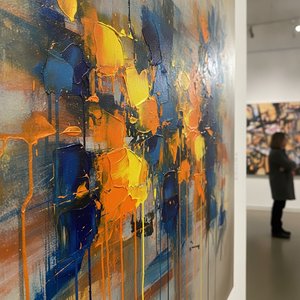
Beyond the Lines: Mastering the High-Impact World of Contemporary Abstraction
Master the high-impact world of contemporary abstraction. Discover how bold colors, textures, and modern movements like Abstract Expressionism can transform your space with premium, high-energy art curated for the design-conscious professional.

Abstract Expressionism's 10 Defining Masterpieces |
Explore 10 defining Abstract Expressionism masterpieces by Pollock, Rothko & de Kooning. Discover the stories behind these iconic paintings and find museum-quality art reproductions to elevate your home decor on .
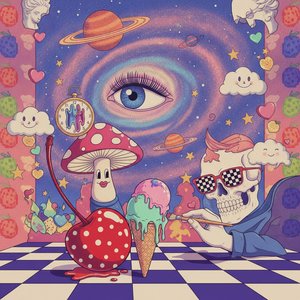
Pop Surrealism Unveiled: The Sophisticated Intersection of Vibrant Pop Art and Dreamlike Subconscious Landscapes
Explore the captivating world of Pop Surrealism. Discover how vibrant Pop Art meets dreamlike subconscious imagery through the works of masters like Jeff Soto and Ryan Heshka. An expert guide for discerning collectors seeking to understand this profound contemporary art movement.

Whistler's Masterpieces: Explore 25 Iconic Paintings & Aesthetic Art for Your Home
Journey through 25 iconic James Abbott McNeill Whistler paintings! Explore his masterpieces of Aestheticism, from 'Nocturne in Black and Gold' to captivating portraits. Find museum-quality art reproductions & elevate your home decor with OriginalUniqueArt.com. Discover the full collection online.

Sir Alfred Munnings' Masterpieces: 25 Paintings That Define Equine Art | OriginalUniqueArt
Explore 25 iconic Sir Alfred Munnings paintings! Discover the beauty of British Impressionism, equine art & rural England. Find museum-quality reproductions and elevate your home decor with OriginalUniqueArt. Explore the full collection online.


