Preview
 Send
Send Share
Share
 Details
 Guide
Guide

 Download
 Similars
 X-Ray
X-Ray Diaporama
 Q&A
Q&A Stats
StatsSchoolmates


 Read More
Hand Made Oil Reproduction
Hand-painted oil on canvas in your size and frame, made to order by our artists. ( Switch to Print Switch to Digital Image)




P118B $10

P118H $10

P118W $10

P438Z $10

P508JH $12

P508YH $12

P805H $10

P805Z $10

P919BZ $10

P919G $10

P919XJ $10

P959ZH $10

P968JZ $12

W106C $8

W218G $10

W218JH $8

W218Y $10

W307PJ $10

W316G $10

W316PJ $8

W316Y $10

W398PJ $8

W4111J $10

W500HY $15

W500JH $15

W692G $12

W849H $8

W940BG $15

W953PJ $8




Pick from our preset sizes that match the artwork's original proportions.

Type the width and the height you need, to fit your frame or your wall. This is hand-painted, so for a size with a different shape the artist can paint a bit more around the picture, or cut a bit — you choose. We send you a digital mockup to approve before the painting starts. The picture shown on this page does not show the real result — only the mockup does.
After order, OriginalUniqueArt.com team will email client for instructions and provide a mockup preview
Worldwide Delivery () in 3/4 weeks instead of standard 5 weeks. (29 October). No compromise on quality.

Free Worldwide Express Shipping

High-Quality Linen Canvas

Full Shipping Insurance

Customs Tax Refund Guarantee

True Color Matching Guarantee

100-Day Return Policy (Defects Only)

100% Money-Back Guarantee

Bulk Discount Offer
 Glass option is only available in size under 110 CM

Schoolmates
Reproduction Medium
Reproduction Size
-


Total Price
$ 300
A Moment Captured in Oil: The Charm of Schoolmates
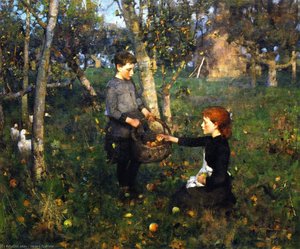
To gaze upon James Guthrie's Schoolmates is to be instantly transported to a sunlit afternoon brimming with the uncomplicated joy of youth. This exquisite oil on canvas, dating from 1884, does more than merely depict three children strolling down a cobbled street; it captures the ephemeral magic of companionship. The scene unfolds with remarkable naturalism, presenting a tableau vivant where every detail—from the drape of the girl's dress to the casual placement of a nearby handbag and backpack—speaks volumes about the simple rhythms of life in that era. Guthrie possesses an unparalleled gift for observing humanity at its most unguarded, allowing us a privileged glimpse into a shared moment of carefree camaraderie.
Mastery of Light and Everyday Life
Technically speaking, Schoolmates is a testament to the enduring power of oil paint on canvas. Guthrie employs light not just as an illuminator, but as a structural element that builds depth and dimensionality into the composition. Observe how the interplay of shadow and sunlight models the figures, giving them a tangible presence that seems ready to step off the wall. His style is characterized by this meticulous attention to everyday detail, elevating the mundane act of walking into something imbued with quiet significance. While his contemporaries might have explored grand historical narratives, Guthrie found profound beauty in the quotidian, suggesting an artistic sensibility that values lived experience as its highest subject.
Echoes of Artistic Lineage and Style
While James Guthrie’s touch is distinctly his own—elegant, observational, and warm—his work resonates within a broader tradition of capturing modern life. One can sense echoes of the detailed realism found in other masters who chronicled contemporary scenes. The painting speaks to an era where genre scenes flourished, celebrating community and the passage of time. For those drawn to the sophisticated decorative arts, this piece offers a visual narrative that complements richly appointed interiors. It is art that whispers stories rather than shouting pronouncements, making it a perfect focal point for any drawing-room or study.
The Enduring Symbolism of Childhood Bonds
Beyond the technical brilliance lies the emotional core of Schoolmates: the unbreakable bond between friends. The children’s expressions are not merely painted; they seem to radiate genuine delight and mutual affection. The inclusion of school paraphernalia—the backpack, the handbag—grounds this joy in a specific context, suggesting shared journeys and collective memories. These objects become subtle symbols of growth, learning, and the enduring nature of formative friendships. Owning a reproduction of this work is not just acquiring a painting; it is curating an atmosphere of nostalgic warmth and timeless connection within your own space.
Questions & Answers
How harmonious are the colors of "Schoolmates" by James Guthrie?
The color harmony of "Schoolmates" is recorded as strong color unity.
How does the subject of "Schoolmates" relate to James Guthrie's usual themes?
"Schoolmates" depicts children, street scene, group portrait, outing, camaraderie, oil painting, 19th century, while James Guthrie's recorded themes are everyday life captured with detail, influence of genre painting style, focus on youthful companionship moments. Comparing the two shows how the work relates to the artist's usual subjects.
Can I watch "Schoolmates" as a full-screen slideshow?
"Schoolmates" by James Guthrie can be viewed as a slideshow on the artwork's Diaporama page.
Artist Biography
The Soul of Scottish Realism
Born in Greenock, United Kingdom, Sir James Guthrie emerged as a pivotal figure in the landscape of late nineteenth-century art. Though he initially embarked on a path toward a legal career at Glasgow University, the call of the canvas proved irresistible, leading him to abandon his law studies in 1877 to pursue painting. Unlike many of his contemporaries who sought refinement in the studios of Paris, Guthrie followed a more solitary and self-taught trajectory. While he received brief mentorship from figures such as James Drummond in Glasgow and John Pettie in London, his artistic identity was forged through a deep, personal engagement with the natural world and the works of the French Realists.
His development was profoundly shaped by the influence of Jules Bastien-Lepage, whose approach to realism provided a blueprint for Guthrie’s own mastery of atmosphere and light. This connection helped him become a prominent member of the Glasgow Boys, a group known for pushing the boundaries of traditional Scottish painting. His work often moved beyond mere documentation, seeking instead to capture the fleeting sensations of light and air through loose brushstrokes and a vibrant, yet often muted, color palette. Whether depicting the quiet dignity of rural life or the intimate details of portraiture, Guthrie possessed a rare ability to translate the emotional weight of a scene onto the canvas.
Mastery of Light and Landscape
Guthrie’s oeuvre is celebrated for its evocative power, particularly in his ability to imbue landscapes with a sense of profound tranquility. In works such as Pastureland, he demonstrates a symphonic command over light and shadow, creating an immersive experience of the Scottish countryside. His technique often embraced elements of Impressionism, prioritizing mood and sensation over rigid, academic precision. This is evident in his use of textures—the soft fur of cattle, the swaying grass of a field, or the hazy luminosity of a summer day—all rendered with a sensitivity that speaks to the rhythms of nature.
His landscapes were frequently inspired by the Scottish Borders, specifically locations like Cockburnspath, where he lived for much of his life. These settings provided the backdrop for some of his most enduring achievements, including:
- A Hind's Daughter: A masterpiece that serves as a meditation on childhood innocence and the quiet dignity of rural existence.
- Schoolmates: An evocative piece that showcases his skill in capturing human connection within a natural setting.
- Pastoral: A work held within the Scottish National Gallery that exemplifies his ability to capture atmospheric beauty.
Legacy and Recognition
Throughout his career, Guthrie achieved significant institutional recognition, reflecting his importance to the British art scene. His ascent through the ranks of the Royal Scottish Academy saw him elected as an associate in 1888 and a full member in 1892, eventually succeeding Sir George Reid as President of the RSA. This professional prestige was matched by personal honors, including being knighted in 1903 for his immense contributions to the arts.
Beyond his landscapes and portraits, Guthrie’s historical significance is cemented by his ability to capture the spirit of an era. His later years saw him commissioned for monumental tasks, such as the large-scale group portrait Statesmen of World War I, completed in 1930. This work, depicting seventeen politicians and statesmen, stands as a testament to his skill in handling complex compositions and historical gravity. Today, Guthrie is remembered not just as a painter of Scottish Realism, but as an artist who could capture the very essence of peace, light, and the enduring beauty of the natural world.

James Guthrie
1859 - 1930 , United Kingdom
Quick Facts
- Artistic Movement Or Style: Scottish Realism and Glasgow Boys
- Artists Who Influenced This Artist: ['Jules Bastien-Lepage']
- Full Name: Sir James Guthrie
- Nationality: Scottish
- Notable Artworks:
- Pastureland
- A Hind's Daughter
- Schoolmates
- Hard at It
- Statesmen of World War I
- Place Of Birth: Greenock, United Kingdom
- Date Of Birth: 1859
- Date Of Death: 1930
Related Articles

From Initial Sketch to Enduring Legacy: A Comprehensive Exploration of the Oil Painting Reproduction Process
Discover the art of museum-quality oil painting reproduction. Explore our expert process, skilled artists & authentic replicas. Elevate your home with timeless beauty – handcrafted and customized to your vision.
The Enduring Legacy of Hand-Painted Oil Paintings: Aesthetic Value, Longevity & Emotional Resonance
Explore the enduring legacy of hand-painted oil paintings. Discover the aesthetic value, material longevity & emotional resonance that sets original art—and expertly crafted reproductions—apart. Invest in timeless beauty.
Turn Your Digital Art Into Hand‑Painted Oil Masterpieces—Earn Big on Every Sale and Build an Enduring Legacy
Transform your NFT collection into hand‑painted oil masterpieces with OriginalUniqueArt’s expert artisans. Enjoy museum‑grade quality, free worldwide shipping, and a 100% satisfaction guarantee—turn digital art into a lasting legacy that earns you real value.
Reproducing Artistry: A Guide to Oil, Canvas & Paper Reproduction Mediums
Explore the world of art reproduction! Learn about oil, canvas & paper options with our expert guide. Discover museum-quality reproductions for your home or collection.
19th Century Masterpieces: 10 Paintings That Defined an Era | OriginalUniqueArt
Journey through 19th century art with OriginalUniqueArt! Explore 10 iconic paintings – from Monet & Renoir to Courbet – and discover the stories behind Romanticism, Realism & Impressionism. Find museum-quality reproductions for your home decor. Explore the full collection online!