
 Preview
 Send
Send Share
Share
 Details
 Guide
Guide

 Download
 Similars
 X-Ray
X-Ray Diaporama
 Stats
StatsThe Monument
 Oil On Canvas
- WallArt
- Glasgow School
 1917
1917 152.0 x 139.0 cm
 Government Art Collection
 Read More
Giclée / Art Print
Museum-quality giclée or canvas print with fast production and flexible finish options. ( Buy Hand Made Painting Switch to Digital Image)




P118B $10

P118H $10

P118W $10

P438Z $10

P508JH $12

P508YH $12

P805H $10

P805Z $10

P919BZ $10

P919G $10

P919XJ $10

P959ZH $10

P968JZ $12

W106C $8

W218G $10

W218JH $8

W218Y $10

W307PJ $10

W316G $10

W316PJ $8

W316Y $10

W398PJ $8

W4111J $10

W500HY $15

W500JH $15

W692G $12

W849H $8

W940BG $15

W953PJ $8




Pick from our preset sizes that match the artwork's original proportions.

You may enter your own dimensions to fit a specific frame or space. If your selected size does not match the original image's proportions, we will either crop the artwork or extend the image with a mirrored or solid-fill edge. A digital mockup will be sent for your approval before production begins.
Please note that the on-screen preview does not reflect the actual cropping or extension. Only the mockup will accurately show the final composition.
While custom sizes are available, we recommend selecting a dimension from the predefined list to preserve the original proportions.
Worldwide Delivery () in 2 weeks instead of standard 4/5 weeks. (10 October)

Free Worldwide Express Shipping

High-Quality Linen Canvas

Full Shipping Insurance

Customs Tax Refund Guarantee

True Color Matching Guarantee

100-Day Return Policy (Defects Only)

100% Money-Back Guarantee

Bulk Discount Offer
 Glass option is only available in size under 110 CM

The Monument
Giclée / Art Print
Reproduction Size
-


Total Price
$ 81
A Monument to Resilience: James Ferrier Pryde’s Dramatic Vision
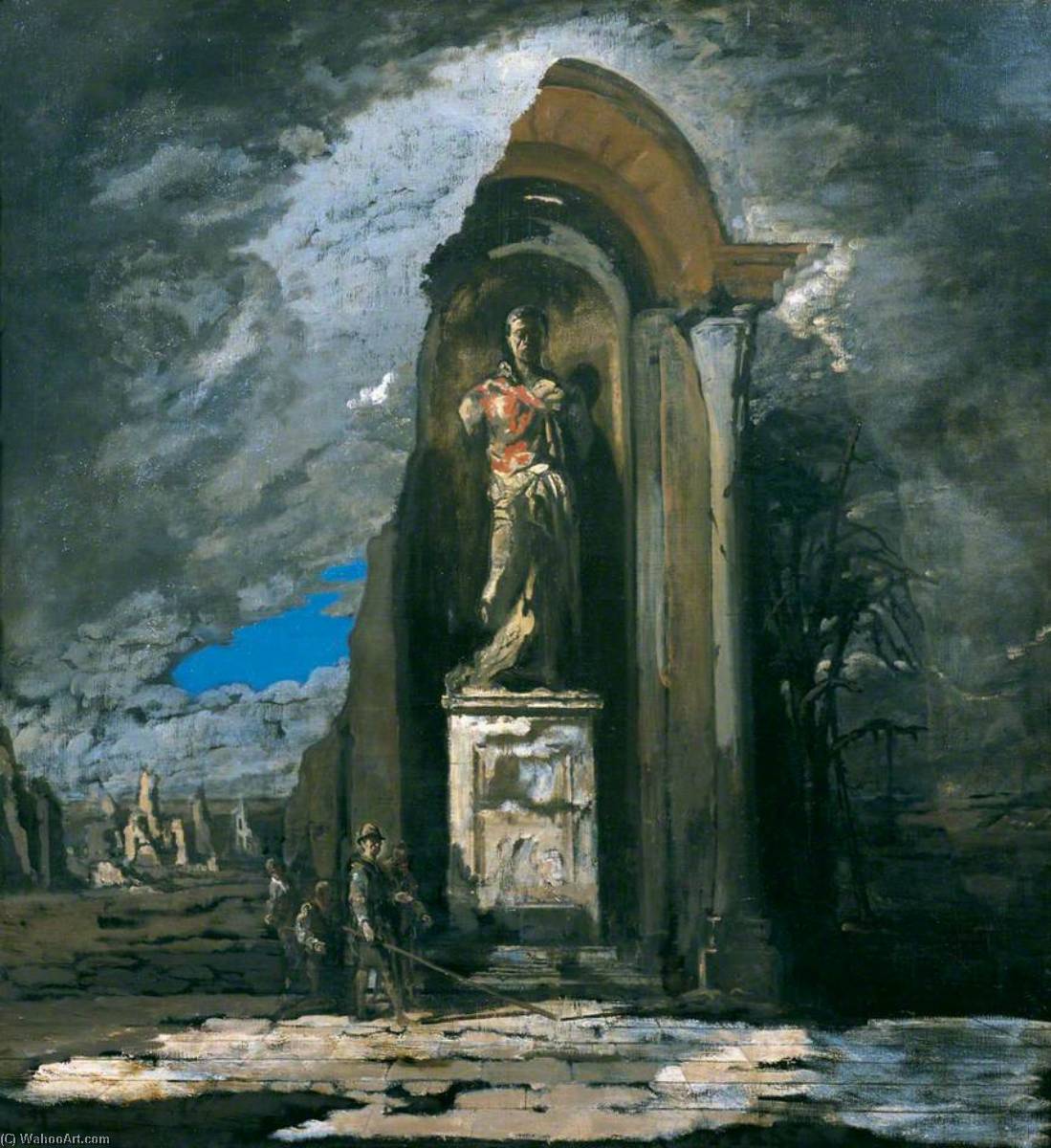
James Ferrier Pryde's "The Monument," completed in 1916–17, stands as a testament to both artistic ambition and the spirit of its time—a poignant reflection on Britain’s wartime effort amidst an atmosphere thick with symbolism and masterful execution. This monumental oil painting captures a scene of profound significance: figures ascending a ladder towards a colossal stone monolith bearing a carved victory emblem. The artwork hails from the Government Art Collection, offering a glimpse into the artistic endeavors undertaken during World War I to bolster morale and celebrate national triumph.- Subject Matter & Composition: Pryde’s central focus is undeniably symbolic—a towering edifice representing unwavering determination and aspiration. Surrounding figures climb upwards, mirroring humanity's struggle for progress against formidable obstacles. The deliberate positioning of individuals emphasizes the collective pursuit of victory, creating a dynamic visual narrative that transcends mere representation.
- Style & Technique: Pryde’s style aligns closely with the Glasgow School’s aesthetic principles—characterized by atmospheric perspective and an emphasis on capturing mood and emotion. He employs meticulous brushwork to render textures convincingly, particularly in the stone structure itself, conveying a palpable sense of solidity and grandeur. The artist skillfully utilizes chiaroscuro – dramatic contrasts between light and dark – to heighten the emotional impact of the scene.
- Historical Context: Painted during the height of World War I, “The Monument” embodies Britain’s determination to persevere despite immense hardship. It reflects a broader cultural preoccupation with ideals of heroism and resilience—themes prevalent in art and literature of the era. The artwork served as part of a government initiative aimed at bolstering public morale and commemorating wartime achievements.
- Symbolism: The stone monolith itself is laden with symbolic weight, representing permanence, strength, and divine authority – ideals crucial to maintaining faith during times of crisis. The ladder symbolizes the arduous journey towards success, highlighting the effort required to overcome adversity. Furthermore, the victory emblem signifies triumph over darkness and oppression.
- Emotional Impact: Pryde’s masterful portrayal evokes feelings of hope, aspiration, and unwavering resolve. The painting's luminous palette contributes to its emotive power, conveying a sense of grandeur and solemn contemplation. It invites viewers to contemplate the significance of perseverance in confronting challenges—a timeless message resonating powerfully even today.
Questions & Answers
How light is "The Monument" overall?
In terms of perceived brightness, "The Monument" by James Ferrier Pryde is shadow.
Who created "The Monument"?
"The Monument" is attributed to James Ferrier Pryde.
In what year was "The Monument" by James Ferrier Pryde created?
"The Monument" by James Ferrier Pryde was created in 1917.
What technique was used for "The Monument" by James Ferrier Pryde?
"The Monument" is executed in oil on canvas.
How old was James Ferrier Pryde when creating "The Monument" in 1917?
When "The Monument" was created in 1917, James Ferrier Pryde - born in 1866 - was 51 years old.
How do contrast and harmony combine in "The Monument"?
The color composition of "The Monument" by James Ferrier Pryde combines a balanced contrast with a discordant palette harmony.
Who created "The Monument" and in what year?
James Ferrier Pryde made "The Monument" in 1917.
Artist Biography
A Life Etched in Atmosphere: The World of James Ferrier Pryde
Born in Edinburgh on March 30, 1866, into a family steeped in artistic lineage – related to the renowned Scottish painters Robert Scott Lauder and James Eckford Lauder – James Ferrier Pryde embarked on a journey that would see him leave an indelible mark on both painting and graphic design. His early life was nurtured within a stimulating intellectual environment; his father, David Pryde, served as headmaster of Edinburgh Ladies’ College, fostering a household valuing education and creativity. Young James received his formal artistic training at the Royal Scottish Academy from 1885 to 1888, laying the foundation for a career that would ultimately defy easy categorization. He was encouraged by leading figures of the Glasgow School, notably James Guthrie and Edward Arthur Walton, whose influence helped shape his initial artistic explorations. A brief sojourn in Paris, studying under William-Adolphe Bouguereau at the Académie Julian, proved less formative; Pryde found the atmosphere stifling, quickly returning to Scotland with a clearer sense of his own path.The Beggarstaffs and a Revolution in Design
Pryde’s most significant collaborative venture began in 1893 with the formation of “The Beggarstaffs,” a partnership with William Nicholson. This union proved remarkably fruitful, pioneering a new aesthetic in poster design that dramatically challenged prevailing conventions. Prior to The Beggarstaffs, posters were often cluttered and illustrative; Pryde and Nicholson stripped away excess detail, embracing bold compositions, striking imagery, and a theatrical sensibility. Their designs weren’t merely advertisements—they were statements, elevating the status of poster art from commercial necessity to legitimate artistic expression. They deliberately eschewed established norms, creating work that was both visually arresting and intellectually stimulating. The partnership dissolved in 1899, but its impact resonated for decades, influencing generations of graphic designers and fundamentally altering the landscape of visual communication. Their innovative approach wasn’t limited to posters; they also produced distinctive signboards and other graphic works, all characterized by a unique blend of artistic vision and commercial practicality.Atmospheric Visions: A Painterly Language
While celebrated for his contributions to graphic design, Pryde's true passion lay in painting. He developed a deeply personal style centered around atmospheric architectural scenes. These weren’t straightforward depictions of buildings; they were evocative explorations of mood and emotion, often imbued with a sense of drama and foreboding. His canvases frequently feature structures dwarfing the human figures within them, emphasizing our fragility against the weight of history and time. Broad brushwork and dramatic lighting effects are hallmarks of his technique, creating an almost palpable atmosphere that draws the viewer into the scene. The influence of Giovanni Battista Piranesi’s etchings is evident in Pryde's monumental compositions and fascination with architectural ruins. He wasn’t interested in precise representation; rather, he sought to capture the *feeling* of a place, its history, and its inherent melancholy. His paintings often feel like fragments of dreams, hauntingly beautiful and subtly unsettling.A Multifaceted Artist: Stagecraft and Recognition
Pryde’s artistic pursuits weren't confined to painting and design. He briefly pursued an acting career between 1894 and 1899, a period that undoubtedly informed his theatrical sensibility and understanding of spatial dynamics. This foray into the performing arts also brought him into contact with influential figures like Edward Gordon Craig, who recognized Pryde’s exceptional talent as a painter despite acknowledging his limitations as an actor. He became actively involved in artistic societies, becoming an associate of the International Society of Sculptors, Painters and Gravers in 1901 and later serving as its vice-president in 1921. In 1930, he brought his visual artistry to the stage, designing sets for Paul Robeson’s production of *Othello* at the Savoy Theatre, demonstrating a versatility that extended beyond the canvas. Though he held only two solo exhibitions during his lifetime – one at the Baillie Gallery in 1911 and another at the Leicester Galleries in 1933 – Pryde received recognition from patrons like Viscountess Cowdray and was lauded by critics such as Frank Rutter, who described him as “stupendous.”A Lasting Legacy
James Ferrier Pryde passed away on February 24, 1941, in London. While he didn’t align himself with any specific artistic movement, his unique style and contributions to early 20th-century art are increasingly recognized. A memorial exhibition held in 1949, touring Edinburgh, Brighton, and London, helped revive interest in his work. Though exhibitions of his paintings remain relatively infrequent, a growing number of his works are held in public collections, ensuring that his atmospheric visions continue to captivate audiences. Pryde’s legacy rests not only on the beauty of his individual artworks but also on the profound impact of The Beggarstaffs' innovative graphic design, which continues to inspire artists and designers today. He remains a compelling figure—a painter who dared to explore the emotional power of architecture and a designer who helped redefine the very language of visual communication.
James Ferrier Pryde
1866 - 1941 , United Kingdom
Quick Facts
- Full Name: James Ferrier Pryde
- Nationality: British
- Date Of Birth: 1866
- Date Of Death: 1941
- Place Of Birth: Edinburgh, United Kingdom
- Notable Artworks:
- Ruined Arch with Figure
- The Haunted House
- Moll Cutpurse
- Artistic Movement Or Style: Graphic design,Atmospheric art
- Artists Who Influenced This Artist:
- James Guthrie
- Edward Walton
- Whistler
- Bouguereau
- Piranesi
- Artists Or Movements Influenced By This Artist:
- William Nicholson
- Graphic design
Related Articles

The Enduring Form: Sculpture Across History, Technique & Emotional Resonance
Explore the rich history of sculpture with OriginalUniqueArt. Discover key techniques, influential artists & investment potential for discerning collectors. Expert insights into valuing and collecting timeless masterpieces.

Bronze Age to Modern Masters: 10 Sculptures That Redefined Art | OriginalUniqueArt
Journey through art history with 10 legendary bronze sculptures – from Michelangelo's David to Rodin’s Thinker. Explore the stories, techniques & timeless beauty of these masterpieces. Find museum-quality reproductions & elevate your home decor on OriginalUniqueArt.com.

Bronze Sculptures That Defined Art History | OriginalUniqueArt
Journey through art history with our Top 10 bronze sculptures! Explore masterpieces by Rodin, Michelangelo & more. Discover stories behind iconic statues and find museum-quality reproductions for your home decor at OriginalUniqueArt.com.

The Enduring Form: Exploring Themes & Techniques in Sculpture Across Historical Periods
Explore the rich history of sculpture from ancient masterpieces to contemporary innovations. Discover key techniques, influential artists & investment potential for discerning art collectors.

Whistler's Masterpieces: Explore 25 Iconic Paintings & Aesthetic Art for Your Home
Journey through 25 iconic James Abbott McNeill Whistler paintings! Explore his masterpieces of Aestheticism, from 'Nocturne in Black and Gold' to captivating portraits. Find museum-quality art reproductions & elevate your home decor with OriginalUniqueArt.com. Discover the full collection online.


