Expressionism
The Assassination (James Ensor)
James Ensor (1860–1949) made The Assassination. It belongs to the Expressionism movement. It is made in acrylic on canvas.
- Acrylic On Canvas

 Preview

 Hand Made Oil Painting
 Send
 Share
 Guide


 Download
 Similars
 X-Ray
 Diaporama
 Q&A

 Stats
The Assassination: the essentials
- Title
- The Assassination
- Artist
- James Ensor (1860–1949)
- Artist born in
- Ostend, Belgium
- Medium
- Acrylic On Canvas
- Movement
- Expressionism
- Subject
- death, execution, spectacle, horror, theatre, mortality
What does The Assassination depict?
A Stage of Macabre: Decoding James Ensor’s ‘The Assassination’
James Ensor's 'The Assassination' is a deeply unsettling and powerfully evocative work that plunges the viewer into a world of theatrical grotesquerie. This painting, characteristic of his mature style, isn’t simply a depiction of violence; it’s an exploration of societal anxieties, morbid fascination, and the performative nature of human experience.Subject & Composition: A Disturbing Spectacle
The artwork presents a chaotic scene centered around what appears to be a staged execution or, more accurately, the *presentation* of a corpse. Multiple figures are crammed into a shallow space, actively involved in preparing and displaying the body for public viewing. The composition is deliberately crowded and unsettling, with overlapping forms and intense interaction between subjects. This isn’t a moment captured; it's a performance unfolding before an unseen audience. The ambiguity of the setting – resembling a stage more than a realistic location – reinforces this sense of theatricality.Style & Technique: Expressionism at its Height
‘The Assassination’ is firmly rooted in the Expressionist tradition. Ensor employs distorted forms, exaggerated features, and a heightened emotional intensity to convey a feeling of unease and psychological turmoil. His brushwork is loose and gestural, contributing to the urgency and instability of the scene. The predominant use of organic and angular shapes further amplifies this unsettling effect. Oil on canvas is the medium, expertly handled with visible layering and texture that adds a raw quality to the work. The flat, diffused lighting – lacking strong shadows – emphasizes the flatness of the composition and contributes to its dreamlike, yet disturbing, atmosphere.Color & Emotional Impact: A Jarring Palette
The color palette is dominated by jarring combinations of reds, yellows, and browns. These aren’t harmonious hues; they clash and vibrate, creating a visceral reaction in the viewer. Red, often associated with violence and passion, dominates, while sickly yellows and earthy browns contribute to a sense of decay and morbidity. The overall effect isn't simply unpleasant; it's deliberately designed to provoke discomfort and force contemplation. The painting evokes feelings of morbid fascination, anxiety, and a profound sense of alienation.Historical Context & Symbolism: Ensor’s Worldview
James Ensor (1860-1949) was a Belgian painter who challenged artistic conventions throughout his career. Growing up in Ostend, a bustling port city, exposed him to diverse cultures and social realities that deeply influenced his art. He rejected academic traditions and embraced an intensely personal and often satirical style. ‘The Assassination’ reflects Ensor's critical view of society – its hypocrisy, its fascination with spectacle, and its indifference to suffering. The display of the corpse can be interpreted as a commentary on the sensationalism of public executions or, more broadly, the human tendency to turn tragedy into entertainment. His work often features masked figures, representing the hidden faces and deceptive appearances within society.Collecting & Interior Design: A Statement Piece
A high-quality reproduction of ‘The Assassination’ is a bold statement for any art collection or interior space. Its dramatic composition and unsettling imagery demand attention and spark conversation. While its dark subject matter might not suit every environment, it can be powerfully effective in spaces that embrace artistic risk and intellectual depth. Consider pairing it with minimalist furnishings to allow the artwork's intensity to take center stage, or juxtapose it with more serene pieces to create a compelling dialogue between contrasting styles.- Ideal for collectors of Expressionist art.
- A striking focal point in a modern living room or study.
- Adds depth and intrigue to a gallery wall.
The Assassination in high resolution
James Ensor, The Assassination. Public domain.
A digital expert checks the colors against the original painting and retouches the file, faithful to the artist's brushwork.
Buy the high-resolution imageQuestions about The Assassination
What explains the copyright situation of "The Assassination" by James Ensor?
"The Assassination" by James Ensor is in the public domain - its copyright has expired. Copyright duration runs from the artist's death, which occurred in 1949.
Can I see an X-ray view of "The Assassination" by James Ensor?
"The Assassination" can be examined layer by layer on the artwork's X-Ray page, a viewer inspired by a conservator's light bench with eleven optical readings of the image.
Which color stands out most in "The Assassination"?
The color that stands out most in "The Assassination" is driftwood (#b49667). The dominant color is useful when matching an artwork to an interior.
Where can I see a preview of "The Assassination"?
A preview of "The Assassination" by James Ensor is available on the artwork's Preview page.
Which artist is "The Assassination" attributed to?
"The Assassination" is attributed to James Ensor.
How harmonious are the colors of "The Assassination" by James Ensor?
"The Assassination" by James Ensor displays a strong color unity color harmony.
Which print setup is suggested for "The Assassination" by James Ensor?
For "The Assassination", the recommended print setup is a large size and a landscape orientation.
Where does "The Assassination" stand among James Ensor's recurring subjects?
"The Assassination" depicts death, execution, spectacle, horror, theatre, mortality, chaos, symbolism, while James Ensor's recorded themes are symbolic horror, goya's influence, social critique, victorian anxieties, memento mori, death's spectacle, theatrical macabre, public display. Comparing the two shows how the work relates to the artist's usual subjects.
What is "The Assassination" made with, and in which style?
In "The Assassination", the acrylic on canvas technique meets the Expressionism movement.
About the artist, James Ensor

1860–1949, Belgium
James Ensor
Early Life, Family and Artistic Training James Ensor was born on April 13, 1860, in Ostend, Belgium. His identity was shaped by a specific cultural intersection: his father, James Frederic Ensor, was born in Brussels to English parents, while his mother, Maria Catherina Haegheman, was Belgian. This dual heritage provided a foundation for a perspective that often sat outside the narrow confines of local tradition. Growing up, the artist lived within the walls of a souvenir shop operated by his parents in Ostend.
Also by James Ensor
 Entry of Christ Into Brussels1888
 Self-Portrait with Masks1899
 The Baths at Ostend
 Skeletons Warming Themselves1889
Essays around The Assassination
 The Geometry of Presence: Mastering Composition and Stance in Classical PortraitureMaster the secrets of classical portraiture through geometry and light. Explore the techniques of the Old Masters today.
 Beyond Representation: Decoding Emotion and Meaning in Modern Abstract ArtExplore the profound world of Abstract Expressionism with OriginalUniqueArt. Discover its history, emotional power & key artists like Pollo…
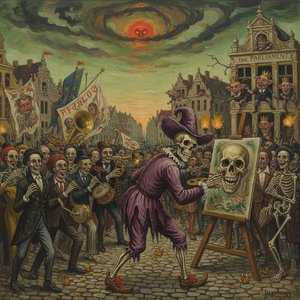 James Ensor's Grotesque Visions: Social Commentary & Artistic InnovationExplore the unsettling yet captivating world of James Ensor, a pioneer of Expressionism. Discover his satirical masterpieces, symbolic imag…