Switch to Print
 Read More







































 For artworks or reproductions larger than 105 cm (approximately 41 inches) on any side, the frame will be shipped as a kit, disassembled. This method ensures safe delivery and prevents damage during transport.


A Twilight Encounter on the High Seas
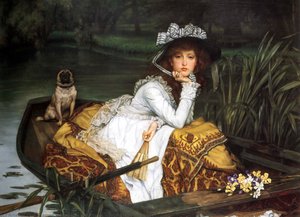
In the soft, amber glow of a fading day, Jacques Joseph Tissot’s 1873 masterpiece, “The Last Evening,” invites us to step aboard a vessel suspended between the elegance of the Belle Époque and the quiet melancholy of an approaching night. This exquisite oil on canvas is far more than a mere maritime scene; it is a meticulously choreographed tableau of Victorian social grace. As the sun dips below the horizon, Tissot captures a group of well-dressed individuals gathered upon a yacht, their figures bathed in a warm, atmospheric light that seems to vibrate with the stillness of the moment. The composition draws the eye through a delicate dance of gazes and postures, where the rustle of embroidered gowns and the quiet presence of leather-bound books suggest a world of refined intellect and leisurely sophistication.
The painting serves as a profound window into the soul of the late nineteenth century, a period defined by both opulent splendor and an underlying preoccupation with the fleeting nature of time. While the setting is one of luxury, there is a palpable sense of intimacy and perhaps even a touch of memento mori—a gentle reminder of mortality that often haunted the Victorian psyche. The way the figures are clustered together, some lost in thought and others engaged in quiet companionship, evokes a feeling of shared solitude. For the discerning collector or interior designer, this piece offers an unparalleled emotional depth, providing a focal point that is simultaneously commanding in its detail and soothing in its nostalgic warmth.
Mastery of Light and Japonisme Influence
Technically, “The Last Evening” stands as a testament to Tissot’s extraordinary ability to blend the precision of academic realism with the burgeoning sensibilities of Impressionism. His brushwork, though controlled and precise when rendering the intricate textures of silk and lace, possesses a luminous quality that captures the shimmering reflections on the water and the hazy atmosphere of twilight. One cannot overlook the subtle yet striking influence of Japonisme—the era's fascination with Japanese aesthetics—which manifests in Tissot’s sophisticated use of asymmetrical balance and his nuanced, muted color palette. By eschewing garish contrasts in favor of harmonious browns, deep blues, and soft golds, he creates a sense of atmospheric luminescence that feels remarkably modern.
This mastery of light does more than just illuminate the scene; it sculpts the very mood of the artwork. The interplay of shadow and glow lends a three-dimensional weight to the figures, making them feel as though they might step off the canvas and into the room. For those seeking to adorn a space with art that breathes life into an interior, Tissot’s technique offers a perfect balance of classical structure and ethereal beauty. The painting does not merely sit upon a wall; it transforms the surrounding environment, casting a spell of historical grandeur and quiet contemplation over any room it inhabits.
A Timeless Legacy for the Modern Collector
To possess a reproduction of “The Last Evening” is to hold a fragment of history. Tissot’s ability to capture the nuances of fashion, social hierarchy, and human emotion ensures that this work remains eternally relevant. Whether it is the way a woman tilts her head in quiet reflection or the meticulous rendering of the yacht's fine furnishings, every detail serves to transport the viewer to an era of unparalleled elegance. It is a piece that speaks to the connoisseur who appreciates the intersection of narrative storytelling and technical brilliance.
For interior designers crafting sophisticated, curated spaces, this artwork provides a foundational element of class and character. It pairs exquisitely with period-appropriate decor or serves as a stunning, soulful contrast to contemporary minimalist settings. As an investment in beauty, Tissot’s work continues to inspire awe, offering a timeless escape into a world where every evening holds the promise of quiet splendor and every shadow tells a story of elegance lost to time.
Questions & Answers
In what year was "The Last Evening" by Jacques Joseph Tissot created?
"The Last Evening" dates from 1873. The date places the work within Jacques Joseph Tissot's career and its era.
What shape and dimensions is "The Last Evening" by Jacques Joseph Tissot?
"The Last Evening" by Jacques Joseph Tissot is a landscape composition measuring 72 x 103 cm in the original.
How do the colors of "The Last Evening" by Jacques Joseph Tissot relate to its emotion?
In "The Last Evening", earthy colors accompany a romantic feeling.
More about this painting
 Preview
 Send
Send Share
Share
 Details
 Guide
Guide

 Download
 Similars
 X-Ray
X-Ray Diaporama
 Q&A
Q&A Stats
Stats