Preview
 Send
Send Share
Share
 Details

 Download
 Similars
 X-Ray
X-Ray Diaporama
Lamentation
 Oil On Canvas
- WallArt
- Mannerism
 1563
1563- Renaissance
 108.0 x 170.0 cm
 Pinacoteca di Brera
 Read More
Giclée / Art Print
Museum-quality giclée or canvas print with fast production and flexible finish options. ( Buy Hand Made Painting Buy Image)




P118B $10

P118H $10

P118W $10

P438Z $10

P508JH $12

P508YH $12

P805H $10

P805Z $10

P919BZ $10

P919G $10

P919XJ $10

P959ZH $10

P968JZ $12

W106C $8

W218G $10

W218JH $8

W218Y $10

W307PJ $10

W316G $10

W316PJ $8

W316Y $10

W398PJ $8

W4111J $10

W500HY $15

W500JH $15

W692G $12

W849H $8

W940BG $15

W953PJ $8




Pick from our preset sizes that match the artwork's original proportions.

You may enter your own dimensions to fit a specific frame or space. If your selected size does not match the original image's proportions, we will either crop the artwork or extend the image with a mirrored or solid-fill edge. A digital mockup will be sent for your approval before production begins.
Please note that the on-screen preview does not reflect the actual cropping or extension. Only the mockup will accurately show the final composition.
While custom sizes are available, we recommend selecting a dimension from the predefined list to preserve the original proportions.
Worldwide Delivery () in 2 weeks instead of standard 4/5 weeks. (2 September)

Free Worldwide Express Shipping

High-Quality Linen Canvas

Full Shipping Insurance

Customs Tax Refund Guarantee

True Color Matching Guarantee

60-Day Return Policy (Defects Only)

100% Money-Back Guarantee

Bulk Discount Offer
 Glass option is only available in size under 110 CM

Lamentation
Giclée / Art Print
Reproduction Size
-


Total Price
$ 81
The Weight of Grief: An Encounter with Tintoretto's Lamentation
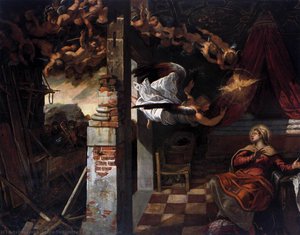
To stand before Jacopo Tintoretto’s Lamentation is not merely to observe paint on canvas; it is to be enveloped by an overwhelming tide of sorrow. Painted in 1563, this masterpiece captures a moment so profoundly human—the immediate aftermath of unimaginable loss—that the centuries feel thin. The composition draws the viewer into its tight embrace, presenting a gathering of figures consumed by grief around the still form of Christ. Tintoretto, known to history as *il Furioso*, does not offer polite detachment; he thrusts us directly into the heart of the tragedy, using every brushstroke to amplify the raw, visceral ache of mourning.
Mastery in Shadow and Light: Technical Brilliance
Technically, this work is a breathtaking display of Venetian dynamism. Tintoretto’s handling of oil on canvas allows for a richness that seems almost palpable. Observe how the light, originating from an unseen source above and to the left, does not simply illuminate; it sculpts emotion. It carves out the anguished faces, catches the folds of drapery in deep reds and muted blues, and casts dramatic shadows that lend monumental weight to every gesture. The texture is incredibly rich, a testament to his visible brushwork—a technique that gives volume and depth, making the fabric seem heavy with sorrow itself. While the perspective retains some Renaissance flattening, it is overcome by the sheer emotional force of the arrangement, creating an intensely focused, almost claustrophobic intimacy.
Symbolism and the Human Condition
The subject matter—the Lamentation—is steeped in profound religious symbolism, yet its power transcends dogma. It speaks to universal themes: loss, sacrifice, and enduring sorrow. The grouping of figures, their bodies intertwined with palpable despair, forces a contemplation of shared human experience. The deep color palette, dominated by somber earth tones punctuated by the vibrant tragedy of crimson, anchors the piece in melancholy. For the collector or decorator, this painting offers more than mere decoration; it is a meditation on the sublime weight of feeling, an anchor point for contemplative spaces.
A Style of Intense Emotion: Mannerism's Peak
Stylistically, Lamentation sits at the thrilling intersection of Late Renaissance and early Mannerist sensibilities. Tintoretto eschews placid balance for dramatic energy. His lines are not merely descriptive; they are expressive—flowing drapery becomes a visual manifestation of weeping souls, and strong diagonals guide the eye inexorably toward the central tragedy. This dynamism is what makes the piece so arresting. It possesses an urgent vitality that modern sensibilities find both challenging and deeply compelling. Owning a reproduction of this work allows one to harness that same electric tension within a contemporary setting.
Bringing the Drama Home
The dimensions, 108 x 170 cm, suggest a commanding presence, perfect for an entryway or a grand hall where drama is desired. When considering a reproduction of this monumental piece, one is acquiring not just art, but an atmosphere—an echo of Tintoretto’s furious genius. It promises to elevate any interior space by infusing it with depth, history, and the unforgettable resonance of profound human feeling.
Artist Biography
Jacopo Tintoretto: The Furious Master of Venetian Light
Jacopo Robusti, better known as Tintoretto (from the Italian word *tintore*, meaning dyer, a reference to his father’s profession), emerged in 16th-century Venice as one of the most innovative and influential figures of the Renaissance. Born around 1518, likely late September or early October, his life was a whirlwind of artistic creation, marked by both prodigious talent and a fiercely independent spirit that often clashed with established norms. Unlike many artists of his time who meticulously documented their training, Tintoretto’s early years remain shrouded in some mystery. Tradition holds he apprenticed briefly under Titian, though this is debated; what's undeniable is that he quickly forged his own path, absorbing the lessons of Venetian masters like Giorgione and Giovanni Bellini while simultaneously pushing beyond their conventions with a dynamism all his own. His nickname, *il Furioso* ("the Furious"), speaks to the intensity of his working style – a rapid, almost frenzied approach that produced an astonishing volume of work in a relatively short career, ending with his death on May 31, 1594.A Revolution in Composition and Light
Tintoretto’s genius lay not just in his technical skill but also in his revolutionary approach to composition and the use of light. He rejected the static, balanced arrangements favored by earlier Renaissance painters, opting instead for dramatic diagonals, dynamic movement, and a sense of theatricality that foreshadowed Baroque art. His figures are often caught in moments of intense action, their bodies contorted with emotion, their gestures expansive and expressive. But it was his mastery of light that truly set him apart. Unlike the soft, diffused lighting of Raphael or the carefully controlled chiaroscuro of Caravaggio, Tintoretto employed a bold, almost theatrical use of illumination. Beams of light would slash across canvases, highlighting key figures while plunging others into deep shadow, creating an atmosphere of heightened drama and spiritual intensity. This innovative approach is brilliantly exemplified in works like "The Miracle of Saint Mark," where the saint appears bathed in divine light amidst a swirling vortex of action, or his numerous depictions of “The Last Supper,” each exploring different perspectives and emotional nuances with remarkable freedom. He wasn't afraid to experiment with perspective, often employing dramatic foreshortening and unusual viewpoints to create a sense of immediacy and involvement for the viewer.Major Works and Patronage
Tintoretto’s career flourished under the patronage of Venice’s powerful institutions, particularly the Scuola Grande di San Marco and the Doge's Palace. The Scuola Grande commissions, especially the cycle of paintings depicting the life of Saint Mark, are considered among his greatest achievements, showcasing his ability to combine narrative clarity with breathtaking visual drama. These monumental canvases filled the walls of the *Scuola*, immersing viewers in scenes of miracles, processions, and moments of profound spiritual significance. His work for the Doge's Palace included vast historical paintings that celebrated Venetian power and military triumphs, demonstrating his versatility as an artist capable of tackling both religious and secular subjects with equal skill. Beyond these major commissions, Tintoretto produced countless altarpieces, portraits, and smaller works for private patrons, solidifying his reputation as the leading painter in Venice during a period of intense artistic competition. His son, Domenico Tintoretto, also became a painter, working alongside his father and continuing the family’s legacy after Jacopo's death.Influence and Legacy
Tintoretto’s impact on subsequent generations of artists was profound. He paved the way for the Baroque movement with his dramatic compositions, dynamic figures, and theatrical use of light. Artists like Rubens and Rembrandt were deeply influenced by his innovative approach to painting, adopting his techniques and adapting them to their own styles. His emphasis on emotional intensity and psychological realism also anticipated later developments in art history. While contemporaries sometimes criticized his rapid working style and unconventional methods, today Tintoretto is recognized as a pivotal figure in the transition from Renaissance to Baroque art—a visionary artist who transformed the landscape of Venetian painting and left an indelible mark on Western art history. His ability to infuse religious narratives with such palpable human emotion and dramatic visual power continues to captivate audiences centuries after his death, ensuring his place among the giants of artistic innovation.
jacopo tintoretto
1518 - 1594
Quick Facts
- Artistic Movement Or Style: Venetian School, Mannerism
- Artists Who Influenced This Artist:
- Titian
- Michelangelo
- Date Of Birth: 1518
- Date Of Death: 1594
- Full Name: Jacopo Tintoretto
- Nationality: Italian
- Notable Artworks:
- Miracle of the Slave
- Last Supper
- Portrait of Procurator Soranzo
Related Articles

Jacopo Tintoretto's Masterpieces: 25 Paintings That Define Venetian Drama | OriginalUniqueArt
Explore 25 breathtaking masterpieces by Jacopo Tintoretto, the Venetian master of drama and light. Discover the stories behind iconic Renaissance paintings & find museum-quality art reproductions to elevate your home decor on OriginalUniqueArt.com.

Venetian Renaissance: The Mastery of Color, Light, and the Art of Colorito
Explore the luminous mastery of the Venetian Renaissance. Discover how masters like Titian and Giorgione revolutionized art through colorito, light, and atmosphere. An expert guide to the golden age of Italian painting for collectors and enthusiasts.
Beyond Perfection: The Dramatic Elegance and Intellectual Tension of Renaissance Mannerism
Explore the captivating world of Renaissance Mannerism. Discover how artists moved beyond High Renaissance harmony into a realm of elegant distortion, psychological tension, and dramatic beauty that bridged the gap to the Baroque era.

The Golden Light of Innovation: Exploring the Venetian Renaissance Art Movement (1430–1580)
Explore the Golden Age of Venetian art (1430–1580). Discover Giorgione, Titian & Tintoretto's techniques, the 'colorito' revolution, and lasting influence. Expert insights for collectors & enthusiasts.

Jacopo Palma il Giovane: A Venetian Master's Poetic Evolution
Explore the captivating world of Jacopo Palma il Giovane, a pivotal Venetian Renaissance master. Discover his unique style, influenced by Titian & Tintoretto, and learn about key works perfect for discerning collectors.