

 Preview
 Send
Send Share
Share
 Details
 Guide
Guide

 Download
 Similars
 X-Ray
X-Ray Diaporama
 Stats
StatsDoge Pietro Loredano
 Oil On Canvas
- WallArt
- Baroque
 1570
1570 109.0 x 93.0 cm
 National Gallery of Victoria
 Read More
Giclée / Art Print
Museum-quality giclée or canvas print with fast production and flexible finish options. ( Buy Hand Made Painting Switch to Digital Image)




P118B $10

P118H $10

P118W $10

P438Z $10

P508JH $12

P508YH $12

P805H $10

P805Z $10

P919BZ $10

P919G $10

P919XJ $10

P959ZH $10

P968JZ $12

W106C $8

W218G $10

W218JH $8

W218Y $10

W307PJ $10

W316G $10

W316PJ $8

W316Y $10

W398PJ $8

W4111J $10

W500HY $15

W500JH $15

W692G $12

W849H $8

W940BG $15

W953PJ $8




Pick from our preset sizes that match the artwork's original proportions.

Type the width and the height you need, to fit your frame or your wall. A print can only be cut, never made bigger than the picture, so a size with a different shape loses a part of the image. We send you a digital mockup to approve before we print anything. The picture shown on this page does not show the real cut — only the mockup does.
Worldwide Delivery () in 2 weeks instead of standard 4/5 weeks. (23 October)

Free Worldwide Express Shipping

High-Quality Linen Canvas

Full Shipping Insurance

Customs Tax Refund Guarantee

True Color Matching Guarantee

100-Day Return Policy (Defects Only)

100% Money-Back Guarantee

Bulk Discount Offer
 Glass option is only available in size under 110 CM

Doge Pietro Loredano
Giclée / Art Print
Reproduction Size
-


Total Price
$ 81
A Doge in Transition: Tintoretto’s Portrait of Pietro Loredano
Jacopo Tintoretto's *Doge Pietro Loredano* (1570) is far more than a stately portrait; it’s a compelling study of power, age, and the anxieties of leadership during a period of Venetian decline. Painted with remarkable sensitivity, this work captures Doge Pietro Loredano – the elected ruler of Venice – not as an untouchable symbol of authority, but as a *vulnerable* man bearing the weight of immense responsibility. The painting’s power lies in its subtle departure from traditional court portraiture, revealing a psychological depth rarely seen at the time. Tintoretto, already established as a leading Venetian artist and court painter, skillfully balances formality with an intimate portrayal of his subject.Technique & Style: A Masterclass in Venetian Painting
Tintoretto’s technique is immediately striking. He began by applying broad strokes of lead white directly onto a dark reddish-brown ground, creating a dramatic contrast and lending the portrait an ethereal quality. This approach, characteristic of his innovative style, diverges from the meticulous layering favored by earlier Renaissance masters like Titian (who Tintoretto succeeded as court painter). The visible brushwork, energetic yet controlled, contributes to the sense of immediacy and psychological realism. The painting exemplifies Venetian mastery of oil paint – utilizing thin glazes to build color and luminosity. X-radiography reveals that Tintoretto deliberately altered the initial composition, adjusting Loredano’s posture to emphasize his age and subtly diminishing the imposing grandeur typically associated with such portraits. This reworking is a testament to Tintoretto's artistic vision and willingness to prioritize emotional truth over rigid convention.Historical Context & Symbolism
The late 16th century was a turbulent time for Venice. The Republic’s maritime dominance was waning, challenged by rising powers like the Ottoman Empire. Pietro Loredano assumed office during this period of uncertainty, and Tintoretto's portrait subtly reflects this anxiety. While Loredano is adorned in the ceremonial robes – including the distinctive *corno ducale* (doge’s crown) – his posture and expression convey a sense of weariness rather than unyielding authority. The rich attire itself symbolizes wealth and power, but it also serves as a visual reminder of the traditions and expectations placed upon the Doge. The portrait can be interpreted as a commentary on the burdens of leadership, hinting at the fragility of even the most powerful positions in a changing world.Emotional Impact & Lasting Appeal
*Doge Pietro Loredano* resonates with viewers today because it transcends mere representation. It’s a deeply human portrait that invites contemplation on themes of power, mortality, and the passage of time. The Doge's contemplative gaze and subtly melancholic expression evoke empathy and understanding. This painting isn’t simply *about* a powerful man; it’s about the *experience* of being human, even – or perhaps especially – in positions of great responsibility. Its enduring appeal makes it a captivating addition to any collection, offering both historical insight and profound emotional resonance for art lovers and interior design enthusiasts alike.Questions & Answers
Where is "Doge Pietro Loredano" by Jacopo Robusti on display today?
You can see the original "Doge Pietro Loredano" at the National Gallery of Victoria, Melbourne, Australia.
How is "Doge Pietro Loredano" by Jacopo Robusti proportioned, and how big is it?
"Doge Pietro Loredano" by Jacopo Robusti is proportioned as a portrait work of 109 x 93 cm.
Is "Doge Pietro Loredano" held in the country of its creator?
No - the artwork is kept abroad. The birth country of Jacopo Robusti is Italy, and the museum holding the original of "Doge Pietro Loredano" is in Australia.
Artist Biography
early life and training
jacopo robusti, also known as tintoretto, was an italian painter identified with the venetian school. he was born in venice in 1518 and his father was a dyer. tintoretto is known to have had at least one sibling, a brother named domenico robusti. he is believed to have originated from brescia, in lombardy, then part of the republic of venice.artistic style and influences
tintoretto's artistic style was characterized by his bold brushwork and inventiveness in composition. he was influenced by the works of michelangelo, but ultimately spent most of his career rejecting the high renaissance style with his own approach.notable works
- saint george and the dragon (158 x 100 cm, national gallery, london, oil on canvas), a painting that showcases tintoretto's unique ability to capture the essence of a place.
- mary with the child, venerated by two evangelists (160 x 228 cm, canvas), a work that demonstrates tintoretto's mastery of light and shadow.
- christ carried to the tomb (scottish national gallery, edinburgh, oil on canvas), a painting that exemplifies tintoretto's boldness and inventiveness in composition.
museums and collections
tintoretto's works can be found in various museums around the world, including the gallerie dell'accademia (venezia, italy), the national gallery (london, united kingdom), and the scottish national gallery (edinburgh, scotland).legacy
tintoretto remains one of the most prolific italian painters of the venetian school, known for his bold brushwork and inventiveness in composition. his legacy continues to inspire artists and art enthusiasts alike.- view more works by jacopo robusti on OriginalUniqueArt.com
- read more about the venetian school and its notable artists on wikipedia

Jacopo Robusti
1518 - 1594 , Italy
Quick Facts
- Full Name: Jacopo Robusti Tintoretto
- Nationality: Italian
- Date Of Birth: 1518
- Date Of Death: 1594
- Place Of Birth: Venice, Italy
- Notable Artworks:
- The Worship of Venus
- Assumption of the Virgin
- Last Supper (San Giorgio Maggiore)
- Origin of the Milky Way
- Artistic Movement Or Style: Late Renaissance, Mannerism, Venetian school
- Artists Who Influenced This Artist:
- Titian
- Michelangelo
- Giovanni Francesco Caroto
- Artists Or Movements Influenced By This Artist: ['Paolo Veronese']
Related Articles

Jacopo Palma il Giovane: A Venetian Master's Poetic Evolution
Explore the captivating world of Jacopo Palma il Giovane, a pivotal Venetian Renaissance master. Discover his unique style, influenced by Titian & Tintoretto, and learn about key works perfect for discerning collectors.

Venetian Renaissance: The Mastery of Color, Light, and the Art of Colorito
Explore the luminous mastery of the Venetian Renaissance. Discover how masters like Titian and Giorgione revolutionized art through colorito, light, and atmosphere. An expert guide to the golden age of Italian painting for collectors and enthusiasts.

Pietro Longhi's Venetian Scenes: A Study of Rococo Society & Domestic Life
Explore the captivating world of Pietro Longhi's Venetian scenes! Discover insightful analysis of his Rococo masterpieces & social commentary on 18th-century life. Learn about this 'Venetian Hogarth' and his lasting artistic legacy.

The Golden Light of Innovation: Exploring the Venetian Renaissance Art Movement (1430–1580)
Explore the Golden Age of Venetian art (1430–1580). Discover Giorgione, Titian & Tintoretto's techniques, the 'colorito' revolution, and lasting influence. Expert insights for collectors & enthusiasts.
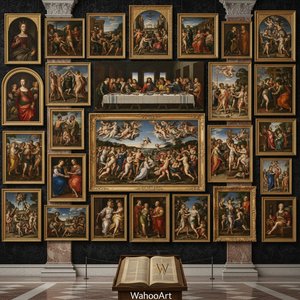
Jacopo Tintoretto's Masterpieces: 25 Paintings That Define Venetian Drama | OriginalUniqueArt
Explore 25 breathtaking masterpieces by Jacopo Tintoretto, the Venetian master of drama and light. Discover the stories behind iconic Renaissance paintings & find museum-quality art reproductions to elevate your home decor on OriginalUniqueArt.com.


