Preview
 Send
Send Share
Share
 Details
 Guide
Guide

 Download
 Similars
 X-Ray
X-Ray Diaporama
 Stats
StatsSt. Anthony Abbot
 Oil On Panel
- WallArt
- Renaissance Portraiture
 1519
1519- Renaissance
 78.0 x 66.0 cm
 Galleria degli Uffizi
 Read More
Giclée / Art Print
Museum-quality giclée or canvas print with fast production and flexible finish options. ( Buy Hand Made Painting Switch to Digital Image)




P118B $10

P118H $10

P118W $10

P438Z $10

P508JH $12

P508YH $12

P805H $10

P805Z $10

P919BZ $10

P919G $10

P919XJ $10

P959ZH $10

P968JZ $12

W106C $8

W218G $10

W218JH $8

W218Y $10

W307PJ $10

W316G $10

W316PJ $8

W316Y $10

W398PJ $8

W4111J $10

W500HY $15

W500JH $15

W692G $12

W849H $8

W940BG $15

W953PJ $8




Pick from our preset sizes that match the artwork's original proportions.

You may enter your own dimensions to fit a specific frame or space. If your selected size does not match the original image's proportions, we will either crop the artwork or extend the image with a mirrored or solid-fill edge. A digital mockup will be sent for your approval before production begins.
Please note that the on-screen preview does not reflect the actual cropping or extension. Only the mockup will accurately show the final composition.
While custom sizes are available, we recommend selecting a dimension from the predefined list to preserve the original proportions.
Worldwide Delivery () in 2 weeks instead of standard 4/5 weeks. (7 October)

Free Worldwide Express Shipping

High-Quality Linen Canvas

Full Shipping Insurance

Customs Tax Refund Guarantee

True Color Matching Guarantee

100-Day Return Policy (Defects Only)

100% Money-Back Guarantee

Bulk Discount Offer
 Glass option is only available in size under 110 CM

St. Anthony Abbot
Giclée / Art Print
Reproduction Size
-


Total Price
$ 81
A Renaissance Reverie: The Soul of Pontormo’s St. Anthony Abbot
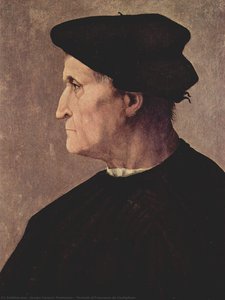
In the quietude of a Florentine studio around 1519, Jacopo Carucci—the master known to history as Pontormo—captured a moment of profound spiritual stillness that continues to resonate centuries later. His depiction of St. Anthony Abbot is far more than a mere portrait of a desert saint; it is a window into the burgeoning Mannerist movement, where the serene balance of the High Renaissance began to yield to a more complex, psychological intensity. As one gazes upon this work, there is an immediate sense of encountering a soul in contemplation, a figure emerging from a muted, greenish-yellow void to offer a glimpse of divine light.
The painting serves as a masterful bridge between eras. While the anatomical precision and sculptural presence of the subject echo the monumental influence of Michelangelo, Pontormo introduces an emotional depth that anticipates the dramatic tension of the Baroque. The saint is rendered with a striking realism; his weathered face, the texture of his long, flowing beard, and the heavy drape of his dark, ascetic robes all speak to a life of rigorous devotion and solitude. This meticulous attention to detail does not merely serve to document the physical form but to ground the spiritual subject in a palpable, human reality.
The Language of Light and Symbolism
Technique and symbolism are inextricably linked in this evocative composition. Pontormo employs chiaroscuro with surgical precision, utilizing a light source that strikes the figure from the left to carve his features out of the shadows. This play of light and dark does more than create a three-dimensional illusion; it acts as a metaphor for the saint's spiritual journey through the darkness of temptation toward the clarity of faith. The subtle use of shadow on the right side of the face adds a layer of mystery, suggesting the internal struggles inherent in the monastic life.
Central to the painting’s narrative is the scroll held firmly in St. Anthony's hand. Upon it, the Latin inscription "EGO SUM LUX MUNDI"—I am the light of the world—serves as a powerful theological anchor. Though these words are attributed to Christ, their presence in the hands of the Abbot connects the saint to the divine essence, reinforcing his role as a beacon of spiritual truth. The muted, atmospheric background, devoid of distracting landscapes, ensures that the viewer’s focus remains locked onto this sacred message and the luminous countenance of the saint himself.
An Enduring Legacy for the Discerning Collector
For the art lover or the interior designer, a reproduction of Pontormo’s St. Anthony Abbot offers much more than aesthetic beauty; it provides an atmosphere of contemplative gravity. The painting's sophisticated palette—dominated by earthy tones, deep shadows, and that singular, haunting greenish-yellow hue—makes it a versatile centerpiece for spaces that value historical depth and intellectual character. It is a piece that invites long periods of study, rewarding the observer with new layers of emotional complexity upon every viewing.
Whether placed in a private library, a formal study, or a curated gallery setting, this work brings with it the weight of Florentine history and the melancholic beauty of the Mannerist vision. To possess such a piece is to invite the spirit of Pontormo into one's environment—a master who dared to look inward and capture the turbulent, beautiful complexity of the human soul through the medium of oil and light.
Questions & Answers
Who is the artist behind "St. Anthony Abbot"?
"St. Anthony Abbot" was created by Jacopo Carucci. The information on this page describes Jacopo Carucci's original work.
What are the dimensions of the original "St. Anthony Abbot" by Jacopo Carucci?
The original "St. Anthony Abbot" by Jacopo Carucci measures 78 x 66 cm.
Where in Jacopo Carucci's career does "St. Anthony Abbot" fall, given its date?
Given its 1519 date, "St. Anthony Abbot" falls in Jacopo Carucci's Mature Renaissance.
Where can I see the original "St. Anthony Abbot" by Jacopo Carucci?
The original "St. Anthony Abbot" by Jacopo Carucci is held at the Galleria degli Uffizi, Florence, Italy. A reproduction allows the work to be displayed at home.
What is the creation date of "St. Anthony Abbot" by Jacopo Carucci?
"St. Anthony Abbot" dates from 1519. The date places the work within Jacopo Carucci's career and its era.
How old was Jacopo Carucci when creating "St. Anthony Abbot" in 1519?
When "St. Anthony Abbot" was created in 1519, Jacopo Carucci - born in 1494 - was 25 years old.
What is the dominant hue of "St. Anthony Abbot" by Jacopo Carucci?
The dominant hue of "St. Anthony Abbot" by Jacopo Carucci is blue-violet to rose. The hue is the underlying tone of the palette.
Artist Biography
The Melancholy Visionary: The Life and Legacy of Jacopo Pontormo
Jacopo Carucci, known to history by the evocative moniker Pontormo, was an artist whose brush captured the very essence of transition. Born in the small Tuscan village of Pontorme around 1494, his early life was marked by a profound sense of solitude and melancholy, qualities that would later infuse his canvases with an unparalleled psychological depth. As a young apprentice in Florence, he moved through a world of shifting artistic paradigms, eventually emerging as a central figure of the Florentine Mannerist movement. Unlike the masters of the High Renaissance who sought perfection through balance and mathematical harmony, Pontormo looked inward, seeking to express the turbulent, often unsettling complexities of the human soul. His formative years were shaped by the shadows of giants. Under the tutelage of Domenico del Pollaiuolo and the monumental influence of Michelangelo Buonarroti, he mastered the anatomical precision required of a Renaissance master, yet he possessed an irrepressible urge to distort that very reality for emotional effect. He drew inspiration not only from the sculptural weight of Michelangelo but also from the intricate, emotive engravings of Albrecht Dürer. This unique synthesis of Italian form and Northern European expressive detail allowed him to pioneer a style where figures seemed to lose their tether to gravity, drifting through ambiguous, dreamlike spaces.The Architecture of Mannerism: Style and Innovation
To witness a Pontormo painting is to enter a realm where the familiar laws of physics and perspective are suspended. His work represents a deliberate departure from the serene, perspectival regularity of his predecessors. In masterpieces such as his "Visitation" or the haunting "Deposition," one observes the hallmarks of his revolutionary Mannerist aesthetic: elongated limbs, twining and unnatural poses, and a palette of vibrant, almost acidic colors that clash and shimmer with an otherworldly light. He replaced the stable, triangular compositions of the Renaissance with swirling, crowded arrangements that evoke a sense of restless energy and spiritual unrest. The technical brilliance of Pontormo lay in his ability to use color and form as psychological tools. His figures often appear to float within uncertain environments, unhampered by weight, creating a sense of profound instability. This was not mere artifice; it was a deliberate attempt to convey the spiritual anxieties of an era caught between the certainties of the Renaissance and the looming drama of the Baroque. Whether through the dramatic light in his "Supper at Emmaus" or the stark, emotive intensity found in his studies of Christ, Pontormo utilized every brushstroke to explore themes of grief, devotion, and the divine.A Lasting Impression on Art History
The historical significance of Jacopo Pontormo cannot be overstated. He served as a vital bridge, translating the classical ideals of the 15th century into the expressive, theatrical language that would define much of the 16th-century art. His influence rippled through the Florentine School, shaping the works of successors like Bronzino and ensuring that the tension between beauty and artifice remained a central dialogue in European painting. His oeuvre remains a testament to the power of individual vision over tradition. Through his portraits, such as the regal "Cosimo I de' Medici," and his deeply symbolic religious works, he demonstrated that art could be more than a mirror of reality; it could be a window into the subconscious. Though his life was often shadowed by personal sorrow, the brilliance of his color and the complexity of his compositions continue to captivate, inviting every viewer to lose themselves in the beautiful, distorted, and deeply human world of the Florentine master.
Jacopo Carucci
1494 - 1557 , Italy
Quick Facts
- Artistic Movement Or Style: Florentine Mannerism
- Artists Or Movements Influenced By This Artist: ['Baroque art']
- Artists Who Influenced This Artist:
- Domenico del Pollaiuolo
- Michelangelo Buonarroti
- Albrecht Dürer
- Full Name: Jacopo Carucci
- Nationality: Italian
- Notable Artworks:
- Visitation
- Deposition
- Place Of Birth: Pontormo, Italy
- Date Of Birth: 1494
- Date Of Death: 1557
Related Articles
Discover the Divine: Inspiring Saint Anthony Artworks to Elevate Your Home Decor
Transform your home with the profound beauty of Saint Anthony artworks. Explore exquisite Baroque reproductions by Murillo and Zurbarán, hand-painted on 100% cotton canvas to bring divine serenity and timeless elegance to your interior design.
Jacopo Tintoretto's Masterpieces: 25 Paintings That Define Venetian Drama | OriginalUniqueArt
Explore 25 breathtaking masterpieces by Jacopo Tintoretto, the Venetian master of drama and light. Discover the stories behind iconic Renaissance paintings & find museum-quality art reproductions to elevate your home decor on OriginalUniqueArt.com.

Jacopo Pontormo: A Bridge Between Renaissance Tradition & Mannerist Emotion
Explore the captivating world of Jacopo Pontormo, a pivotal Italian Mannerist painter. Discover his unique style, influences & masterpieces – and find museum-quality reproductions at OriginalUniqueArt.

El Greco's Masterpieces: Explore 25 Iconic Paintings & Spiritual Visions | OriginalUniqueArt
Journey through El Greco's 25 most iconic paintings! Explore the spiritual depth & dramatic beauty of this Spanish Renaissance master. Discover art history, techniques & find museum-quality reproductions for your home at OriginalUniqueArt.com.
Jacopo Bassano: A Venetian Master of Color, Family & the Renaissance Landscape
Explore the life & art of Jacopo Bassano, a Venetian master renowned for his vibrant colorism and innovative religious scenes. Discover his family legacy & enduring influence on Renaissance painting with OriginalUniqueArt.