Preview
 Send
Send Share
Share
 Details
 Guide
Guide

 Download
 Similars
 X-Ray
X-Ray Diaporama
 Q&A
Q&A Stats
StatsAlessandro de' Medici


 Read More
Giclée / Art Print
Museum-quality giclée or canvas print with fast production and flexible finish options. ( Buy Hand Made Painting Switch to Digital Image)




P118B $10

P118H $10

P118W $10

P438Z $10

P508JH $12

P508YH $12

P805H $10

P805Z $10

P919BZ $10

P919G $10

P919XJ $10

P959ZH $10

P968JZ $12

W106C $8

W218G $10

W218JH $8

W218Y $10

W307PJ $10

W316G $10

W316PJ $8

W316Y $10

W398PJ $8

W4111J $10

W500HY $15

W500JH $15

W692G $12

W849H $8

W940BG $15

W953PJ $8




Pick from our preset sizes that match the artwork's original proportions.

Type the width and the height you need, to fit your frame or your wall. A print can only be cut, never made bigger than the picture, so a size with a different shape loses a part of the image. We send you a digital mockup to approve before we print anything. The picture shown on this page does not show the real cut — only the mockup does.
Worldwide Delivery () in 2 weeks instead of standard 4/5 weeks. (7 November)

Free Worldwide Express Shipping

High-Quality Linen Canvas

Full Shipping Insurance

Customs Tax Refund Guarantee

True Color Matching Guarantee

100-Day Return Policy (Defects Only)

100% Money-Back Guarantee

Bulk Discount Offer
 Glass option is only available in size under 110 CM

Alessandro de' Medici
Giclée / Art Print
Reproduction Size
-


Total Price
$ 81
The Soul Beneath the Crown: A Study in Mannerist Melancholy
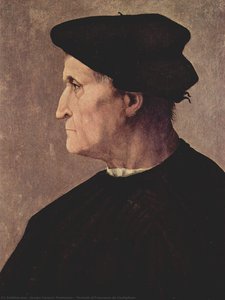
In the quiet, tension-filled corridors of 16th-century Florence, a new kind of portraiture began to emerge—one that sought not to flatter the sitter with outward glory, but to expose the profound psychological tremors beneath their skin. Jacopo Carucci, known more evocatively as Pontormo, achieved this feat masterfully in his 1535 masterpiece, Alessandro de' Medici. This is not merely a record of a ruler’s likeness; it is an intimate encounter with a soul caught in the crosswinds of political instability and personal introspection. As one gazes upon the face of the first Duke of Florence, there is an immediate sense of being drawn into a private moment of contemplation, where the weight of a turbulent reign is visible in the very shadows of the eyes.
The composition eschews the grand, sweeping landscapes and opulent backdrops typical of High Renaissance portraiture. Instead, Pontormo employs a deliberate simplicity, focusing the viewer’s entire attention on the upper torso and the hauntingly expressive face of Alessandro. By stripping away the distractions of worldly wealth, the artist forces an encounter with the subject's humanity. The minimal background serves to isolate the Duke, creating a vacuum of space that amplifies his sense of solitude. This stylistic choice is quintessential to the Mannerist movement, where the goal was to move beyond mere anatomical accuracy toward a more heightened, expressive, and often unsettling emotional truth.
Technique and the Language of Light
To behold this work is to witness the exquisite technical prowess of Pontormo’s brush. Utilizing oil on canvas, the artist layered pigments with a meticulous sensitivity that allows for breathtaking tonal gradations. The lighting is soft, almost diffused, as if filtered through the heavy atmosphere of a Tuscan twilight. This gentle illumination does not strike the subject with dramatic force; rather, it caresses the contours of the face, creating subtle transitions between light and shadow that lend a startling three-dimensional vitality to the skin. Such mastery of sfumato and tonal modulation allows the viewer to perceive the slight tension in the brow and the reflective depth within the gaze.
The color palette is a sophisticated arrangement of muted earth tones—deep browns, creamy highlights, and somber blacks, punctuated by subtle, bruised reds. These colors do not shout; they whisper of gravity and importance. The textures, though appearing smooth to the eye, possess an underlying complexity that suggests the heavy, fine fabrics of ducal attire. For the discerning collector or interior designer, this painting offers a profound sense of gravitas. It is a piece that does not demand attention through garishness but commands it through its quiet, undeniable presence, making it an ideal centerpiece for spaces designed for reflection, study, or sophisticated conversation.
A Legacy of Emotional Resonance
Beyond the technical brilliance lies the historical and symbolic heartbeat of the piece. Alessandro de' Medici lived a life defined by transition and uncertainty, and Pontormo captures this zeitgeist with uncanny precision. The elongated forms and slightly distorted perspectives characteristic of Mannerism serve as visual metaphors for a world where the stable proportions of the Renaissance were fracturing. There is an inherent ambiguity in the subject’s expression—is it pride, or is it sorrow? Is it the composure of a leader, or the mask of a man burdened by his station?
This ambiguity is precisely what gives the portrait its enduring power. It invites the viewer to participate in the interpretation, making every encounter with the artwork a new discovery. For those seeking to adorn their homes or galleries with works of significant intellectual and emotional depth, a high-quality reproduction of this Pontormo masterpiece offers more than just aesthetic beauty; it offers a window into the complexities of the human condition. It is an invitation to dwell in the presence of greatness, even in its most vulnerable and melancholic moments.
Questions & Answers
What is the overall mood of "Alessandro de' Medici" by Jacopo Carucci?
The overall mood of "Alessandro de' Medici" by Jacopo Carucci is dramatic. The mood describes the general atmosphere of the work.
Is there a slideshow for "Alessandro de' Medici" by Jacopo Carucci?
The diaporama of "Alessandro de' Medici" can be watched on the artwork's Diaporama page.
What are the reproduction rights of "Alessandro de' Medici" at the Art Institute of Chicago?
"Alessandro de' Medici" by Jacopo Carucci, held at the Art Institute of Chicago, is in the public domain - its copyright has expired. This status determines whether reproductions of the image may be made.
Artist Biography
The Melancholy Visionary: The Life and Legacy of Jacopo Pontormo
Jacopo Carucci, known to history by the evocative moniker Pontormo, was an artist whose brush captured the very essence of transition. Born in the small Tuscan village of Pontorme around 1494, his early life was marked by a profound sense of solitude and melancholy, qualities that would later infuse his canvases with an unparalleled psychological depth. As a young apprentice in Florence, he moved through a world of shifting artistic paradigms, eventually emerging as a central figure of the Florentine Mannerist movement. Unlike the masters of the High Renaissance who sought perfection through balance and mathematical harmony, Pontormo looked inward, seeking to express the turbulent, often unsettling complexities of the human soul. His formative years were shaped by the shadows of giants. Under the tutelage of Domenico del Pollaiuolo and the monumental influence of Michelangelo Buonarroti, he mastered the anatomical precision required of a Renaissance master, yet he possessed an irrepressible urge to distort that very reality for emotional effect. He drew inspiration not only from the sculptural weight of Michelangelo but also from the intricate, emotive engravings of Albrecht Dürer. This unique synthesis of Italian form and Northern European expressive detail allowed him to pioneer a style where figures seemed to lose their tether to gravity, drifting through ambiguous, dreamlike spaces.The Architecture of Mannerism: Style and Innovation
To witness a Pontormo painting is to enter a realm where the familiar laws of physics and perspective are suspended. His work represents a deliberate departure from the serene, perspectival regularity of his predecessors. In masterpieces such as his "Visitation" or the haunting "Deposition," one observes the hallmarks of his revolutionary Mannerist aesthetic: elongated limbs, twining and unnatural poses, and a palette of vibrant, almost acidic colors that clash and shimmer with an otherworldly light. He replaced the stable, triangular compositions of the Renaissance with swirling, crowded arrangements that evoke a sense of restless energy and spiritual unrest. The technical brilliance of Pontormo lay in his ability to use color and form as psychological tools. His figures often appear to float within uncertain environments, unhampered by weight, creating a sense of profound instability. This was not mere artifice; it was a deliberate attempt to convey the spiritual anxieties of an era caught between the certainties of the Renaissance and the looming drama of the Baroque. Whether through the dramatic light in his "Supper at Emmaus" or the stark, emotive intensity found in his studies of Christ, Pontormo utilized every brushstroke to explore themes of grief, devotion, and the divine.A Lasting Impression on Art History
The historical significance of Jacopo Pontormo cannot be overstated. He served as a vital bridge, translating the classical ideals of the 15th century into the expressive, theatrical language that would define much of the 16th-century art. His influence rippled through the Florentine School, shaping the works of successors like Bronzino and ensuring that the tension between beauty and artifice remained a central dialogue in European painting. His oeuvre remains a testament to the power of individual vision over tradition. Through his portraits, such as the regal "Cosimo I de' Medici," and his deeply symbolic religious works, he demonstrated that art could be more than a mirror of reality; it could be a window into the subconscious. Though his life was often shadowed by personal sorrow, the brilliance of his color and the complexity of his compositions continue to captivate, inviting every viewer to lose themselves in the beautiful, distorted, and deeply human world of the Florentine master.
Jacopo Carucci
1494 - 1557 , Italy
Quick Facts
- Artistic Movement Or Style: Florentine Mannerism
- Artists Or Movements Influenced By This Artist: ['Baroque art']
- Artists Who Influenced This Artist:
- Domenico del Pollaiuolo
- Michelangelo Buonarroti
- Albrecht Dürer
- Full Name: Jacopo Carucci
- Nationality: Italian
- Notable Artworks:
- Visitation
- Deposition
- Place Of Birth: Pontormo, Italy
- Date Of Birth: 1494
- Date Of Death: 1557
Related Articles

About Us
Discover our story! We bring world-class art into your life through expert curation, personalized creations, and free previews. Trusted by individuals and businesses since 2000.

Mastering Shadows: The 25 Most Powerful Artworks by Francisco Goya
Explore Goya's haunting masterpieces from courtly portraits to Black Paintings. Discover the full collection on OriginalUniqueArt.com.

The Enduring Legacy of Fine Art Prints: Technique, History & Aesthetic Impact
Explore the rich history & techniques of fine art prints. Discover investment potential, assess authenticity, and learn how to preserve your collection with expert guidance. Trusted insights for discerning collectors.

Jacopo Pontormo: A Bridge Between Renaissance Tradition & Mannerist Emotion
Explore the captivating world of Jacopo Pontormo, a pivotal Italian Mannerist painter. Discover his unique style, influences & masterpieces – and find museum-quality reproductions at OriginalUniqueArt.

Giclée Prints: Archival Quality & Aesthetic Nuances for the Discerning Collector
Explore the world of giclée prints with OriginalUniqueArt. Learn about archival quality, aesthetic nuances & investment potential. Expert guidance for discerning art collectors seeking museum-quality reproductions and lasting value.