Menu
Text size

() ·

A painting made for you, by hand

The King Drinks

Hand Made Oil Reproduction

Hand-painted oil on canvas in your size and frame, made to order by our artists. ( Switch to Print Switch to Digital Image)

Collectible Description

Explore Jacob Jordaens’ ‘The King Drinks,’ a dynamic Baroque masterpiece! Witness opulent revelry & realistic detail in this 1638 Flemish painting – a captivating work of art.

Artist Biography

Discover Jacob Jordaens (1593-1678), a Flemish Baroque master renowned for his dynamic compositions, realistic depictions of everyday life, and influence on artists like Jan Steen. Explore his vibrant paintings & legacy!

from ·

Chapter 1

How large should it be?

Slide to change the size; the picture on the left shows the frame at its real width. The proportions of the original are kept.

Standard
custom
CM
INCH

Pick from our preset sizes that match the artwork's original proportions.

width
height

Type the width and the height you need, to fit your frame or your wall. This is hand-painted, so for a size with a different shape the artist can paint a bit more around the picture, or cut a bit — you choose. We send you a digital mockup to approve before the painting starts. The picture shown on this page does not show the real result — only the mockup does.

Chapter 2

How should it arrive?

Choose the edges of the stretched canvas

Choose your frame

Corner sample of the WhiteWrap canvas edge finish, stretched on solid wood bars
White $1
Corner sample of the BlurSideWrap canvas edge finish, stretched on solid wood bars
Blurside $1
Corner sample of the ExtendedWrap canvas edge finish, stretched on solid wood bars
Extended $1
Corner sample of the P118B picture frame: moulded polystyrene, 5 cm wide and 3 cm thick
P118B $10
Corner sample of the P118H picture frame: moulded polystyrene, 5 cm wide and 3 cm thick
P118H $10
Corner sample of the P118W picture frame: moulded polystyrene, 5 cm wide and 3 cm thick
P118W $10
Corner sample of the P438Z picture frame: moulded polystyrene, 5.5 cm wide and 3.5 cm thick
P438Z $10
Corner sample of the P508JH picture frame: moulded polystyrene, 7 cm wide and 3.5 cm thick
P508JH $12
Corner sample of the P508YH picture frame: moulded polystyrene, 7 cm wide and 3.5 cm thick
P508YH $12
Corner sample of the P805H picture frame: moulded polystyrene, 5 cm wide and 3.5 cm thick
P805H $10
Corner sample of the P805Z picture frame: moulded polystyrene, 5 cm wide and 3.5 cm thick
P805Z $10
Corner sample of the P919BZ picture frame: moulded polystyrene, 7 cm wide and 3.5 cm thick
P919BZ $10
Corner sample of the P919G picture frame: moulded polystyrene, 7 cm wide and 3.5 cm thick
P919G $10
Corner sample of the P919XJ picture frame: moulded polystyrene, 7 cm wide and 3.5 cm thick
P919XJ $10
Corner sample of the P959ZH picture frame: moulded polystyrene, 5 cm wide and 3 cm thick
P959ZH $10
Corner sample of the P968JZ picture frame: moulded polystyrene, 6 cm wide and 4 cm thick
P968JZ $12
Corner sample of the W106C picture frame: solid wood, 5 cm wide and 3 cm thick
W106C $8
Corner sample of the W218G picture frame: solid wood, 5 cm wide and 3 cm thick
W218G $10
Corner sample of the W218JH picture frame: solid wood, 5 cm wide and 3 cm thick
W218JH $8
Corner sample of the W218Y picture frame: solid wood, 5 cm wide and 3 cm thick
W218Y $10
Corner sample of the W307PJ picture frame: solid wood, 6 cm wide and 3 cm thick
W307PJ $10
Corner sample of the W316G picture frame: solid wood, 6 cm wide and 3 cm thick
W316G $10
Corner sample of the W316PJ picture frame: solid wood, 6 cm wide and 3 cm thick
W316PJ $8
Corner sample of the W316Y picture frame: solid wood, 6 cm wide and 3 cm thick
W316Y $10
Corner sample of the W398PJ picture frame: solid wood, 5 cm wide and 3 cm thick
W398PJ $8
Corner sample of the W4111J picture frame: solid wood, 6.5 cm wide and 3.5 cm thick
W4111J $10
Corner sample of the W500HY picture frame: solid wood, 7 cm wide and 5 cm thick
W500HY $15
Corner sample of the W500JH picture frame: solid wood, 7 cm wide and 5 cm thick
W500JH $15
Corner sample of the W692G picture frame: solid wood, 8 cm wide and 4 cm thick
W692G $12
Corner sample of the W849H picture frame: solid wood, 5 cm wide and 3 cm thick
W849H $8
Corner sample of the W940BG picture frame: solid wood, 7.5 cm wide and 4.5 cm thick
W940BG $15
Corner sample of the W953PJ picture frame: solid wood, 6 cm wide and 3.5 cm thick
W953PJ $8
Corner sample of the H24-GOLD picture frame: carved wood with gesso, 10 cm wide and 6 cm thick
H24-GOLD $30
Corner sample of the H24-SILVER picture frame: carved wood with gesso, 10 cm wide and 6 cm thick
H24-SILVER $30
Corner sample of the H36-GOLD picture frame: carved wood with gesso, 15 cm wide and 6.5 cm thick
H36-GOLD $45
Corner sample of the H36-SILVER picture frame: carved wood with gesso, 15 cm wide and 6.5 cm thick
H36-SILVER $45
Frame preview
Framed

Moulding: . Overall size with the frame: .

Chapter 3

Who paints it, and should anything change?

Examples of what can be changed: Replace face with customer photo; Add pet (e.g., replace cat with dog); Include hidden message in background; Change background landscape or elements.
After order, OriginalUniqueArt.com team will email client for instructions and provide a mockup preview

Worldwide Delivery () in 3/4 weeks instead of standard 5 weeks. (30 October). No compromise on quality.

Chapter 4

The finishing touches

A nameplate, as in a museum?

Engraved Bronze Plaque Details

This elegant plaque features the artist's name and the title of the artwork, finely engraved for a timeless presentation.

It is made from bronze with a refined, elegant finish. The text is precisely laser-engraved for a sharp and permanent result. Measuring 9x2 cm, the plaque is compact yet easy to read. It's built to be durable and scratch-resistant, offering a professional, museum-quality look. Mounting is simple thanks to the included adhesive backing.

Transparent Acrylic Plaque Details

The plaque includes essential engraved details such as the artist's name, the title of the artwork, the date it was created, the type of media used-like oil on canvas or watercolor-a brief description of the piece, and a QR code that links to the complete artwork information.

It is crafted from clear acrylic, offering a sleek, modern appearance. The text is UV-engraved in black to ensure strong visual contrast. With a size of 10x15 cm, it ensures optimal readability. It comes equipped with two metal hooks for secure wall mounting. The plaque is designed to be weather-resistant, making it suitable for various environments, and it includes interactive features that work seamlessly with smartphone scanning.

Black Acrylic Plaque Details

This elegant plaque includes engraved information such as the artist's name, the title of the artwork, the date it was created, the type of media used (like oil on canvas or watercolor), a short description of the artwork, and a QR code for quick access to more information.

The plaque itself is made from refined black acrylic with a premium finish. The text is laser-engraved in white for high contrast and readability. Its size is 10x15 cm, designed to be easy to read. It comes with two metal hooks for professional mounting. The design is sleek and fits any interior style. It is also weather-resistant and durable, with built-in digital integration for mobile compatibility.

A protective varnish?

When do you need it?

Chapter 5

Your painting, as you ordered it

The King Drinks

Reproduction Medium

Reproduction Size

-

Elite Senior Artist

More detail, finesse, and extra production time

-

Reproduction Frame

-

-

For artworks or reproductions larger than 105 cm (approximately 41 inches) on any side, the frame will be shipped as a kit, disassembled. This method ensures safe delivery and prevents damage during transport.

Professional assembly required - this is not a DIY product.
The kit must be assembled and the canvas stretched by an experienced professional framer, using wood glue (not supplied), a canvas stretching plier and clamps to hold the bars square while the glue dries. Incorrect assembly or uneven canvas tension can permanently damage the artwork and is not covered by our warranty.

  • All solid wood bars are included, precisely cut to size.

  • Assembled with the screws provided, plus wood glue for the corner joints, which is not supplied and must be sourced by your framer.

  • Professional tools are required and not included: a canvas stretching plier (tensioner) and clamps to hold the bars square while the glue dries.

Important:
The corner joints require wood glue, the bars must be held with clamps until the glue is fully dry, and tightening the canvas on the assembled frame requires a canvas stretching plier. None of these are included in the kit. Please arrange an experienced professional framer before ordering this size.

Nameplate

-

-

Protective Varnish

Glossy Varnish (enhances colors, protects against light/moisture)

-

Customize My Artwork

Examples of what can be changed: Replace face with customer photo; Add pet (e.g., replace cat with dog); Include hidden message in background; Change background landscape or elements.

-

Urgent

Worldwide Delivery () in 3/4 weeks instead of standard 5 weeks. (30 October). No compromise on quality.

-

Express Shipping

Worldwide Delivery () in 5 weeks. (6 November).

Included

Total Price

$ 575

Total Price $ 575

Glass option is only available in size under 110 CM

Included with every order

  • Free Worldwide Express Shipping
  • High-Quality Linen Canvas
  • Full Shipping Insurance
  • Customs Tax Refund Guarantee
  • True Color Matching Guarantee
  • 100-Day Return Policy (Defects Only)
  • 100% Money-Back Guarantee
  • Bulk Discount Offer

A Riotous Tableau of Flemish Revelry: Jacob Jordaens’ “The King Drinks”

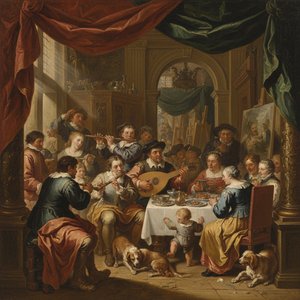
Jacob Jordaens' "The King Drinks," painted in 1640, isn’t merely a depiction of a feast; it’s a vibrant explosion of Baroque energy captured on canvas. This monumental oil painting, now residing within the Oldmasters Museum in Brussels, transports the viewer directly into the heart of a Twelfth Night celebration – a boisterous gathering steeped in tradition and overflowing with life. Jordaens, a key figure in the Antwerp School, masterfully employs his signature style to create an immersive scene that pulsates with movement, color, and a palpable sense of joyous excess.

The painting’s core is dominated by its dynamic composition – a carefully orchestrated chaos of figures engaged in a multitude of activities. Diagonal lines, created through the arrangement of tables laden with food, overflowing goblets, and the bodies of revelers, propel the eye across the canvas, drawing us into the swirling heart of the celebration. Jordaens’s masterful use of perspective flattens the space, lending an immediate and overwhelming sense of participation. The scene feels less like a distant observation and more like being thrust directly into the midst of the merriment – a truly immersive experience.

The Ritual of Twelfth Night: Symbolism in Excess

“The King Drinks” is deeply rooted in the traditions surrounding Twelfth Night, a pivotal event in the medieval calendar. This celebration marked the end of the old year and the beginning of the new, often involving elaborate feasts, games, and symbolic rituals. The central figure, crowned and holding a goblet high, embodies the role of the “Bean King” – a temporary ruler chosen to preside over the festivities. The abundance of food and drink—roast meats, overflowing platters, and goblets brimming with wine—is not simply decorative; it’s a potent symbol of prosperity, indulgence, and the shedding of old ways. The scattered beans themselves, remnants of the celebratory meal, represent the guiding star that led the Magi to the infant Jesus – a reminder of the religious significance underlying the secular revelry.

A Masterclass in Baroque Technique

Jordaens’s skill as a painter is immediately evident in his meticulous attention to detail and his masterful command of light and shadow. The figures are rendered with remarkable realism, each face capturing a distinct expression of delight, drunkenness, or mischievousness. Notice the subtle variations in texture – the rough weave of fabrics, the glistening sheen of wine, the smooth skin tones of the characters. Jordaens employs a dramatic chiaroscuro technique, utilizing strong contrasts between light and dark to heighten the sense of drama and create a palpable atmosphere of excitement. The brushstrokes are visible yet blended seamlessly, contributing to the painting’s rich texture and vibrant color palette.

A Window into 17th-Century Flemish Life

“The King Drinks” offers a fascinating glimpse into the social customs and values of 17th-century Flanders. The scene depicts a gathering that transcends mere entertainment; it's a celebration of community, tradition, and the release of pent-up energy. The inclusion of children amidst the revelry underscores the importance of family and the acceptance of boisterous behavior as part of the festive spirit. Jordaens’s work reflects a society where pleasure was not merely tolerated but actively embraced – a testament to the vibrant cultural landscape of Antwerp during his time. It's a painting that invites us to step back in time and experience, vicariously, the joyous chaos of a Twelfth Night celebration.

Questions & Answers

What level of contrast does "The King Drinks" by Jacob Jordaens show?

The light-dark contrast of "The King Drinks" is recorded as statement. Contrast describes how strongly light and dark areas differ.

Is "The King Drinks" typical of what Jacob Jordaens usually created?

"The King Drinks" depicts feast, revelry, royalty, baroque, celebration, drinking, excess, dutch art, while Jacob Jordaens's recorded themes are rubens' influence, dynamic composition, flemish extravagance, opulent scenes, baroque drama, theatrical display, moral excess, indulgence critique. Comparing the two shows how the work relates to the artist's usual subjects.

Where in Jacob Jordaens's career does "The King Drinks" fall, given its date?

"The King Drinks", created in 1638, belongs to the Mature Period of Jacob Jordaens's career.

More about this painting

Preview AR preview Switch to Print Switch to Digital Image Send
Details Guide Add to favorites Download Similars X-Ray Diaporama Q&A Stats

In numbers

  • 1638the year it was painted
  • 29frames to choose from
  • standard sizes, in its own proportions
  • 5weeks to paint and deliver it
Jacob Jordaens

Jacob Jordaens

1593 - 1678, Belgium

Quick facts about Jacob Jordaens

  • Full Name: Jacob Jordaens
  • Nationality: Flemish
  • Date Of Birth: 1593
  • Date Of Death: 1678
  • Place Of Birth: Antwerp, Belgium
  • Notable Artworks:
    • The Adoration of the Shepherds
    • Argus and Mercury
  • Artistic Movement Or Style: Baroque
  • Artists Who Influenced This Artist:
    • Jacopo Bassano
    • Paolo Veronese
    • Caravaggio
  • Artists Or Movements Influenced By This Artist: ['Jan Steen']

Artist Biography

A Flemish Master of Life’s Abundance: Jacob Jordaens

Born into a prosperous Antwerp family in 1593, Jacob Jordaens emerged as one of the most significant and vibrant voices within the Flemish Baroque. Unlike many of his contemporaries who sought training in Italy, Jordaens remained rooted in his native Flanders, developing a uniquely robust and earthy style that celebrated the pleasures and realities of everyday life. His father, a successful linen merchant, provided him with a comfortable upbringing, allowing for an education befitting his social standing before he began his artistic journey under Adam van Noort – also the master of Peter Paul Rubens. This formative training instilled in Jordaens a foundation in meticulous technique and a keen understanding of composition, yet he quickly diverged to forge his own distinct path. In 1616, solidifying his connection to the established Antwerp art world, he married Van Noort’s daughter, Katharina.

The Painter of Peasant Revelry and Baroque Grandeur

Jordaens' artistic output was remarkably diverse, encompassing religious narratives, mythological scenes, allegorical compositions, genre paintings brimming with life, and even portraits. However, he is perhaps best remembered for his boisterous depictions of peasant festivals and tavern scenes – works that radiate a palpable energy and an uninhibited joy in earthly pleasures. Paintings like *The King Drinks* (also known as the Feast of the Bean King) exemplify this characteristic style: crowded compositions filled with robust figures engaged in lively revelry, rendered in warm, glowing colors and dramatic chiaroscuro. These scenes weren’t merely celebrations of merriment; they were often imbued with subtle moralizing undertones, reflecting the complex relationship between indulgence and restraint prevalent in 17th-century society. Yet, Jordaens was equally adept at handling grander, more formal commissions. His involvement in decorating the Huis ten Bosch palace near The Hague – alongside collaborations with Rubens – showcased his ability to create monumental allegorical works that seamlessly integrated painting and architecture.

Influences and a Distinct Artistic Voice

While Jordaens never traveled to Italy, he was deeply influenced by Italian masters like Jacopo Bassano, Paolo Veronese, and Caravaggio—artists whose work reached Flanders through engravings and paintings brought back by other artists. The influence of Caravaggio is particularly evident in his dramatic use of light and shadow, a technique known as tenebrism, which heightens the emotional intensity of his scenes. However, Jordaens didn’t simply imitate these influences; he synthesized them with his own Flemish sensibilities, creating a style that was uniquely his own. He differed from Rubens and Van Dyck in his preference for realism over idealism, embracing a more direct and unrefined approach to depicting the human form. His figures are often substantial, even corpulent, their faces flushed with health and vitality. This commitment to naturalism, combined with his masterful command of color and composition, set him apart from his contemporaries and established him as a leading figure in Flemish Baroque painting.

Legacy and Enduring Impact

Throughout his long and prolific career, Jordaens trained numerous pupils – fifteen were officially recorded by the Guild of St. Luke between 1621 and 1667— ensuring the continuation of his artistic legacy. His influence can be seen in the work of later artists like Jan Steen, who shared his penchant for depicting lively genre scenes. Beyond his direct impact on other painters, Jordaens’ classically inspired peasant themes had a lasting effect on the art world, challenging traditional hierarchies and celebrating the dignity of everyday life. Even today, his paintings continue to captivate audiences with their energy, vitality, and honest portrayal of human experience. His ability to blend realism with allegory, sensuality with morality, and grandeur with intimacy makes him one of the most compelling and enduring figures of the Baroque period. Discover more of Jordaens’ masterpieces and explore the rich artistic landscape of the Baroque era through resources available online, including detailed databases of his works and insightful analyses of his life and art.

Quick Facts

  • Location: Oldmasters Museum, Brussels
  • Title: The King Drinks
  • Artist: Jacob Jordaens
  • Notable elements: Chaotic scene, feast
  • Movement: Flemish Baroque

Art Quiz

There is only one correct answer for each question.

Question 1:
What is the primary subject depicted in Jacob Jordaens’ ‘The King Drinks’?
Question 2:
The painting ‘The King Drinks’ is an example of which artistic movement?
Question 3:
According to the image description, what is a prominent characteristic of the composition in ‘The King Drinks’?
Question 4:
In what year was ‘The King Drinks’ painted?
Question 5:
What does the 'bean king' symbolize in the context of the painting?