Preview
 Send
Send Share
Share
 Details
 Guide
Guide

 Download
 Similars
 X-Ray
X-Ray Diaporama
 Stats
StatsWheat Fields
 Acrylic On Canvas
- WallArt
- Dutch Golden Age Landscape
 1670
1670 100.0 x 130.0 cm
 Metropolitan Museum of Art
 Read More
Giclée / Art Print
Museum-quality giclée or canvas print with fast production and flexible finish options. ( Buy Hand Made Painting Switch to Digital Image)




P118B $10

P118H $10

P118W $10

P438Z $10

P508JH $12

P508YH $12

P805H $10

P805Z $10

P919BZ $10

P919G $10

P919XJ $10

P959ZH $10

P968JZ $12

W106C $8

W218G $10

W218JH $8

W218Y $10

W307PJ $10

W316G $10

W316PJ $8

W316Y $10

W398PJ $8

W4111J $10

W500HY $15

W500JH $15

W692G $12

W849H $8

W940BG $15

W953PJ $8




Pick from our preset sizes that match the artwork's original proportions.

You may enter your own dimensions to fit a specific frame or space. If your selected size does not match the original image's proportions, we will either crop the artwork or extend the image with a mirrored or solid-fill edge. A digital mockup will be sent for your approval before production begins.
Please note that the on-screen preview does not reflect the actual cropping or extension. Only the mockup will accurately show the final composition.
While custom sizes are available, we recommend selecting a dimension from the predefined list to preserve the original proportions.
Worldwide Delivery () in 2 weeks instead of standard 4/5 weeks. (26 September)

Free Worldwide Express Shipping

High-Quality Linen Canvas

Full Shipping Insurance

Customs Tax Refund Guarantee

True Color Matching Guarantee

100-Day Return Policy (Defects Only)

100% Money-Back Guarantee

Bulk Discount Offer
 Glass option is only available in size under 110 CM

Wheat Fields
Giclée / Art Print
Reproduction Size
-


Total Price
$ 81
Jacob van Ruisdael’s “Wheat Fields”: A Symphony of Light and Landscape
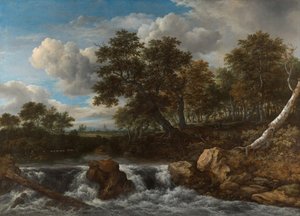
“Wheat Fields,” painted circa 1670 by Jacob Jansz van Ruisdael, stands as arguably the most arresting depiction of Dutch pastoralism from the Golden Age. More than just a scenic vista, it's a masterful orchestration of atmospheric perspective and compositional dynamism—a painting that continues to resonate with viewers centuries later. Examining its intricacies reveals not only Van Ruisdael’s technical prowess but also his profound understanding of conveying emotion through visual language.A Masterclass in Atmospheric Perspective
Van Ruisdael's signature style is characterized by a deliberate flattening of depth, achieved through subtle gradations of color and tonal variation. The distant wheat field recedes into hazy blues and greens—a technique known as atmospheric perspective—creating an illusion of vastness and conveying the serenity of rural life. Unlike many contemporaries who prioritized detailed realism, Ruisdael prioritized capturing the essence of a landscape rather than meticulously recreating every blade of grass. This approach aligns perfectly with the prevailing philosophical currents of the time, where contemplation and reflection on nature held considerable sway. The artist skillfully uses light—particularly diffused sunlight filtering through clouds—to sculpt the forms of the field and its inhabitants, imbuing the scene with an ethereal quality.Compositional Drama: Figures Amidst Vastness
The inclusion of two figures—a man carrying a bag and a woman accompanied by a child—adds a crucial element of narrative complexity to the landscape. Their placement at the forefront draws the eye inward, anchoring the viewer’s gaze amidst the expansive expanse of wheat and sky. The figures aren't merely decorative additions; they serve as symbols of human presence within the natural world, prompting contemplation about our relationship with the environment. Furthermore, Van Ruisdael employs a dynamic diagonal line that bisects the canvas, guiding the eye across the scene and enhancing its visual impact. This compositional device contributes to the painting’s dramatic tension—the subtle interplay between light and shadow emphasizing the contours of the landscape and the figures alike.Symbolism Rooted in Dutch Identity
“Wheat Fields” embodies the spirit of the Dutch Golden Age, reflecting a fascination with idealized representations of national identity. The wheat field itself symbolizes fertility and prosperity—themes central to Dutch agricultural traditions and economic success during this period. The inclusion of livestock reinforces these associations, grounding the scene in tangible realities while simultaneously elevating it to a realm of symbolic significance. Van Ruisdael’s depiction of the sky—dominated by swirling clouds illuminated by sunlight—suggests both beauty and vulnerability—a motif that resonates with broader anxieties about the unpredictable forces of nature.Emotional Resonance: Tranquility and Reflection
Ultimately, “Wheat Fields” succeeds in evoking a profound sense of tranquility and contemplation. The muted palette—primarily blues, greens, and browns—creates an atmosphere of calm repose, inviting viewers to immerse themselves in the stillness of the countryside. Yet, beneath this surface serenity lies a subtle undercurrent of drama—the interplay of light and shadow hinting at hidden complexities. As Gavin Finney eloquently describes it, Ruisdael “picks the moment you’d want to press the shutter on a camera,” capturing not just what is seen but also what is felt—a testament to Van Ruisdael's ability to transform visual observation into emotionally resonant art.- Artist: Jacob Jansz van Ruisdael
- Date: Circa 1670
- Medium: Oil on Canvas
- Dimensions: 39 3/8 x 51 1/4 in. (100 x 130.2 cm)
Artist Biography
early life and career
jacob isaackszoon van ruisdael, a prominent dutch painter, draughtsman, and etcher, was born in 1628 in the netherlands. he is widely regarded as the pre-eminent landscape painter of the dutch golden age, a period marked by great wealth and cultural achievement.
artistic style and contributions
van ruisdael's work is characterized by its versatility and prolific nature, depicting a wide variety of landscape subjects. from 1646, he painted remarkable dutch countryside scenes, which later took on a more heroic character after his trip to germany in 1650. his late work, produced while living and working in amsterdam, featured city panoramas and seascapes, often with the sky occupying two-thirds of the canvas.
- waterfall in a rocky and mountainous landscape, showcasing his mastery of light and composition.
- view of haarlem with bleaching grounds, exemplifying his ability to capture the essence of the dutch landscape.
- view of the dam and the damrak in amsterdam, highlighting his skill in cityscape painting.
museums and collections
van ruisdael's work is spread across private and institutional collections worldwide, with notable holdings at:
- the national gallery in london
- the rijksmuseum in amsterdam
- the hermitage museum in st. petersburg
influence and legacy
van ruisdael's influence on landscape painting traditions is profound, shaping the english romantics, the barbizon school in france, and the hudson river school in the us. he also inspired generations of dutch landscape artists. notable works:
- view of haarlem with bleaching grounds
- waterfall in a rocky and mountainous landscape
- view of the dam and the damrak in amsterdam
artist's profile on OriginalUniqueArt: jacob isaackszoon van ruisdael

jacob isaackszoon van ruisdael
1628 - 1682 , Netherlands
Quick Facts
- Artistic Movement Or Style: Dutch Golden Age, Baroque
- Artists Or Movements Influenced By This Artist:
- English Romantics
- Barbizon School
- Artists Who Influenced This Artist: ['Hendrick Vroom']
- Date Of Birth: 1628/1629, Haarlem
- Date Of Death: 1682, Amsterdam
- Full Name: Jacob Isaackszoon van Ruisdael
- Nationality: Dutch
- Notable Artworks:
- View of Haarlem
- Waterfall landscape
- Amsterdam cityscape
- Place Of Birth: Haarlem, Netherlands
Related Articles

Golden Light & Dutch Skies: Bringing the Magic of Dutch Golden Age Landscapes into Your Home
Transform your home with the breathtaking light of Dutch Golden Age landscapes. Discover how hand-painted oil reproductions of masterworks like Ruisdael and Vermeer bring timeless elegance, atmosphere, and soulful texture to modern interiors. Elevate your space with museum-quality art.
Jacob van Ruisdael: Master of Dutch Landscape & the Evocation of National Identity
Explore the life & work of Jacob van Ruisdael, the preeminent Dutch landscape painter. Discover his technical brilliance, symbolic depth, and lasting influence on art history. Learn about collecting Ruisdael's masterpieces.

Dutch Masters: 10 Golden Age Paintings That Still Inspire |
Journey into the Dutch Golden Age! Explore 10 iconic paintings by Rembrandt, Vermeer & Hals. Discover the stories behind these Baroque masterpieces and find museum-quality art reproductions to elevate your home decor on .

Rembrandt's Masterpieces: Explore 25 Iconic Paintings & Prints | OriginalUniqueArt
Journey through Rembrandt van Rijn's 25 most iconic paintings & etchings. Explore Dutch Golden Age masterpieces, dramatic chiaroscuro, and timeless portraits. Find museum-quality art reproductions to elevate your home decor on OriginalUniqueArt.com.

Golden Light & Dutch Skies: The Timeless Magic of Dutch Golden Age Landscapes
Discover the breathtaking beauty of Dutch Golden Age landscapes. Explore the mastery of light, chiaroscuro, and 17th-century realism through an expert art history lens, celebrating the enduring legacy of the Dutch Masters for discerning collectors and art lovers.