Preview
 Send
Send Share
Share
 Details
 Guide
Guide

 Download
 Similars
 X-Ray
X-Ray Diaporama
 Q&A
Q&A Stats
StatsThe Breakwater

- 110.0 x 160.0 cm


 Read More
Giclée / Art Print
Museum-quality giclée or canvas print with fast production and flexible finish options. ( Buy Hand Made Painting Switch to Digital Image)




P118B $10

P118H $10

P118W $10

P438Z $10

P508JH $12

P508YH $12

P805H $10

P805Z $10

P919BZ $10

P919G $10

P919XJ $10

P959ZH $10

P968JZ $12

W106C $8

W218G $10

W218JH $8

W218Y $10

W307PJ $10

W316G $10

W316PJ $8

W316Y $10

W398PJ $8

W4111J $10

W500HY $15

W500JH $15

W692G $12

W849H $8

W940BG $15

W953PJ $8




Pick from our preset sizes that match the artwork's original proportions.

Type the width and the height you need, to fit your frame or your wall. A print can only be cut, never made bigger than the picture, so a size with a different shape loses a part of the image. We send you a digital mockup to approve before we print anything. The picture shown on this page does not show the real cut — only the mockup does.
Worldwide Delivery () in 2 weeks instead of standard 4/5 weeks. (3 November)

Free Worldwide Express Shipping

High-Quality Linen Canvas

Full Shipping Insurance

Customs Tax Refund Guarantee

True Color Matching Guarantee

100-Day Return Policy (Defects Only)

100% Money-Back Guarantee

Bulk Discount Offer
 Glass option is only available in size under 110 CM

The Breakwater
Giclée / Art Print
Reproduction Size
-


Total Price
$ 81
A Tempestuous Vision: The Raw Power of Ruisdael’s Coastline
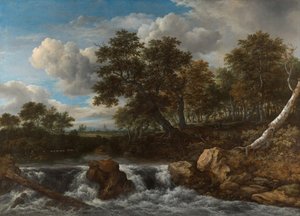
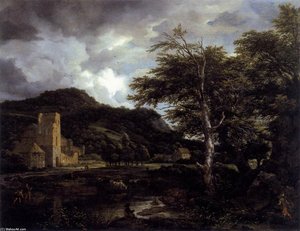
In the grand tapestry of the Dutch Golden Age, few works command the viewer's attention with such visceral intensity as Jacob Isaackszoon van Ruisdael’s 1670 masterpiece, The Breakwater. This is not merely a depiction of a coastal landscape; it is a profound meditation on the struggle between human industry and the indomitable forces of nature. As one gazes upon this monumental canvas, currently preserved in the hallowed halls of the Musée du Louvre, there is an immediate sense of being present at the edge of a world under siege. The scene is dominated by a turbulent seascape, where dark, brooding clouds gather like a heavy shroud over the horizon, signaling the arrival of an impending storm. Through his masterful command of light and shadow, Ruisdael captures that breathless moment of tension before the gale breaks, inviting the observer to feel the dampness of the salt spray and the weight of the heavy, moisture-laden air.
The composition is a brilliant study in movement and stability. In the foreground, a rugged shoreline, strewn with weathered boulders, provides a tactile anchor for the eye. Here, several moored boats rest against the encroaching tide, their sails furlected tight to withstand the rising winds. These vessels serve as poignant symbols of the industrious spirit of Haarlem—Ruisdael’s own birthplace—representing the maritime commerce that fueled the prosperity of the Netherlands, even when faced with the perilous whims of the North Sea. At the heart of this drama stands the breakwater itself, a formidable man-made barrier of heavy stones. It acts as both a physical and metaphorical shield, standing in stark, textured contrast to the fluid, swirling dynamism of the ocean waves that crash against its flanks.
Mastery of Atmosphere and the Golden Age Legacy
Technically, The Breakwater is a triumph of atmosfearische perspectief, or atmospheric perspective. Ruisdael was a pioneer in using layers of thinly applied oil paint to manipulate the viewer's perception of depth and distance. By subtly blending colors into hazy blues, muted greys, and deep charcoals as the eye moves toward the horizon, he creates an illusion of vast, infinite space. This technique does more than provide realism; it enhances the emotional weight of the painting, making the distant sea feel both immense and unreachable. The meticulous rendering of textures—from the rough, pitted surface of the rocks to the shimmering, agitated surface of the water—demonstrates a level of skill that remains breathtaking even centuries later.
For the discerning collector or interior designer, this painting offers much more than aesthetic beauty; it provides a focal point of profound character. The dramatic interplay of light and shadow makes it an ideal centerpiece for spaces that require a sense of drama, depth, and historical gravity. Whether placed in a contemporary gallery-style room or a classic study, a high-quality reproduction of this work brings with it the prestige of the Dutch Golden Age. It is a piece that invites contemplation, sparking conversations about resilience, the passage of time, and our enduring relationship with the natural world. To own such an image is to possess a window into a period of unparalleled artistic achievement, capturing a moment where the beauty of the landscape meets the sublime terror of the storm.
Questions & Answers
What is the art-historical place of "The Breakwater" by Jacob Isaackszoon Van Ruisdael?
"The Breakwater" by Jacob Isaackszoon Van Ruisdael belongs to the Dutch Golden Age Landscape movement, within the Early-Modern period. Together they give the work its place in art history.
Is there a guide for "The Breakwater" by Jacob Isaackszoon Van Ruisdael?
The Guide page of "The Breakwater" by Jacob Isaackszoon Van Ruisdael offers a printable two-sheet factsheet: the artwork with its identity table, a decade band placing it in the artist's lifetime, other works by the artist, the measured color palette, and ready-to-copy citations in four styles.
Does "The Breakwater" have an augmented reality preview?
The AR Preview page of "The Breakwater" by Jacob Isaackszoon Van Ruisdael uses augmented reality to show the artwork in your own space, on a compatible device.
Artist Biography
early life and career
jacob isaackszoon van ruisdael, a prominent dutch painter, draughtsman, and etcher, was born in 1628 in the netherlands. he is widely regarded as the pre-eminent landscape painter of the dutch golden age, a period marked by great wealth and cultural achievement.
artistic style and contributions
van ruisdael's work is characterized by its versatility and prolific nature, depicting a wide variety of landscape subjects. from 1646, he painted remarkable dutch countryside scenes, which later took on a more heroic character after his trip to germany in 1650. his late work, produced while living and working in amsterdam, featured city panoramas and seascapes, often with the sky occupying two-thirds of the canvas.
- waterfall in a rocky and mountainous landscape, showcasing his mastery of light and composition.
- view of haarlem with bleaching grounds, exemplifying his ability to capture the essence of the dutch landscape.
- view of the dam and the damrak in amsterdam, highlighting his skill in cityscape painting.
museums and collections
van ruisdael's work is spread across private and institutional collections worldwide, with notable holdings at:
- the national gallery in london
- the rijksmuseum in amsterdam
- the hermitage museum in st. petersburg
influence and legacy
van ruisdael's influence on landscape painting traditions is profound, shaping the english romantics, the barbizon school in france, and the hudson river school in the us. he also inspired generations of dutch landscape artists. notable works:
- view of haarlem with bleaching grounds
- waterfall in a rocky and mountainous landscape
- view of the dam and the damrak in amsterdam
artist's profile on OriginalUniqueArt: jacob isaackszoon van ruisdael

Jacob Isaackszoon Van Ruisdael
1628 - 1682 , Netherlands
Quick Facts
- Full Name: Jacob Isaackszoon van Ruisdael
- Nationality: Dutch
- Date Of Birth: 1628
- Date Of Death: 1682
- Place Of Birth: Haarlem, Netherlands
- Notable Artworks:
- View of Haarlem
- Waterfall landscape
- Amsterdam cityscape
- Artistic Movement Or Style: Dutch Golden Age, Baroque
- Artists Who Influenced This Artist: ['Hendrick Vroom']
- Artists Or Movements Influenced By This Artist:
- English Romantics
- Barbizon School
Related Articles

Mastering Light and Shadow: The 25 Greatest Artworks by Rembrandt van Rijn
Explore Rembrandt's greatest Baroque masterpieces through light and shadow. Discover the full collection online at OriginalUniqueArt.com.

Golden Light & Dutch Skies: Bringing the Magic of Dutch Golden Age Landscapes into Your Home
Transform your home with the breathtaking light of Dutch Golden Age landscapes. Discover how hand-painted oil reproductions of masterworks like Ruisdael and Vermeer bring timeless elegance, atmosphere, and soulful texture to modern interiors. Elevate your space with museum-quality art.

Golden Light & Dutch Skies: The Timeless Magic of Dutch Golden Age Landscapes
Discover the breathtaking beauty of Dutch Golden Age landscapes. Explore the mastery of light, chiaroscuro, and 17th-century realism through an expert art history lens, celebrating the enduring legacy of the Dutch Masters for discerning collectors and art lovers.
Jacob van Ruisdael: Master of Dutch Landscape & the Evocation of National Identity
Explore the life & work of Jacob van Ruisdael, the preeminent Dutch landscape painter. Discover his technical brilliance, symbolic depth, and lasting influence on art history. Learn about collecting Ruisdael's masterpieces.

Dutch Masters: 10 Golden Age Paintings That Still Inspire |
Journey into the Dutch Golden Age! Explore 10 iconic paintings by Rembrandt, Vermeer & Hals. Discover the stories behind these Baroque masterpieces and find museum-quality art reproductions to elevate your home decor on .