Preview
 Send
Send Share
Share
 Details
 Guide
Guide

 Download
 Similars
 X-Ray
X-Ray Diaporama
 Stats
StatsTo Each His Own

 Read More
Giclée / Art Print
Museum-quality giclée or canvas print with fast production and flexible finish options. ( Buy Hand Made Painting Switch to Digital Image)




P118B $10

P118H $10

P118W $10

P438Z $10

P508JH $12

P508YH $12

P805H $10

P805Z $10

P919BZ $10

P919G $10

P919XJ $10

P959ZH $10

P968JZ $12

W106C $8

W218G $10

W218JH $8

W218Y $10

W307PJ $10

W316G $10

W316PJ $8

W316Y $10

W398PJ $8

W4111J $10

W500HY $15

W500JH $15

W692G $12

W849H $8

W940BG $15

W953PJ $8




Pick from our preset sizes that match the artwork's original proportions.

You may enter your own dimensions to fit a specific frame or space. If your selected size does not match the original image's proportions, we will either crop the artwork or extend the image with a mirrored or solid-fill edge. A digital mockup will be sent for your approval before production begins.
Please note that the on-screen preview does not reflect the actual cropping or extension. Only the mockup will accurately show the final composition.
While custom sizes are available, we recommend selecting a dimension from the predefined list to preserve the original proportions.
Worldwide Delivery () in 2 weeks instead of standard 4/5 weeks. (21 September)

Free Worldwide Express Shipping

High-Quality Linen Canvas

Full Shipping Insurance

Customs Tax Refund Guarantee

True Color Matching Guarantee

100-Day Return Policy (Defects Only)

100% Money-Back Guarantee

Bulk Discount Offer
 Glass option is only available in size under 110 CM

To Each His Own
Giclée / Art Print
Reproduction Size
-


Total Price
$ 81
A World Within a Workshop: Decoding Jacek Yerka’s “To Each His Own”
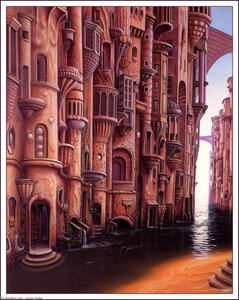
Jacek Yerka's "To Each His Own" is more than just a depiction of an elderly man in his workshop; it’s a meticulously crafted portal into a realm of memory, craftsmanship, and quiet contemplation. Born in 1952 in Toruń, Poland, Yerka has established himself as a master of surreal realism, blending the exacting detail of the Flemish masters with fantastical elements that hint at hidden narratives. This painting exemplifies his signature style – a hyperrealistic rendering of an imagined space brimming with symbolic weight.
The Art of Detail and Nostalgia
- Technical Brilliance: Yerka’s technique is immediately striking. The artwork showcases an astonishing level of detail, achieved through a layering process beginning with graphite sketches, progressing to crayon and pastel, and culminating in acrylic paint. This painstaking approach allows for the creation of textures that are almost palpable – from the worn wood of the workbench to the subtle sheen on the man’s suit.
- Flemish Influence: Yerka openly acknowledges his debt to artists like Jan van Eyck and Hugo van der Goes. Like these Renaissance masters, he employs a rich color palette dominated by warm browns, reds, and golds, creating an atmosphere of age and history. The dramatic use of light and shadow – emanating from a single overhead bulb – further enhances the three-dimensionality and intensifies the emotional impact.
- A Nostalgic Vision: Yerka’s work often evokes a sense of nostalgia, particularly for the mid-20th century. He frequently incorporates objects and aesthetics from this era into his fantastical scenes, as he states “For me, the 1950s were a kind of golden age…”. This is subtly present here in the man's attire and the overall feeling of a bygone era preserved within the workshop’s walls.
Symbolism and Emotional Resonance
- The Weight of Years: The slumped posture of the central figure, head in hand, speaks volumes about weariness, contemplation, and perhaps even regret. He is surrounded by the tools of his trade – symbols of a life dedicated to skill and labor – yet appears lost in thought, disconnected from his surroundings.
- A Cluttered Universe: The workshop itself is a powerful symbol. Its cluttered environment suggests a life filled with experiences, memories, and accumulated possessions. Each object holds a potential story, inviting the viewer to imagine the man’s past and the significance of his craft.
- Light as Metaphor: The single light source not only defines form but also serves as a metaphor for clarity amidst darkness or perhaps a fading memory struggling to remain illuminated. It draws our attention to the central figure, emphasizing his isolation and introspection.
Yerka’s Place in Contemporary Art
“To Each His Own” is representative of Yerka's unique contribution to contemporary art. While rooted in traditional techniques, his work transcends mere imitation. He creates worlds that are both familiar and fantastical, inviting viewers to explore the boundaries between reality and imagination. His paintings have been exhibited internationally and he received the World Fantasy Award for Best Artist in 1995, solidifying his reputation as a visionary artist whose work continues to captivate audiences worldwide.
Artist Biography
Jacek Yerka: A Surrealist Visionary
Early Life and Artistic Beginnings
Born in 1952 in Toruń, Poland, Jacek Yerka emerged from a deeply artistic family. Both his parents were graduates of the local Fine Art Academy, immersing him in a world of paints, inks, and brushes from an early age. This formative environment profoundly shaped his future career path. As a child, Yerka preferred solitary creative pursuits – drawing and sculpting – over outdoor play, leading to social challenges during primary school which he described as a “grey, sometimes horrifying reality.” However, his talent for sketching earned him respect in high school.
Artistic Journey and Development
Initially considering careers in astronomy or medicine, Yerka ultimately chose to pursue fine art and graphic design. During his studies at Nicolaus Copernicus University in Toruń, he resisted pressure to adopt contemporary styles, steadfastly adhering to the classic Flemish technique that defines his work. This dedication to meticulous detail and traditional methods became a hallmark of his artistic identity.
Influences and Inspirations
Yerka’s artistic vision is deeply rooted in the works of masters past. He cites Hieronymus Bosch, Pieter Bruegel, Cagliostro, Jan van Eyck, and Hugo van der Goes as key influences. These artists instilled in him a fascination with intricate detail, symbolic imagery, and fantastical narratives. Beyond art history, Yerka draws inspiration from scientific concepts and his own childhood memories.
Key Characteristics of His Work
- Surrealism: Yerka’s paintings are firmly rooted in the surrealist tradition, blending reality with dreamlike imagery.
- Flemish Technique: He employs a meticulous and detailed painting style reminiscent of the Flemish masters.
- Intricate Detail: His works are characterized by an astonishing level of detail, inviting viewers to explore hidden narratives within each composition.
- Fantastical Worlds: Yerka creates imaginative landscapes populated with bizarre creatures and extraordinary architecture.
- Scientific & Mythological Themes: He often merges scientific concepts with artistic expression and mythological references.
Notable Works and Achievements
Yerka’s portfolio includes numerous acclaimed works, such as “The Angels' Kitchen” and “Wegener's Theory.” His art has been exhibited internationally in Poland, Germany, Monaco, France, and the United States. He also collaborated with Hollywood producer Renee Daalder on designs for the science fiction film “Strawberry Fields,” further expanding his reach.
Historical Significance and Legacy
Jacek Yerka’s unique artistic vision has earned him a significant place in contemporary art. His ability to seamlessly blend the surreal, the scientific, and the mythological creates captivating works that resonate with audiences worldwide. He continues to inspire artists and captivate viewers with his meticulously crafted and imaginative paintings.
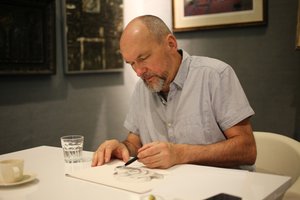
Jacek Yerka
1952 - , Poland
Quick Facts
- Birth Date: 1952
- Birth Place: Toruń, Poland
- Influenced By:
- Hieronymus Bosch
- Pieter Bruegel
- Jan van Eyck
- Hugo van der Goes
- Movement: Surrealism
- Name: Jacek Yerka
- Nationality: Polish
- Notable Works:
- The Angels' Kitchen
- Wegener's theory
Related Articles
Beyond Reality: The Dreamlike Power of Surrealist Expressionism and the Subconscious Mind
Explore the profound depths of Surrealist Expressionism. Discover how masters like Dalí used dream logic and subconscious imagery to redefine reality through emotionally resonant, museum-quality art.
Surrealist Dreamscapes: A Curated Journey Through the Subconscious Majesty of Surrealism
Embark on a sophisticated journey through Surrealist dreamscapes. Explore the profound symbolism of masters like Dalí and discover how to curate breathtaking, museum-quality surrealist art for your private collection with expert guidance.

Jacek Yerka: Surreal Visions & Nostalgia in Contemporary Polish Painting
Explore the captivating surreal worlds of Jacek Yerka, a leading Polish painter renowned for his meticulous Flemish technique & dreamlike landscapes. Discover his unique style and learn about collecting this exceptional artist's work.
Surrealist Painting Masterpieces: 10 Artworks That Redefined Reality | OriginalUniqueArt
Journey into the dreamlike world of Surrealism! Explore 10 masterpieces by Dali, Magritte & Miró that redefined art. Discover their stories & find museum-quality reproductions to elevate your home decor on OriginalUniqueArt.com.
Echoes of Time: Nostalgia, Technique & Cultural Significance in Vintage Paintings
Explore the captivating world of vintage paintings! Discover key styles, cultural significance & collecting tips from art experts at OriginalUniqueArt. Find authentic reproductions and elevate your home décor.