Text size

() ·

A painting made for you, by hand

The Shipwreck

Hand Made Oil Reproduction

Hand-painted oil on canvas in your size and frame, made to order by our artists. ( Switch to Print Switch to Digital Image)

Collectible Description

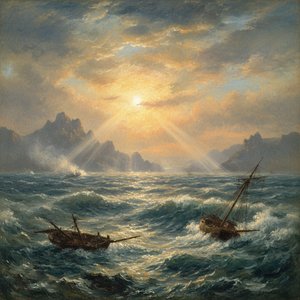
Witness the dramatic aftermath of a maritime disaster in J.M.W. Turner's 'The Shipwreck.' A powerful Romantic painting capturing chaos, vulnerability, and nature’s raw force – a masterpiece of light and atmosphere.

Artist Biography

Explore the captivating world of J.M.W. Turner (1775-1851), a pioneer of Romantic painting. Discover his expressive landscapes, turbulent seascapes & influence on Impressionism. View artworks and learn about this British master.

from ·

Chapter 1

How large should it be?

Slide to change the size; the picture on the left shows the frame at its real width. The proportions of the original are kept.

Standard
custom
CM
INCH

Pick from our preset sizes that match the artwork's original proportions.

width
height

Type the width and the height you need, to fit your frame or your wall. This is hand-painted, so for a size with a different shape the artist can paint a bit more around the picture, or cut a bit — you choose. We send you a digital mockup to approve before the painting starts. The picture shown on this page does not show the real result — only the mockup does.

Chapter 2

How should it arrive?

Choose the edges of the stretched canvas

Choose your frame

Corner sample of the WhiteWrap canvas edge finish, stretched on solid wood bars
White $1
Corner sample of the BlurSideWrap canvas edge finish, stretched on solid wood bars
Blurside $1
Corner sample of the ExtendedWrap canvas edge finish, stretched on solid wood bars
Extended $1
Corner sample of the P118B picture frame: moulded polystyrene, 5 cm wide and 3 cm thick
P118B $10
Corner sample of the P118H picture frame: moulded polystyrene, 5 cm wide and 3 cm thick
P118H $10
Corner sample of the P118W picture frame: moulded polystyrene, 5 cm wide and 3 cm thick
P118W $10
Corner sample of the P438Z picture frame: moulded polystyrene, 5.5 cm wide and 3.5 cm thick
P438Z $10
Corner sample of the P508JH picture frame: moulded polystyrene, 7 cm wide and 3.5 cm thick
P508JH $12
Corner sample of the P508YH picture frame: moulded polystyrene, 7 cm wide and 3.5 cm thick
P508YH $12
Corner sample of the P805H picture frame: moulded polystyrene, 5 cm wide and 3.5 cm thick
P805H $10
Corner sample of the P805Z picture frame: moulded polystyrene, 5 cm wide and 3.5 cm thick
P805Z $10
Corner sample of the P919BZ picture frame: moulded polystyrene, 7 cm wide and 3.5 cm thick
P919BZ $10
Corner sample of the P919G picture frame: moulded polystyrene, 7 cm wide and 3.5 cm thick
P919G $10
Corner sample of the P919XJ picture frame: moulded polystyrene, 7 cm wide and 3.5 cm thick
P919XJ $10
Corner sample of the P959ZH picture frame: moulded polystyrene, 5 cm wide and 3 cm thick
P959ZH $10
Corner sample of the P968JZ picture frame: moulded polystyrene, 6 cm wide and 4 cm thick
P968JZ $12
Corner sample of the W106C picture frame: solid wood, 5 cm wide and 3 cm thick
W106C $8
Corner sample of the W218G picture frame: solid wood, 5 cm wide and 3 cm thick
W218G $10
Corner sample of the W218JH picture frame: solid wood, 5 cm wide and 3 cm thick
W218JH $8
Corner sample of the W218Y picture frame: solid wood, 5 cm wide and 3 cm thick
W218Y $10
Corner sample of the W307PJ picture frame: solid wood, 6 cm wide and 3 cm thick
W307PJ $10
Corner sample of the W316G picture frame: solid wood, 6 cm wide and 3 cm thick
W316G $10
Corner sample of the W316PJ picture frame: solid wood, 6 cm wide and 3 cm thick
W316PJ $8
Corner sample of the W316Y picture frame: solid wood, 6 cm wide and 3 cm thick
W316Y $10
Corner sample of the W398PJ picture frame: solid wood, 5 cm wide and 3 cm thick
W398PJ $8
Corner sample of the W4111J picture frame: solid wood, 6.5 cm wide and 3.5 cm thick
W4111J $10
Corner sample of the W500HY picture frame: solid wood, 7 cm wide and 5 cm thick
W500HY $15
Corner sample of the W500JH picture frame: solid wood, 7 cm wide and 5 cm thick
W500JH $15
Corner sample of the W692G picture frame: solid wood, 8 cm wide and 4 cm thick
W692G $12
Corner sample of the W849H picture frame: solid wood, 5 cm wide and 3 cm thick
W849H $8
Corner sample of the W940BG picture frame: solid wood, 7.5 cm wide and 4.5 cm thick
W940BG $15
Corner sample of the W953PJ picture frame: solid wood, 6 cm wide and 3.5 cm thick
W953PJ $8
Corner sample of the H24-GOLD picture frame: carved wood with gesso, 10 cm wide and 6 cm thick
H24-GOLD $30
Corner sample of the H24-SILVER picture frame: carved wood with gesso, 10 cm wide and 6 cm thick
H24-SILVER $30
Corner sample of the H36-GOLD picture frame: carved wood with gesso, 15 cm wide and 6.5 cm thick
H36-GOLD $45
Corner sample of the H36-SILVER picture frame: carved wood with gesso, 15 cm wide and 6.5 cm thick
H36-SILVER $45
Frame preview
Framed

Moulding: . Overall size with the frame: .

Chapter 3

Who paints it, and should anything change?

Examples of what can be changed: Replace face with customer photo; Add pet (e.g., replace cat with dog); Include hidden message in background; Change background landscape or elements.
After order, OriginalUniqueArt.com team will email client for instructions and provide a mockup preview

Worldwide Delivery () in 3/4 weeks instead of standard 5 weeks. (2 November). No compromise on quality.

Chapter 4

The finishing touches

A nameplate, as in a museum?

Engraved Bronze Plaque Details

This elegant plaque features the artist's name and the title of the artwork, finely engraved for a timeless presentation.

It is made from bronze with a refined, elegant finish. The text is precisely laser-engraved for a sharp and permanent result. Measuring 9x2 cm, the plaque is compact yet easy to read. It's built to be durable and scratch-resistant, offering a professional, museum-quality look. Mounting is simple thanks to the included adhesive backing.

Transparent Acrylic Plaque Details

The plaque includes essential engraved details such as the artist's name, the title of the artwork, the date it was created, the type of media used-like oil on canvas or watercolor-a brief description of the piece, and a QR code that links to the complete artwork information.

It is crafted from clear acrylic, offering a sleek, modern appearance. The text is UV-engraved in black to ensure strong visual contrast. With a size of 10x15 cm, it ensures optimal readability. It comes equipped with two metal hooks for secure wall mounting. The plaque is designed to be weather-resistant, making it suitable for various environments, and it includes interactive features that work seamlessly with smartphone scanning.

Black Acrylic Plaque Details

This elegant plaque includes engraved information such as the artist's name, the title of the artwork, the date it was created, the type of media used (like oil on canvas or watercolor), a short description of the artwork, and a QR code for quick access to more information.

The plaque itself is made from refined black acrylic with a premium finish. The text is laser-engraved in white for high contrast and readability. Its size is 10x15 cm, designed to be easy to read. It comes with two metal hooks for professional mounting. The design is sleek and fits any interior style. It is also weather-resistant and durable, with built-in digital integration for mobile compatibility.

A protective varnish?

When do you need it?

Chapter 5

Your painting, as you ordered it

The Shipwreck

Reproduction Medium

Reproduction Size

-

Elite Senior Artist

More detail, finesse, and extra production time

-

Reproduction Frame

-

-

For artworks or reproductions larger than 105 cm (approximately 41 inches) on any side, the frame will be shipped as a kit, disassembled. This method ensures safe delivery and prevents damage during transport.

Professional assembly required - this is not a DIY product.
The kit must be assembled and the canvas stretched by an experienced professional framer, using wood glue (not supplied), a canvas stretching plier and clamps to hold the bars square while the glue dries. Incorrect assembly or uneven canvas tension can permanently damage the artwork and is not covered by our warranty.

  • All solid wood bars are included, precisely cut to size.

  • Assembled with the screws provided, plus wood glue for the corner joints, which is not supplied and must be sourced by your framer.

  • Professional tools are required and not included: a canvas stretching plier (tensioner) and clamps to hold the bars square while the glue dries.

Important:
The corner joints require wood glue, the bars must be held with clamps until the glue is fully dry, and tightening the canvas on the assembled frame requires a canvas stretching plier. None of these are included in the kit. Please arrange an experienced professional framer before ordering this size.

Nameplate

-

-

Protective Varnish

Glossy Varnish (enhances colors, protects against light/moisture)

-

Customize My Artwork

Examples of what can be changed: Replace face with customer photo; Add pet (e.g., replace cat with dog); Include hidden message in background; Change background landscape or elements.

-

Urgent

Worldwide Delivery () in 3/4 weeks instead of standard 5 weeks. (2 November). No compromise on quality.

-

Express Shipping

Worldwide Delivery () in 5 weeks. (9 November).

Included

Total Price

$ 650

Total Price $ 650

Glass option is only available in size under 110 CM

Included with every order

  • Free Worldwide Express Shipping
  • High-Quality Linen Canvas
  • Full Shipping Insurance
  • Customs Tax Refund Guarantee
  • True Color Matching Guarantee
  • 100-Day Return Policy (Defects Only)
  • 100% Money-Back Guarantee
  • Bulk Discount Offer

A Tempestuous Vision: J.M.W. Turner’s “The Shipwreck”

J.M.W. Turner's "The Shipwreck," painted in 1805, isn’t merely a depiction of maritime disaster; it’s a visceral embodiment of Romanticism’s fascination with the sublime—the awe-inspiring and potentially terrifying power of nature. This dramatic seascape captures a moment of profound chaos and vulnerability, drawing the viewer into a swirling vortex of turbulent waves, bruised skies, and desperate figures clinging to fragments of shattered vessels. Turner, a lifelong devotee of the sea, wasn't interested in literal accuracy; instead, he sought to convey an emotional response—the primal fear and humbling respect evoked by confronting forces far greater than ourselves.

The painting’s genesis is often linked to the tragic sinking of the Earl of Abergavenny off the coast of Weymouth. While speculation persists about a direct connection, Turner's genius lies in transforming this specific event into a universal allegory for human fragility against the relentless power of the elements. The composition immediately commands attention with its dynamic arrangement: a chaotic cluster of boats—some capsized, others desperately battling the waves—forms the central focus, while a vast, ominous sky dominates the upper half of the canvas. The horizon line is deliberately obscured by swirling clouds and mist, creating an unsettling sense of disorientation and emphasizing the immense scale of the ocean.

Masterful Technique: Light, Color, and Texture

Turner’s signature technique—a masterful manipulation of light and color—is on full display in “The Shipwreck.” He employs loose, expressive brushstrokes to capture the movement of water with breathtaking dynamism. Thick impasto is strategically applied to represent the crests of the waves, lending them a tangible physicality that seems to surge towards the viewer. The palette is predominantly dark and muted – shades of grey, brown, and black—creating a mood of foreboding and despair. However, flashes of yellow and orange punctuate the gloom, particularly within the churning waves and the clothing of the figures, offering brief moments of intense visual drama and hinting at the destructive potential of the storm.

Crucially, Turner wasn’t simply replicating what he saw; he was translating his *experience* of the sea onto canvas. He utilized a technique known as ‘atmospheric perspective,’ subtly lightening and desaturating distant elements to create an illusion of depth and distance. This layering of color and texture contributes significantly to the painting's overall sense of vastness and instability, mirroring the psychological impact of confronting such overwhelming forces.

Symbolism and Emotional Resonance

Beyond its technical brilliance, “The Shipwreck” is rich in symbolic meaning. The scattered ships represent not just a specific maritime disaster but also the precariousness of human existence. The struggling figures embody our vulnerability in the face of nature’s indifference—a poignant reminder of mortality and the limits of control. The tempestuous sea itself functions as a metaphor for the unpredictable forces that shape our lives, capable of both destruction and renewal.

Furthermore, the painting taps into the Romantic concept of the ‘sublime,’ a feeling of awe mixed with terror experienced when confronted with something overwhelmingly powerful. Turner’s depiction isn't intended to offer comfort or reassurance; rather, it compels us to confront our own insignificance within the grand scheme of nature and to appreciate its untamed beauty—and inherent danger.

A Legacy of Atmospheric Impressionism

“The Shipwreck” stands as a pivotal work in Turner’s oeuvre and a cornerstone of Romantic art. Its innovative use of light, color, and brushwork profoundly influenced subsequent generations of artists, particularly those associated with Impressionism. Turner's willingness to prioritize emotional expression over precise representation paved the way for a more subjective and evocative approach to landscape painting. Reproductions of this powerful image continue to resonate today, offering a timeless meditation on humanity’s relationship with the natural world—a reminder that even in the face of overwhelming adversity, there is an undeniable beauty to be found.

Questions & Answers

From which era does "The Shipwreck" date?

"The Shipwreck" by J.M.W. Turner dates from the 19th-Century period. The period gives the historical context of the work.

What underlying hue runs through "The Shipwreck" by J.M.W. Turner?

"The Shipwreck" leans toward a green to violet spectrum tone.

Is "The Shipwreck" free of copyright?

"The Shipwreck" by J.M.W. Turner is in the public domain - its copyright has expired. This status governs how the image of the work may be reproduced.

More about this painting

Preview AR preview Switch to Print Switch to Digital Image Send
Details Guide Add to favorites Download Similars X-Ray Diaporama Q&A Stats

In numbers

  • 1805the year it was painted
  • 29frames to choose from
  • standard sizes, in its own proportions
  • 5weeks to paint and deliver it
J.M.W. Turner

J.M.W. Turner

1775 - 1851, United Kingdom

Quick facts about J.M.W. Turner

  • Full Name: Joseph Mallord William Turner
  • Nationality: British
  • Date Of Birth: 1775
  • Date Of Death: 1851
  • Place Of Birth: Maiden Lane, United Kingdom
  • Notable Artworks:
    • Fort Vimieux
    • Scene in the Campagna
  • Artistic Movement Or Style: Romanticism
  • Artists Who Influenced This Artist:
    • John Robert Cozens
    • Richard Wilson
  • Artists Or Movements Influenced By This Artist:
    • Impressionism
    • Abstract Art

Artist Biography

A Life Painted in Light: The World of J.M.W. Turner

Joseph Mallord William Turner, known to the world as J.M.W. Turner, was more than just a painter; he was a visionary who redefined landscape art and paved the way for modern abstraction. Born in Maiden Lane, Covent Garden, London, in 1775, his beginnings were humble – the son of a barber and wig maker. Yet, even as a child, a remarkable talent blossomed within him. By age fourteen, he was enrolled at the Royal Academy, exhibiting his first work just a year later. This early promise wasn’t merely technical skill; it hinted at an innate understanding of light, color, and atmosphere that would become the hallmarks of his extraordinary career. He supplemented his artistic education with practical experience as an architectural draftsman, honing his perspective and compositional abilities – skills that would prove invaluable in rendering both detailed topographical views and vast, emotive landscapes. Turner’s early life was marked by a dedication to his craft, fueled by a natural aptitude and a relentless pursuit of artistic excellence.

The Romantic Tempest: Style and Influences

Turner emerged during the height of the Romantic era, but he wasn't simply a follower of its conventions. He absorbed influences from various sources – the Dutch masters like Claude Lorrain and Aelbert Cuyp for their luminous landscapes, and artists such as Richard Wilson for his poetic approach to nature. However, Turner didn’t merely imitate; he synthesized these influences into something entirely new. His work is characterized by an expressive use of color, often employing bold contrasts and vibrant hues to convey emotion and atmosphere. He was fascinated by the power and drama of nature – turbulent seascapes, fiery sunsets, and swirling storms became recurring motifs in his paintings. He wasn’t interested in simply depicting what he saw; he sought to capture the *feeling* of a place, the sublime awe inspired by the natural world. This pursuit led him to experiment with increasingly loose brushwork, dissolving forms into washes of color and light – techniques that would anticipate the Impressionist movement decades later. From 1840, his work gained significant recognition thanks to the championing of John Ruskin, who elevated landscape painting to a new level of critical acclaim.

A Prolific Legacy: The Scope of Turner’s Output

The sheer volume of Turner's artistic output is astonishing. He created over 550 oil paintings, nearly 2,000 watercolors, and an astounding 30,000 works on paper. This prolificacy wasn’t simply a matter of quantity; it reflected his tireless exploration of different subjects, techniques, and styles. His paintings range from detailed topographical views of British landscapes to dramatic historical scenes and evocative maritime paintings. He was equally adept at capturing the tranquility of a pastoral scene and the terrifying power of a raging storm. Works like “Fort Vimieux” exemplify his mastery of depicting atmospheric effects – the swirling clouds, the crashing waves, and the intense light all contribute to a sense of drama and sublime beauty. Similarly, "Scene in the Campagna" showcases his ability to capture the warmth and serenity of the Italian countryside with delicate brushwork and luminous colors. Beyond painting, Turner was also a skilled printmaker, further disseminating his artistic vision through engravings and lithographs.

Eccentricity and Remembrance: The Man Behind the Masterpieces

Turner’s personal life was as complex and enigmatic as his art. He remained intensely private and reclusive, often shunning social gatherings and preferring the solitude of his studio or the open road. He fathered two daughters, Evelina and Georgiana, with Sarah Danby, the wife of a fellow artist, but maintained a distant relationship with them. His later years were marked by increasing eccentricity and declining health. After his father’s death in 1829, he became increasingly morose and withdrawn, living in squalor and neglecting his appearance. He adopted the pseudonym “Mr. Booth” to avoid recognition and even rowed his boat into the Thames during a census to remain untraceable. Despite his eccentricities, or perhaps because of them, Turner remains one of Britain’s most beloved artists. His final years were spent in Chelsea where he passed away on December 19, 1851, at the age of 76. In a fitting tribute to his enduring legacy, he is buried in St Paul's Cathedral, alongside other British luminaries – a testament to his profound impact on art and culture. His work continues to inspire artists and captivate audiences worldwide, ensuring that the light of J.M.W. Turner will continue to shine for generations to come.

Quick Facts

  • Artist: J.M.W. Turner
  • Artistic style: Loose brushwork, atmospheric
  • Medium: Oil on canvas
  • Title: The Shipwreck
  • Subject or theme: Maritime disaster
  • Movement: Romanticism

Art Quiz

There is only one correct answer for each question.

Question 1:
What is the primary theme depicted in J.M.W. Turner’s ‘The Shipwreck’?
Question 2:
In ‘The Shipwreck’, what artistic technique is prominently used to convey the movement of water?
Question 3:
The painting ‘The Shipwreck’ is considered a prime example of which artistic movement?
Question 4:
Approximately when was ‘The Shipwreck’ painted by J.M.W. Turner?
Question 5:
What does the turbulent sea in ‘The Shipwreck’ primarily symbolize?