Switch to Print
 Read More







































 For artworks or reproductions larger than 105 cm (approximately 41 inches) on any side, the frame will be shipped as a kit, disassembled. This method ensures safe delivery and prevents damage during transport.


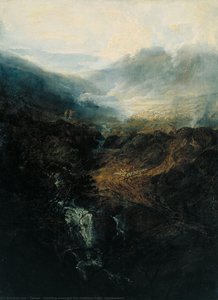
A Glimpse into the Past: The Luminous World of Jedburgh Abbey
In the delicate, translucent layers of J.M.W. Turner’s 1832 watercolor, Jedburgh Abbey, we are invited to step through a window of time into a bygone era of English history. This intimate work, measuring a mere 7 x 13 cm, captures far more than a simple topographical view; it encapsulates the very essence of atmosphere and movement. The scene unfolds around the historic silhouette of an abbey and castle, where the soft, bleeding edges of watercolor create a sense of morning mist or perhaps the hazy warmth of a summer afternoon. Turner, a master of light, uses the medium to weave a tapestry of life, where the architectural permanence of the stone structures meets the fleeting, ephemeral nature of human activity.
The composition is a masterful study in narrative depth. At first glance, one might focus on the imposing presence of the castle and its surrounding moat, but as the eye wanders through the washes of color, a lively social tapestry reveals itself. Tiny, gestural figures populate the landscape, engaged in the quiet rhythms of daily life. Horses graze and wander near the fortifications, while the subtle inclusion of an umbrella suggests a moment of respite from the elements. These small, human details prevent the painting from feeling like a cold architectural study; instead, they infuse the work with a sense of community and shared experience, transforming a historical site into a living, breathing stage.
Technique and the Mastery of Light
To behold this piece is to witness Turner’s unparalleled ability to manipulate light and shadow. As an expert in the watercolor medium, Turner employs a technique that balances precision with abstraction. The way the pigment settles into the paper allows for a luminous quality that seems to radiate from within the artwork itself. There is a rhythmic flow to his brushstrokes—some areas are defined by sharp, delicate lines that trace the contours of the masonry, while others dissolve into ethereal clouds of color. This interplay between the tangible and the atmospheric is what makes a reproduction of this piece so captivating for a modern interior; it offers a focal point that changes character depending on the light of the room.
For the discerning collector or interior designer, Jedburgh Abbey serves as an exquisite anchor for a curated space. Its small scale belies its immense emotional weight, making it an ideal choice for a gallery wall or a sophisticated study. The painting does not merely decorate a wall; it introduces a sense of historical continuity and romantic nostalgia. It evokes the "Sublime"—that quintessential Romantic era feeling of awe in the face of history and nature. Bringing a high-quality reproduction of this Turner masterpiece into a home allows one to possess a fragment of the nineteenth century, a quiet moment of beauty captured forever in light and pigment.
Questions & Answers
What feeling is "Jedburgh Abbey" associated with?
The emotional tone recorded for "Jedburgh Abbey" by J.M.W. Turner is nostalgic. It summarizes the feeling the work expresses.
Which artist is "Jedburgh Abbey" attributed to?
The artist behind "Jedburgh Abbey" is J.M.W. Turner. The work is catalogued under J.M.W. Turner's name.
Can the image of "Jedburgh Abbey" by J.M.W. Turner be freely reproduced?
The copyright answer for "Jedburgh Abbey" by J.M.W. Turner: the work is in the public domain - its copyright has expired. This determines whether reproductions of the image may be freely made.
More about this painting
 Preview
 Send
Send Share
Share
 Details
 Guide
Guide

 Download
 Similars
 X-Ray
X-Ray Diaporama
 Q&A
Q&A Stats
Stats