Send
Send Share
Share
 Details
 Guide
Guide

 Download
 Similars
 Diaporama
 Stats
StatsCement Eclipses


 Read More
The artwork displayed on this page is protected by copyright law, which means we cannot legally create or sell an identical reproduction. This protection is enforced under international agreements such as the Berne Convention and by national laws, including those outlined by the U.S. Copyright Law - Title 17.
As a respectful and legal alternative, we offer custom, hand-painted artworks inspired by the original. Our skilled and professional artists carefully study the original's style, mood, and artistic essence to create a new, unique piece that evokes the same feeling - while remaining an original creation in its own right.
This method fully complies with copyright regulations because it does not involve copying or duplicating the protected artwork. Instead, it is a creative reinterpretation - a new painting that is influenced by the original but not identical to it.
Hand Made Oil Reproduction
Hand-painted oil on canvas in your size and frame, made to order by our artists. ( Switch to Print Switch to Digital Image)




































Pick from our preset sizes that match the artwork's original proportions.

Type the width and the height you need, to fit your frame or your wall. This is hand-painted, so for a size with a different shape the artist can paint a bit more around the picture, or cut a bit — you choose. We send you a digital mockup to approve before the painting starts. The picture shown on this page does not show the real result — only the mockup does.
After order, OriginalUniqueArt.com team will email client for instructions and provide a mockup preview
Worldwide Delivery () in 3/4 weeks instead of standard 5 weeks. (22 October). No compromise on quality.

Free Worldwide Express Shipping

High-Quality Linen Canvas

Full Shipping Insurance

Customs Tax Refund Guarantee

True Color Matching Guarantee

100-Day Return Policy (Defects Only)

100% Money-Back Guarantee

Bulk Discount Offer
 Glass option is only available in size under 110 CM

Cement Eclipses
Reproduction Medium
Reproduction Size
-


Total Price
$ 300
The Miniature Echoes of Urban Solitude
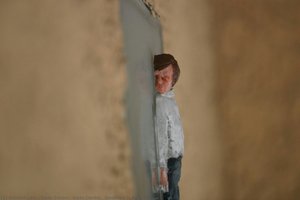
In the vast, often overwhelming expanse of the modern metropolis, there exists a profound, quiet tension between the monumental architecture of our cities and the fragile psyche of the individuals inhabiting them. Isaac Cordal’s Cement Eclipses serves as a hauntingly beautiful window into this disparity. Through his meticulous placement of small, humanoid concrete figures within the overlooked crevices of urban landscapes—gutters, cracks in pavement, and weathered walls—Cordal creates a surreal photographic diorama that demands we pause. These tiny protagonists, standing at a mere 25 centimeters, act as mirrors to our own existence, reflecting a sense of profound alienation and the quiet struggle for identity amidst the concrete giants of the twenty-first century.
The visual language of the work is one of stark, monochromatic realism blended with a dreamlike, surrealist sensibility. The choice of cement as the primary medium for the sculptures is deeply symbolic; it is a material that is both foundational to our urban world and inherently cold, unyielding, and industrial. This texture mirrors the emotional landscape Cordal seeks to explore—a landscape of isolation where the figures appear trapped by the very structures meant to house them. When captured through photography, the scale disparity becomes a powerful narrative tool, making the mundane elements of a city street feel like epic, desolate landscapes, height enough to evoke a sense of cosmic loneliness.
A Masterpiece of Contemporary Commentary
To encounter Cement Eclipses is to engage with a sophisticated critique of modern societal structures. The artist utilizes the concept of "found art" by integrating his sculptures into existing urban environments, ensuring that the context of the city becomes an inseparable part of the artwork itself. This technique blurs the line between sculpture and street art, inviting the viewer to reconsider their relationship with the spaces they traverse daily. There is a poignant irony in seeing these small, grey figures navigating the debris of civilization; they represent the vulnerability of the human spirit when faced with the relentless march of urbanization and the loss of communal connection.
For the discerning collector or interior designer, a high-quality reproduction of this work offers more than mere decoration; it provides a profound conversational centerpiece. The piece possesses an atmospheric depth that can transform a contemporary living space, adding a layer of intellectual rigor and emotional complexity to a room. Whether placed in a minimalist gallery setting or integrated into a curated domestic collection, the imagery of Cement Eclipses invites contemplation on themes of scale, presence, and the enduring human search for meaning within the shadows of the concrete jungle.
Questions & Answers
Who sells hand-painted copies of "Cement Eclipses" by Isaac Cordal?
Hand-painted copies of "Cement Eclipses" by Isaac Cordal are sold on this website: a hand-painted oil reproduction on linen canvas, ordered from its Hand-Painted Reproduction page.
What is "Cement Eclipses" about?
The themes present in "Cement Eclipses" by Isaac Cordal include urban alienation, miniature sculpture, surrealism, concrete figures, social commentary, urban isolation. Together they summarize the artwork's subject matter.
How does "Cement Eclipses" by Isaac Cordal connect Surrealism to the artist's home country?
"Cement Eclipses" was created by Isaac Cordal, born in Spain, within the Surrealism movement. The artist's origin links the work to Surrealism as practiced by artists from Spain.
Artist Biography
The Concrete Echoes of Urban Alienation
Born in the coastal landscape of Pontevedra, Spain, in 1974, Isaac Cordal has emerged as a profound voice in contemporary sculpture and photography. His artistic journey is one defined by a deep, contemplative engagement with the spaces we inhabit and the psychological weight of modern existence. Through his meticulous craftsmanship, Cordal explores the delicate tension between the individual and the overwhelming architecture of the city, creating a visual language that speaks to the universal experience of isolation.
Cordal’s formal education provided him with a robust foundation in both classical and contemporary methodologies. His studies at the University of Vigo instilled in him a mastery of sculptural form, while his time at the Camberwell College of Arts in London expanded his conceptual horizons. This duality—the ability to execute precise, physical forms while maintaining a sharp, critical eye on sociological themes—is what allows his work to transcend mere decoration and enter the realm of poignant social commentary.
The Surrealism of 'Cement Eclipses'
At the heart of Cordal’s most celebrated contributions is the series known as ‘Cement Eclipses.’ This project serves as a haunting window into the psyche of the modern worker. The series features miniature figures, approximately 15 cm in height, cast from cold, grey concrete. These figures are not mere trinkets; they are stylized representations of a middle-aged man, often clad in a suit and carrying a briefcase, trapped in a state of perpetual, weary transit.
The brilliance of Cordal’s technique lies in his use of scale and setting. By placing these heavy, concrete protagonists within the vast, indifferent landscapes of urban environments—abandoned buildings, desolate pavements, or starkly lit city corners—he creates a jarring juxtaposition. The viewer witnesses:
- A businessman slumped against a cold wall, embodying the exhaustion of late-stage capitalism.
- Figures attempting to navigate insurmountable urban obstacles, symbolizing the struggle for agency in an automated world.
- The silent, unmoving presence of the concrete man against the fleeting shadows of the city.
This interplay between the miniature and the monumental forces a reconsideration of our own vulnerability. The use of concrete is particularly symbolic; it is a material that is both foundational to our cities and inherently lifeless, mirroring the emotional numbness Cordal seeks to critique.
A Photographic Lens on Desolation
Cordal’s artistic vision extends beyond the physical sculpture into the realm of photographic exploration. He utilizes photography not merely as a way to document his sculptures, but as an essential medium to intensify the atmosphere of urban alienation. His photographic series often feature these same concrete figures placed within starkly lit, desolate cityscapes, where the lighting and composition emphasize the emptiness of the surrounding environment.
In these works, the camera acts as a witness to the disappearance of the human spirit within the machine of the metropolis. The shadows cast by his miniature subjects become characters in their own right, stretching across empty plazas to suggest a presence that is both there and not there. This seamless blend of sculpture and photography allows Cordal to build entire worlds of quiet despair and surreal beauty, inviting the observer to find meaning in the cracks of the pavement and the silence of the streets.
Through his ongoing dedication to exploring the intersection of the mundane and the surreal, Isaac Cordal has secured a significant place in the contemporary art dialogue. His work remains a vital, unsettling mirror held up to modern society, reminding us of the fragile threads that connect—or fail to connect—us within the concrete labyrinth of the 21st century.

Isaac Cordal
1974 - , Spain
Quick Facts
- Full Name: Isaac Cordal
- Nationality: Spanish
- Date Of Birth: 1974
- Place Of Birth: Pontevedra, Spain
- Notable Artworks: ['Cement Eclipses']
- Artistic Movement Or Style: Urban Sculpture
Related Articles

Bronze Sculptures That Defined Art History | OriginalUniqueArt
Journey through art history with our Top 10 bronze sculptures! Explore masterpieces by Rodin, Michelangelo & more. Discover stories behind iconic statues and find museum-quality reproductions for your home decor at OriginalUniqueArt.com.

The Enduring Form: Sculpture Across History, Technique & Emotional Resonance
Explore the rich history of sculpture with OriginalUniqueArt. Discover key techniques, influential artists & investment potential for discerning collectors. Expert insights into valuing and collecting timeless masterpieces.
The Enduring Legacy of Bronze Sculpture: History, Techniques & Contemporary Interpretations
Explore the rich history & enduring appeal of bronze sculpture. Learn about casting techniques, iconic artists, collecting tips, & contemporary interpretations. Expert insights for discerning art collectors.

Bronze Age to Modern Masters: 10 Sculptures That Redefined Art | OriginalUniqueArt
Journey through art history with 10 legendary bronze sculptures – from Michelangelo's David to Rodin’s Thinker. Explore the stories, techniques & timeless beauty of these masterpieces. Find museum-quality reproductions & elevate your home decor on OriginalUniqueArt.com.

The Enduring Form: Exploring Themes & Techniques in Sculpture Across Historical Periods
Explore the rich history of sculpture from ancient masterpieces to contemporary innovations. Discover key techniques, influential artists & investment potential for discerning art collectors.