Text size

() ·

A painting made for you, by hand

Guizot or the Bore

Hand Made Oil Reproduction

Hand-painted oil on canvas in your size and frame, made to order by our artists. ( Switch to Print Switch to Digital Image)

Collectible Description

Honoré Daumier's "Guizot or the Bore" (1832) is a biting satirical lithograph lampooning French politician François Guizot. Witness Daumier’s masterful critique of 19th-century society through this iconic artwork.

Artist Biography

Discover Honoré Daumier (1808-1879), the French master of realism & satire. Explore his powerful lithographs, paintings & sculptures critiquing 19th-century society and influencing modern art.

from ·

Chapter 1

How large should it be?

Slide to change the size; the picture on the left shows the frame at its real width. The proportions of the original are kept.

Standard
custom
CM
INCH

Pick from our preset sizes that match the artwork's original proportions.

width
height

Type the width and the height you need, to fit your frame or your wall. This is hand-painted, so for a size with a different shape the artist can paint a bit more around the picture, or cut a bit — you choose. We send you a digital mockup to approve before the painting starts. The picture shown on this page does not show the real result — only the mockup does.

Chapter 2

How should it arrive?

Choose the edges of the stretched canvas

Choose your frame

Corner sample of the WhiteWrap canvas edge finish, stretched on solid wood bars
White $1
Corner sample of the BlurSideWrap canvas edge finish, stretched on solid wood bars
Blurside $1
Corner sample of the ExtendedWrap canvas edge finish, stretched on solid wood bars
Extended $1
Corner sample of the P118B picture frame: moulded polystyrene, 5 cm wide and 3 cm thick
P118B $10
Corner sample of the P118H picture frame: moulded polystyrene, 5 cm wide and 3 cm thick
P118H $10
Corner sample of the P118W picture frame: moulded polystyrene, 5 cm wide and 3 cm thick
P118W $10
Corner sample of the P438Z picture frame: moulded polystyrene, 5.5 cm wide and 3.5 cm thick
P438Z $10
Corner sample of the P508JH picture frame: moulded polystyrene, 7 cm wide and 3.5 cm thick
P508JH $12
Corner sample of the P508YH picture frame: moulded polystyrene, 7 cm wide and 3.5 cm thick
P508YH $12
Corner sample of the P805H picture frame: moulded polystyrene, 5 cm wide and 3.5 cm thick
P805H $10
Corner sample of the P805Z picture frame: moulded polystyrene, 5 cm wide and 3.5 cm thick
P805Z $10
Corner sample of the P919BZ picture frame: moulded polystyrene, 7 cm wide and 3.5 cm thick
P919BZ $10
Corner sample of the P919G picture frame: moulded polystyrene, 7 cm wide and 3.5 cm thick
P919G $10
Corner sample of the P919XJ picture frame: moulded polystyrene, 7 cm wide and 3.5 cm thick
P919XJ $10
Corner sample of the P959ZH picture frame: moulded polystyrene, 5 cm wide and 3 cm thick
P959ZH $10
Corner sample of the P968JZ picture frame: moulded polystyrene, 6 cm wide and 4 cm thick
P968JZ $12
Corner sample of the W106C picture frame: solid wood, 5 cm wide and 3 cm thick
W106C $8
Corner sample of the W218G picture frame: solid wood, 5 cm wide and 3 cm thick
W218G $10
Corner sample of the W218JH picture frame: solid wood, 5 cm wide and 3 cm thick
W218JH $8
Corner sample of the W218Y picture frame: solid wood, 5 cm wide and 3 cm thick
W218Y $10
Corner sample of the W307PJ picture frame: solid wood, 6 cm wide and 3 cm thick
W307PJ $10
Corner sample of the W316G picture frame: solid wood, 6 cm wide and 3 cm thick
W316G $10
Corner sample of the W316PJ picture frame: solid wood, 6 cm wide and 3 cm thick
W316PJ $8
Corner sample of the W316Y picture frame: solid wood, 6 cm wide and 3 cm thick
W316Y $10
Corner sample of the W398PJ picture frame: solid wood, 5 cm wide and 3 cm thick
W398PJ $8
Corner sample of the W4111J picture frame: solid wood, 6.5 cm wide and 3.5 cm thick
W4111J $10
Corner sample of the W500HY picture frame: solid wood, 7 cm wide and 5 cm thick
W500HY $15
Corner sample of the W500JH picture frame: solid wood, 7 cm wide and 5 cm thick
W500JH $15
Corner sample of the W692G picture frame: solid wood, 8 cm wide and 4 cm thick
W692G $12
Corner sample of the W849H picture frame: solid wood, 5 cm wide and 3 cm thick
W849H $8
Corner sample of the W940BG picture frame: solid wood, 7.5 cm wide and 4.5 cm thick
W940BG $15
Corner sample of the W953PJ picture frame: solid wood, 6 cm wide and 3.5 cm thick
W953PJ $8
Corner sample of the H24-GOLD picture frame: carved wood with gesso, 10 cm wide and 6 cm thick
H24-GOLD $30
Corner sample of the H24-SILVER picture frame: carved wood with gesso, 10 cm wide and 6 cm thick
H24-SILVER $30
Corner sample of the H36-GOLD picture frame: carved wood with gesso, 15 cm wide and 6.5 cm thick
H36-GOLD $45
Corner sample of the H36-SILVER picture frame: carved wood with gesso, 15 cm wide and 6.5 cm thick
H36-SILVER $45
Frame preview
Framed

Moulding: . Overall size with the frame: .

Chapter 3

Who paints it, and should anything change?

Examples of what can be changed: Replace face with customer photo; Add pet (e.g., replace cat with dog); Include hidden message in background; Change background landscape or elements.
After order, OriginalUniqueArt.com team will email client for instructions and provide a mockup preview

Worldwide Delivery () in 3/4 weeks instead of standard 5 weeks. (2 November). No compromise on quality.

Chapter 4

The finishing touches

A nameplate, as in a museum?

Engraved Bronze Plaque Details

This elegant plaque features the artist's name and the title of the artwork, finely engraved for a timeless presentation.

It is made from bronze with a refined, elegant finish. The text is precisely laser-engraved for a sharp and permanent result. Measuring 9x2 cm, the plaque is compact yet easy to read. It's built to be durable and scratch-resistant, offering a professional, museum-quality look. Mounting is simple thanks to the included adhesive backing.

Transparent Acrylic Plaque Details

The plaque includes essential engraved details such as the artist's name, the title of the artwork, the date it was created, the type of media used-like oil on canvas or watercolor-a brief description of the piece, and a QR code that links to the complete artwork information.

It is crafted from clear acrylic, offering a sleek, modern appearance. The text is UV-engraved in black to ensure strong visual contrast. With a size of 10x15 cm, it ensures optimal readability. It comes equipped with two metal hooks for secure wall mounting. The plaque is designed to be weather-resistant, making it suitable for various environments, and it includes interactive features that work seamlessly with smartphone scanning.

Black Acrylic Plaque Details

This elegant plaque includes engraved information such as the artist's name, the title of the artwork, the date it was created, the type of media used (like oil on canvas or watercolor), a short description of the artwork, and a QR code for quick access to more information.

The plaque itself is made from refined black acrylic with a premium finish. The text is laser-engraved in white for high contrast and readability. Its size is 10x15 cm, designed to be easy to read. It comes with two metal hooks for professional mounting. The design is sleek and fits any interior style. It is also weather-resistant and durable, with built-in digital integration for mobile compatibility.

A protective varnish?

When do you need it?

Chapter 5

Your painting, as you ordered it

Guizot or the Bore

Reproduction Medium

Reproduction Size

-

Elite Senior Artist

More detail, finesse, and extra production time

-

Reproduction Frame

-

-

For artworks or reproductions larger than 105 cm (approximately 41 inches) on any side, the frame will be shipped as a kit, disassembled. This method ensures safe delivery and prevents damage during transport.

Professional assembly required - this is not a DIY product.
The kit must be assembled and the canvas stretched by an experienced professional framer, using wood glue (not supplied), a canvas stretching plier and clamps to hold the bars square while the glue dries. Incorrect assembly or uneven canvas tension can permanently damage the artwork and is not covered by our warranty.

  • All solid wood bars are included, precisely cut to size.

  • Assembled with the screws provided, plus wood glue for the corner joints, which is not supplied and must be sourced by your framer.

  • Professional tools are required and not included: a canvas stretching plier (tensioner) and clamps to hold the bars square while the glue dries.

Important:
The corner joints require wood glue, the bars must be held with clamps until the glue is fully dry, and tightening the canvas on the assembled frame requires a canvas stretching plier. None of these are included in the kit. Please arrange an experienced professional framer before ordering this size.

Nameplate

-

-

Protective Varnish

Glossy Varnish (enhances colors, protects against light/moisture)

-

Customize My Artwork

Examples of what can be changed: Replace face with customer photo; Add pet (e.g., replace cat with dog); Include hidden message in background; Change background landscape or elements.

-

Urgent

Worldwide Delivery () in 3/4 weeks instead of standard 5 weeks. (2 November). No compromise on quality.

-

Express Shipping

Worldwide Delivery () in 5 weeks. (9 November).

Included

Total Price

$ 300

Total Price $ 300

Glass option is only available in size under 110 CM

Included with every order

  • Free Worldwide Express Shipping
  • High-Quality Linen Canvas
  • Full Shipping Insurance
  • Customs Tax Refund Guarantee
  • True Color Matching Guarantee
  • 100-Day Return Policy (Defects Only)
  • 100% Money-Back Guarantee
  • Bulk Discount Offer

A Stark Portrait of Disillusionment: Honoré Daumier’s “Guizot or the Bore”

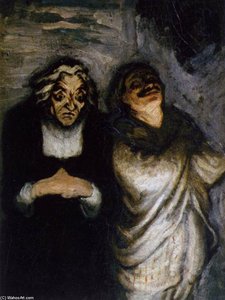
Honoré Daumier's "Guizot or the Bore," painted in 1832, isn’t merely a caricature; it’s a meticulously crafted indictment of political complacency and the stifling atmosphere of post-revolutionary France. The image, rendered in stark black and white lithograph, immediately confronts the viewer with a figure that is both recognizable and profoundly unsettling – François Pierre-Guillaume Guizot, a prominent liberal politician whose name became synonymous with tediousness and intellectual stagnation. Daumier doesn’t offer a flattering likeness; instead, he presents a man seemingly carved from granite, his face an impenetrable mask of boredom and self-importance. The details are remarkably precise: the meticulously rendered mustache, the rigid posture, the almost glacial stare directed squarely at the viewer – each element contributes to a portrait of profound detachment. It’s a deliberate choice, reflecting Daumier's lifelong commitment to exposing the hypocrisy and moral failings he observed within French society.

The Context of Critique: Political Satire in 19th-Century France

To fully appreciate “Guizot or the Bore,” one must understand the tumultuous political landscape of 1832. Following the July Revolution, France was grappling with the aftermath of Napoleon’s empire and attempting to establish a stable constitutional monarchy under Louis Philippe. Daumier, a staunch republican democrat, used his art as a weapon against what he perceived as the corruption and inertia of the established order. His satirical cartoons, published in newspapers like *Le Charivari*, were wildly popular, offering sharp critiques of politicians, the aristocracy, and the bourgeoisie. Guizot himself was a key figure in this era, advocating for moderate reforms within the existing system – precisely the kind of cautious approach that Daumier so vehemently opposed. The painting isn’t simply a personal jab; it's a broader commentary on the dangers of prioritizing stability over genuine progress and reform.

Technique and Symbolism: A Masterclass in Lithography

Daumier’s mastery of lithography is evident throughout “Guizot or the Bore.” The medium itself – stone printing – lends a certain coldness and precision to the image, mirroring the character's impassive demeanor. The stark contrasts between light and shadow are expertly manipulated, creating a dramatic effect that draws attention to Guizot’s face and emphasizing his rigid features. Notice how Daumier utilizes hatching and cross-hatching to build up texture and volume, particularly in the man’s clothing and hair. The background is deliberately devoid of detail, further isolating Guizot and reinforcing the sense of detachment. The very act of creating a lithograph – a process that involved transferring an image from a prepared stone onto paper – speaks to Daumier's commitment to directness and clarity in his artistic expression.

Beyond the Portrait: A Reflection on Modernity

“Guizot or the Bore” transcends its immediate subject matter, offering a poignant meditation on the challenges of navigating modernity. The figure’s blank stare suggests an inability to engage with the world around him, a refusal to acknowledge the social and political realities that demand action. Daumier isn't simply criticizing Guizot; he’s critiquing a broader cultural malaise – a tendency towards intellectualism divorced from empathy and social responsibility. The painting resonates powerfully even today, reminding us of the importance of critical thinking, civic engagement, and resisting the allure of complacency. It serves as a timeless warning against allowing self-importance to overshadow genuine concern for the well-being of society. Reproductions of this powerful image continue to provoke thought and discussion, solidifying Daumier’s legacy as one of the most insightful and enduring satirists in art history.

Questions & Answers

Where does "Guizot or the Bore" fall in Honoré Daumier's career?

"Guizot or the Bore" belongs to the Mature Period of Honoré Daumier's career. This classification relates the work to the artist's development.

How popular is "Guizot or the Bore" within Contemporary Realism?

"Guizot or the Bore" is recorded as recognized among the Contemporary Realism works in the catalog.

What print size of "Guizot or the Bore" by Honoré Daumier fits the recommended room?

The recommended pairing for "Guizot or the Bore" by Honoré Daumier: a medium print in a living room.

More about this painting

Preview AR preview Switch to Print Switch to Digital Image Send
Details Guide Add to favorites Download Similars X-Ray Diaporama Q&A Stats

In numbers

  • 1832the year it was painted
  • 29frames to choose from
  • standard sizes, in its own proportions
  • 5weeks to paint and deliver it
Honoré Daumier

Honoré Daumier

1808 - 1879, France

Quick facts about Honoré Daumier

  • Full Name: Honoré-Victorin Daumier
  • Nationality: French
  • Date Of Birth: 1808
  • Date Of Death: 1879
  • Place Of Birth: Marseille, France
  • Notable Artworks:
    • Rue Transnonain
    • Les gens de justice
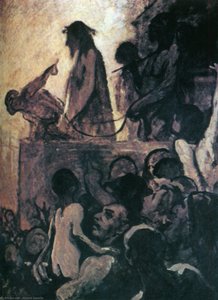
    • Ecce Homo
  • Artistic Movement Or Style: Realism, Satire
  • Artists Who Influenced This Artist:
    • Alexandre Lenoir
    • Jacques-Louis David
  • Artists Or Movements Influenced By This Artist:
    • Impressionism
    • Modern art

Artist Biography

A Life Etched in Satire: The World of Honoré Daumier

Born in Marseille in 1808, Honoré-Victorin Daumier’s journey was one deeply intertwined with the tumultuous currents of 19th-century France. His early life, marked by his father's poetic aspirations and subsequent relocation to Paris in 1814, immersed him in a city brimming with artistic energy. Though initially destined for a legal career, young Daumier’s inclination leaned irrevocably towards art. He apprenticed under Alexandre Lenoir, absorbing classical influences alongside an appreciation for the dramatic chiaroscuro of Rubens, and further honed his skills at the Académie Suisse. This foundational training would prove crucial in shaping his distinctive style—a potent blend of realism and expressive draftsmanship. However, it wasn’t merely artistic technique that defined Daumier; it was a profound sensitivity to the social injustices and political absurdities surrounding him.

The Sharpened Pen: Caricature and Social Commentary

Daumier's career truly ignited in the wake of the 1830 Revolution, an event that irrevocably altered the course of French history and simultaneously provided fertile ground for his burgeoning satirical talent. He quickly established himself as a master lithographer, initially contributing anonymously to various publications before gaining prominence through his work with *Le Charivari*, a fiercely independent comic journal founded by Charles Philipon. It was here that Daumier’s genius truly blossomed. His caricatures weren't simply humorous depictions; they were scathing indictments of the bourgeoisie, the legal system, and the political establishment. He fearlessly lampooned King Louis-Philippe, earning himself a six-month imprisonment in 1832 for a particularly biting caricature. This experience, far from silencing him, only solidified his commitment to exposing hypocrisy and challenging authority through art. His lithographs became visual manifestos, capturing the spirit of dissent and offering a critical commentary on the societal ills of his time. The sheer volume of his output during this period is astonishing—thousands of lithographs that served as both popular entertainment and potent political statements.

Beyond Caricature: Painting and Sculptural Visions

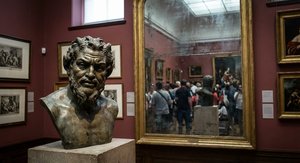
While Daumier is most celebrated for his lithography, to confine him solely to the realm of caricature would be a grave disservice. He was also a dedicated painter and sculptor, though recognition for these works came later in life. His paintings, often depicting scenes of everyday Parisian life—the third-class carriage, the laundresses, the lawyers—are imbued with a profound sense of realism and empathy. They are not idealized portrayals but rather unflinching depictions of hardship and struggle. He masterfully employed loose brushwork and dramatic lighting to convey emotion and atmosphere, foreshadowing some of the techniques later embraced by the Impressionists. His sculptural work, largely created in clay (many pieces remaining unbaked during his lifetime), reveals a similar commitment to capturing the human form with honesty and emotional depth. These sculptures, rediscovered after his death, demonstrate a remarkable talent for modeling and an ability to convey psychological complexity through physical gesture.

A Lasting Legacy: Influence and Historical Significance

Honoré Daumier’s impact on art history is undeniable. He bridged the gap between Romanticism and Realism, paving the way for future generations of artists who sought to depict the world as it truly was—warts and all. His unflinching social commentary influenced artists like Gustave Courbet and Édouard Manet, while his innovative use of lithography revolutionized printmaking. His work continues to resonate today, reminding us of the power of art to challenge authority, expose injustice, and bear witness to the human condition. The Musée d'Orsay in Paris houses a significant collection of his paintings and sculptures, offering visitors a glimpse into the world he so vividly portrayed. His lithographs are widely accessible through collections like those found on OriginalUniqueArt, ensuring that his satirical genius continues to provoke thought and inspire dialogue. Daumier wasn’t merely an artist; he was a chronicler of his time—a visual poet who used his talent to give voice to the voiceless and hold power accountable. His legacy endures as a testament to the enduring relevance of art as a force for social change.

Quick Facts

  • Notable elements: Satirical portrait
  • Influences: Daumier
  • Movement: Realism
  • Dimensions: 22 cm
  • Medium: Clay (terra cotta)
  • Location: Musée d'Orsay, France

Art Quiz

There is only one correct answer for each question.

Question 1:
What is the primary subject depicted in Honoré Daumier’s ‘Guizot or the Bore’?
Question 2:
In what year was ‘Guizot or the Bore’ created?
Question 3:
What artistic technique is most prominently used in ‘Guizot or the Bore’?
Question 4:
Honoré Daumier was a key figure in which artistic movement?
Question 5:
What does the title ‘Guizot or the Bore’ suggest about the subject of the artwork?