Preview
 Send
Send Share
Share
 Details
 Guide
Guide

 Download
 Similars
 X-Ray
X-Ray Diaporama
 Stats
StatsThe Lemon Tree


 Read More
Giclée / Art Print
Museum-quality giclée or canvas print with fast production and flexible finish options. ( Buy Hand Made Painting Switch to Digital Image)




P118B $10

P118H $10

P118W $10

P438Z $10

P508JH $12

P508YH $12

P805H $10

P805Z $10

P919BZ $10

P919G $10

P919XJ $10

P959ZH $10

P968JZ $12

W106C $8

W218G $10

W218JH $8

W218Y $10

W307PJ $10

W316G $10

W316PJ $8

W316Y $10

W398PJ $8

W4111J $10

W500HY $15

W500JH $15

W692G $12

W849H $8

W940BG $15

W953PJ $8




Pick from our preset sizes that match the artwork's original proportions.

Type the width and the height you need, to fit your frame or your wall. A print can only be cut, never made bigger than the picture, so a size with a different shape loses a part of the image. We send you a digital mockup to approve before we print anything. The picture shown on this page does not show the real cut — only the mockup does.
Worldwide Delivery () in 2 weeks instead of standard 4/5 weeks. (23 October)

Free Worldwide Express Shipping

High-Quality Linen Canvas

Full Shipping Insurance

Customs Tax Refund Guarantee

True Color Matching Guarantee

100-Day Return Policy (Defects Only)

100% Money-Back Guarantee

Bulk Discount Offer
 Glass option is only available in size under 110 CM

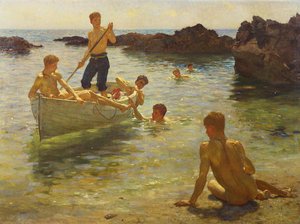
The Lemon Tree
Giclée / Art Print
Reproduction Size
-


Total Price
$ 81
A Sun-Drenched Symphony of Color and Light
In the luminous realm of Henry Scott Tuke’s The Lemon Tree, the viewer is immediately transported to a Mediterranean-inspired sanctuary where the boundaries between nature and tranquility dissolve. This exquisite oil on canvas serves as a breathtaking testament to the artist's mastery of light, presenting a central lemon tree that acts as a vibrant anchor for the entire composition. The fruit itself—heavy, ripe, and bursting with a brilliant yellow hue—seems to glow from within, casting a warm radiance across the scene. Tuke’s ability to capture the tactile essence of the citrus, from the textured rind to the delicate weight of the branches, creates an immersive sensory experience that invites the observer to step directly into this sun-soaked grove.
Beyond the mere depiction of flora, the painting weaves a complex tapestry of texture and depth. The artist employs a technique where bold yet delicate brushstrokes dance across the canvas, defining the intricate network of leaves and branches with an almost rhythmic precision. This interplay of light and shadow creates a profound sense of dimensionality; one can almost feel the warmth of the sun filtering through the canopy. Scattered amongst the lemons, hints of oranges add unexpected pops of color, enriching the palette and contributing to a lush, bountiful atmosphere that celebrates the fecundity of the natural world.
The Human Element and the Impressionist Spirit
While the lemon tree commands the spotlight, Tuke subtly integrates human presence to breathe life and narrative into the landscape. Two figures are positioned within the scene—one standing near the left periphery and another nestled further back on the right—acting as quiet observers of this natural splendor. These figures do not dominate the work; rather, they serve as a bridge between humanity and the wild beauty of the earth, suggesting a moment of peaceful coexistence and quiet contemplation. Their presence adds a layer of storytelling, transforming a botanical study into a lived experience, where the scale of nature is both celebrated and respected.
As a prominent figure associated with the Newlyn School, Tuke brought an en plein air sensibility to his work, a technique heavily influenced by his time in Paris. This influence is palpable in The Lemon Tree through its vibrant, impressionistic use of color and its focus on capturing the fleeting effects of natural light. For collectors and interior designers alike, this piece offers more than just visual beauty; it provides an emotional anchor for any space. The painting’s ability to evoke feelings of serenity, warmth, and vitality makes it a timeless choice for those seeking to infuse their environments with the restorative power of classical Impressionism.
Whether viewed as a study of botanical brilliance or a poetic meditation on summer afternoons, this masterpiece remains an enduring jewel of British art. It stands as a perfect acquisition for the discerning enthusiast who appreciates the delicate balance of technical rigor and emotional resonance, offering a window into a world where nature remains eternally bright and unblemished.
Questions & Answers
What emotion does "The Lemon Tree" by Henry Scott Tuke convey?
"The Lemon Tree" is associated with a calm feeling. The emotional tone describes the impression the work gives.
What orientation does "The Lemon Tree" by Henry Scott Tuke have?
The format of "The Lemon Tree" is landscape. This is useful when planning where a reproduction will be placed.
Is Henry Scott Tuke, creator of "The Lemon Tree", known under other names?
Henry Scott Tuke is also known as H.S. Tuke.
Artist Biography
**early life and education**
henry scott tuke, a prominent english visual artist, was born on june 12, 1858, in lawrence street, york, into a quaker family. his father, daniel hack tuke, was a well-known medical doctor specializing in psychiatry. tuke's early life was marked by a strong inclination towards art, encouraged by his family.**artistic career**
tuke's artistic journey began with enrollment in the slade school of art under alphonse legros and sir edward poynter in 1875. he later won a scholarship that allowed him to continue his training at the slade and in italy in 1880. his time in paris from 1881 to 1883, where he met jules bastien-lepage, influenced his decision to paint en plein air.- henry scott tuke's most notable work was in the impressionist style.
- he is best known for his paintings of nude boys and young men, a subject matter that was both personal and professionally significant.
- tuke's prolific career resulted in over 1,300 works, including oil paintings of young men, maritime scenes, and portraits of sailing ships.
**notable works and legacy**
some of tuke's most notable works include:- the boy’s dream, a poignant example of his impressionist style.
- august, blue, showcasing his skill in capturing the essence of youth and nature.
- sailing ships at newlyn, highlighting his maritime artistry.
**later life and death**
tuke suffered a heart attack in 1928 and passed away on march 13, 1929. despite knowing that his work was no longer fashionable towards the end of his life, tuke's generosity to his models, many of whom were young men, speaks volumes about his character.- view more works by henry scott tuke at https://OriginalUniqueArt.com/@/henryscotttuke
- explore the impressionist movement and its notable artists at /en/art/list/
- discover more about tuke's life and art on wikipedia

Henry Scott Tuke
1858 - 1929 , United Kingdom
Quick Facts
- Full Name: Henry Scott Tuke
- Nationality: British
- Date Of Birth: 1858
- Date Of Death: 1929
- Place Of Birth: York, United Kingdom
- Notable Artworks:
- The Boy’s Dream
- August
- Sailing Ships at Newlyn
- Artistic Movement Or Style: Impressionism
- Artists Who Influenced This Artist:
- Alphonse Legros
- Sir Edward Poynter
- Artists Or Movements Influenced By This Artist: ['Newlyn School']
Related Articles

The Soul of Impressionism: Why Oil on Canvas Captures Eternal Light and Timeless Emotion
Discover the enchanting alchemy of Impressionism. Explore how the mastery of oil on canvas, through glazing and impasto, captures eternal light and emotion. Perfect for lovers of Monet and Van Gogh seeking the profound depth of hand-painted fine art.

Cézanne's Masterpieces: 25 Iconic Artworks to Transform Your Space
Journey through 25 iconic artworks by Paul Cézanne – a master of Impressionism and Post-Impressionism. Explore his landscapes, still lifes, and the stories behind these timeless masterpieces. Discover museum-quality reproductions & curated decor at OriginalUniqueArt.com.
Renoir's Masterpieces: Explore 25 Iconic Paintings & Bring Art Home | OriginalUniqueArt
Explore 25 iconic Pierre-Auguste Renoir paintings! Discover the stories behind Impressionist masterpieces like 'Dance at Le Moulin de la Galette' & 'Luncheon of the Boating Party'. Find museum-quality art reproductions and elevate your home decor with OriginalUniqueArt.com.

Monet's Masterpieces: 25 Iconic Artworks to Transform Your Home
Journey through 25 iconic Claude Monet masterpieces! Explore Impressionism’s beauty, from Water Lilies to Rouen Cathedral. Discover stunning art reproductions & curated decor ideas – explore the full collection online at OriginalUniqueArt.com.
Golden Hues: Top 10 Paintings Dominated by Yellow Ochre |
Explore 10 iconic paintings bathed in golden yellow ochre! From Van Gogh's sunflowers to Monet’s haystacks, discover the stories behind these masterpieces. Find museum-quality art reproductions & elevate your home decor on .