 Preview
 Send
Send Share
Share
 Details
 Guide
Guide

 Download
 Similars
 X-Ray
X-Ray Diaporama
 Stats
StatsLittle Miss Muffet
 Etching
- WallArt
- Japanese Color Woodblock Printmaking
 1918
1918- Modern
 22.0 x 17.0 cm
 Smithsonian American Art Museum
 Read More
Giclée / Art Print
Museum-quality giclée or canvas print with fast production and flexible finish options. ( Buy Hand Made Painting Switch to Digital Image)




P118B $10

P118H $10

P118W $10

P438Z $10

P508JH $12

P508YH $12

P805H $10

P805Z $10

P919BZ $10

P919G $10

P919XJ $10

P959ZH $10

P968JZ $12

W106C $8

W218G $10

W218JH $8

W218Y $10

W307PJ $10

W316G $10

W316PJ $8

W316Y $10

W398PJ $8

W4111J $10

W500HY $15

W500JH $15

W692G $12

W849H $8

W940BG $15

W953PJ $8




Pick from our preset sizes that match the artwork's original proportions.

Type the width and the height you need, to fit your frame or your wall. A print can only be cut, never made bigger than the picture, so a size with a different shape loses a part of the image. We send you a digital mockup to approve before we print anything. The picture shown on this page does not show the real cut — only the mockup does.
Worldwide Delivery () in 2 weeks instead of standard 4/5 weeks. (28 October)

Free Worldwide Express Shipping

High-Quality Linen Canvas

Full Shipping Insurance

Customs Tax Refund Guarantee

True Color Matching Guarantee

100-Day Return Policy (Defects Only)

100% Money-Back Guarantee

Bulk Discount Offer
 Glass option is only available in size under 110 CM

Little Miss Muffet
Giclée / Art Print
Reproduction Size
-


Total Price
$ 81
A Moment Frozen in Etched Serenity
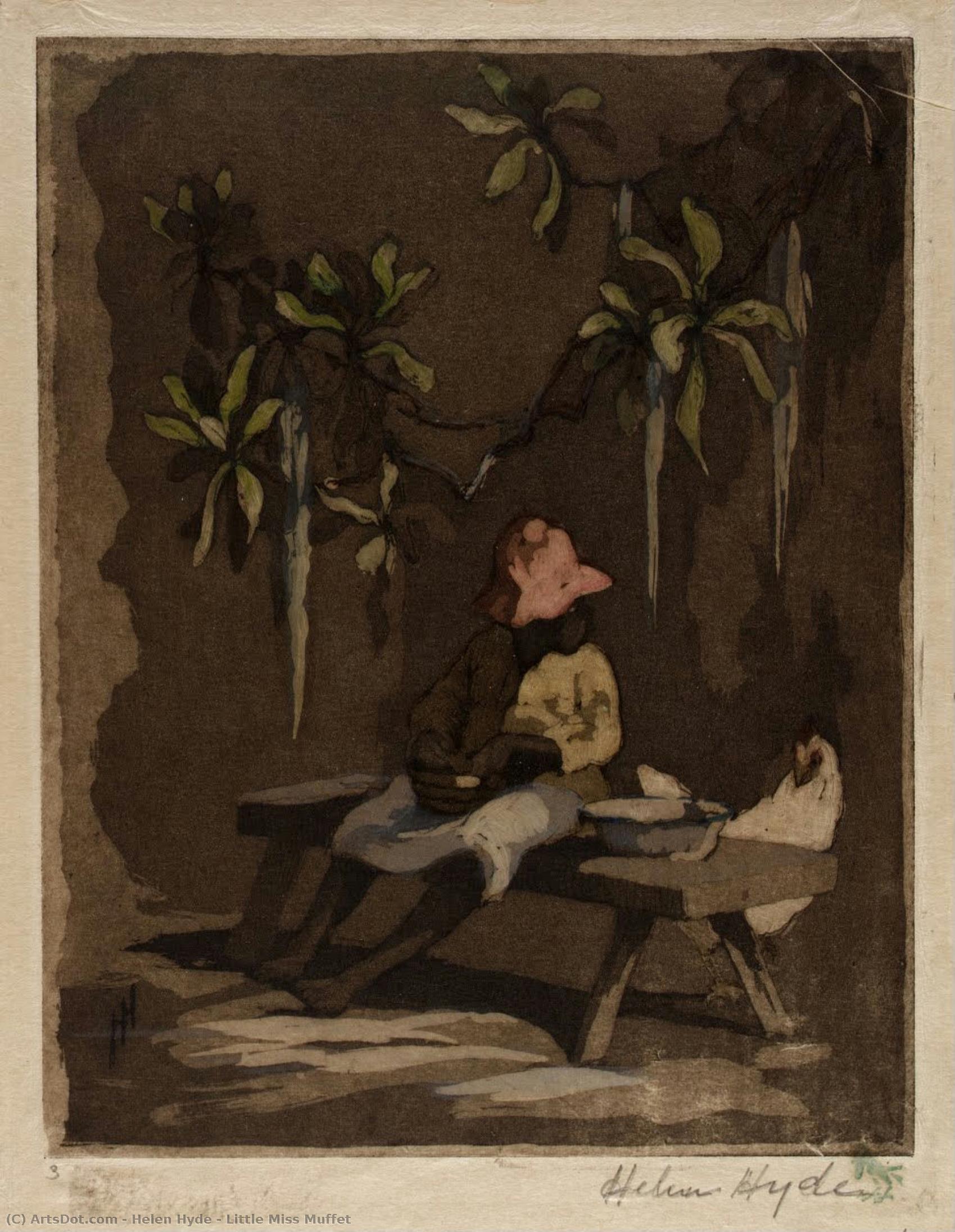
In the delicate interplay of light and shadow found within Helen Hyde’s 1918 masterpiece, “Little Miss Muffet,” we encounter far more than a mere illustration of a nursery rhyme. This striking color etching on paper serves as a profound exploration of vulnerability and the transformative power of quiet observation. At first glance, the viewer is drawn into a peaceful garden setting, where a young figure sits poised upon a bench, lost in the pages of a book. Yet, beneath this tranquil surface lies a sophisticated narrative of resilience. Hyde masterfully captures a moment frozen in time, inviting us to witness the stillness that precedes discovery, making it an exquisite piece for those who appreciate art that speaks softly yet carries immense emotional weight.
The composition is a triumph of understated suggestion. Hyde positions Miss Muffet—a figure embodying innocence and fragility—upon a bench accompanied by another, slightly larger seat, a subtle arrangement that symbolizes stability and the presence of support in a changing world. Above her, a bird perched upon a branch acts as a visual metaphor for freedom and aspiration, creating a beautiful juxtaposition against the grounded, contemplative nature of the child. This careful balance of elements ensures that the artwork remains dynamic, pulling the eye through a landscape of symbolic resonance where every leaf and shadow contributes to a larger story of harmony.
The Mastery of Japonism and Technique
To understand the soul of this work, one must look toward the artist’s profound engagement with Japonisme. Having studied traditional ink painting and woodblock printing techniques in Japan, Hyde brought an Eastern aesthetic sensibility to her American roots. In “Little Miss Muffet,” this influence is palpable in the meticulous attention to detail and the use of muted, harmonious tones. The palette, dominated by earthy browns and serene greens, evokes a sense of timelessness and healing, reminiscent of the contemplative garden traditions found in Japanese art.
The technical execution of this piece is nothing short of extraordinary. Utilizing the complex process of color etching and aquatint, Hyde was able to layer tonal shades to achieve a velvety, rich surface texture that gives the paper a tactile depth. This layering allows for a sophisticated manipulation of light, where shadows do not merely darken the scene but add a sense of atmospheric weight and mystery. For the discerning collector or interior designer, this technical brilliance translates into a reproduction that possesses a remarkable lifelike quality, offering a sophisticated focal point that can anchor a room with its nuanced textures and classical elegance.
An Enduring Legacy for the Modern Collector
Beyond its technical merits, “Little Miss Muffet” stands as a testament to Hyde’s ability to distill complex human emotions into a deceptively simple visual form. It is an invitation to find beauty in unexpected places and to embrace the courage found in moments of quietude. As a piece of art, it transcends its era, offering a timeless message that resonates with the modern desire for peace and mindfulness.
Whether displayed in a curated gallery setting or as a soulful addition to a private study, this work provides an unparalleled sense of sophistication. It is a piece designed for those who seek more than mere decoration; it is for those who wish to surround themselves with art that possesses a narrative heartbeat, a historical soul, and a lasting aesthetic grace.
Questions & Answers
Where does "Little Miss Muffet" stand among Helen Hyde's recurring subjects?
Helen Hyde's recurring themes include japanese aesthetics, symbolism, femininity, observation, printmaking tradition; "Little Miss Muffet" focuses on woman, bench, chicken, book, garden, tranquility, japonism.
How was "Little Miss Muffet" made, and how big is it?
"Little Miss Muffet" was made in etching and measures 22 x 17 cm in its original form.
Where does "Little Miss Muffet" by Helen Hyde sit in art history?
Historically, "Little Miss Muffet" is a Japanese Color Woodblock Printmaking work of the broader Modern era.
Artist Biography
Early Life and Education
- Born: Lima, New York (April 6, 1868)
- Died: Pasadena, California (May 13, 1919)
- Helen Hyde's artistic journey began early. She received initial instruction from Ferdinand Richardt at the age of twelve.
- Her family moved to San Francisco, where she continued her education at the California School of Design.
- Further studies took her to Europe, including Berlin and Paris, where she studied with Franz Skarbina, Raphael Collin, and Félix Régamey.
- Régamey's extensive Japanese art collection significantly influenced Hyde’s artistic direction, introducing her to Japonism.
Artistic Development and Influences
- Upon returning to California, Hyde experimented with color etching and began depicting scenes of San Francisco's Chinatown.
- A pivotal moment was her 1899 journey to Japan, where she immersed herself in Japanese culture and artistic techniques.
- She studied traditional ink painting with Kano Tomonobu and learned woodblock printing from Emil Carlsen.
- Key Influences: Japonism, Mary Cassatt's prints, and the traditional Japanese art forms she encountered during her time in Japan.
- Her style blended Western artistic training with Japanese aesthetics, creating a unique visual language.
Major Works and Techniques
- Notable Works: "A Monarch of Japan" (1901), "Baby Talk" (1909), "Sausalito," "Footbridge," and "Her Bit."
- Techniques: Hyde was primarily known for her color etching and woodblock prints. She employed a divided labor system in Japan, utilizing Japanese carvers and printers.
- “A Monarch of Japan” earned first place at the Nihon Kaiga Kyokai exhibition in 1901.
- "Baby Talk" received a gold medal at the Alaska–Yukon–Pacific Exposition in 1909.
- Her prints often depicted Japanese women and children, reflecting her fascination with their daily lives and cultural traditions.
Achievements and Recognition
- Exhibitions: Hyde’s work was exhibited widely both nationally and internationally.
- Awards: She received numerous awards for her prints, including medals at the Alaska–Yukon–Pacific Exposition and the Panama-Pacific International Exposition.
- Collections: Her works are held in prestigious collections such as the Brooklyn Museum, the Art Institute of Chicago, the Library of Congress, and the Smithsonian American Art Museum.
- Membership: She was a member of several art societies, including the Chicago Society of Etchers and the Printmakers Society of California.
Historical Significance
- Helen Hyde played a significant role in bridging Western and Japanese artistic traditions.
- Her innovative use of color etching and woodblock printing techniques contributed to the development of American printmaking.
- She is recognized as one of the foremost American artists working within the Japonism movement.
- Hyde's depictions of Japanese life offer valuable insights into a period of cultural exchange and artistic innovation.
- Her legacy continues to inspire contemporary artists and collectors alike, with her works remaining highly sought after.

Helen Hyde
1868 - 1919 , United States of America
Quick Facts
- Full Name: Helen Hyde
- Nationality: American
- Date Of Birth: 1868
- Date Of Death: 1919
- Place Of Birth: Lima, United States of America
- Notable Artworks:
- A Monarch of Japan
- Baby Talk
- Sausalito
- Footbridge
- Her Bit
- Artistic Movement Or Style: Color etching, Woodblock prints
- Artists Who Influenced This Artist:
- Franz Skarbina
- Raphael Collin
- Félix Régamey
- Emil Carlsen
- Kano Tomonobu
Related Articles
Etching Masters: 10 Legendary Prints That Revolutionized Art | OriginalUniqueArt
Journey through 10 legendary etching masterpieces by Rembrandt, Dürer & Goya. Explore the history of printmaking and discover timeless art for your home. Find museum-quality reproductions at OriginalUniqueArt.com.
Etching Unlocked: The Sharp, High-Impact Art of Line and Shadow for the Modern Collector
Master the high-impact world of etching. Explore the transformative power of line and shadow through the intaglio tradition, from its armor-making origins to modern collecting strategies for the sophisticated art enthusiast.

The Intricate World of Etching: A Historical Survey of Technique, Aesthetic Evolution, and Enduring Artistic Impact
Explore the rich history of etching, from its origins to modern practice. Discover techniques, key artists like Rembrandt, and insights for collectors. A comprehensive guide by OriginalUniqueArt.

Helen Hyde: Narrative & Symbolism in Contemporary Botanical Illustration
Explore the captivating world of Helen Hyde (1868-1919), a pioneering American artist renowned for her exquisite Japanese woodblock prints and evocative botanical illustrations. Discover her legacy & symbolism.

Etching: A Historical Survey of Technique, Aesthetic Qualities & Enduring Artistic Significance
Explore the rich history of etching, from its origins to Rembrandt's masterful innovations. Discover the technique, aesthetic qualities & enduring legacy of this captivating art form. Expert insights for collectors and enthusiasts.