 Preview
 Send
Send Share
Share
 Details
 Guide
Guide

 Download
 Similars
 X-Ray
X-Ray Diaporama
 Q&A
Q&A Stats
StatsLittle Miss Muffet

- 22.0 x 17.0 cm


 Read More
Get a print-ready file that goes far beyond the web preview. Every digital image we sell comes from a high-resolution master in our stock database — usually 5,000 to 15,000 pixels wide — so you can print large, crop tightly, or reproduce fine detail with confidence.
No file leaves our studio untouched. A digital expert checks the colors against the original painting and corrects them if needed, then improves clarity and detail with professional retouching tools — always staying faithful to the artist's brushwork and style. The result is an image that looks like the painting, not like a filtered scan.
You approve before you're done: our expert sends the image by e-mail within 72 hours for your review. Not satisfied? Ask for improvements or corrections, or request a refund if the quality falls short.
This is the quality relied on by publishers, design studios, galleries and print shops.
Digital Image
Download a high-resolution file for personal display, printing, and creative projects. ( Switch to Print Buy Hand Made Painting)
Included in Every Digital Image Order
Expert Digital Delivery, Guaranteed
When you choose OriginalUniqueArt.com, you're not just getting an image - you're receiving a professionally enhanced digital artwork, crafted with precision and backed by a satisfaction guarantee. Here's everything that comes with your order, automatically:

Fast Email Delivery
Your high-resolution digital image file will be emailed to you within 72 hours of ordering - ready for immediate use.

AI-Enhanced Digital File
Your artwork is professionally optimized using advanced AI tools and manual editing, ensuring maximum detail, clarity, and color accuracy.

Free Lifetime Re-Delivery
Accidentally deleted or lost your file? No worries - we'll resend it to you anytime, free of charge.

No Import Fees - Ever
Enjoy your artwork instantly with zero customs, duties, or delivery fees - digital downloads are always tax-free.

Color Accuracy Guarantee
We ensure your digital image reflects the original colors as closely as possible using professional tools and color management.

100-Day Satisfaction Guarantee
If you're not satisfied with your digital image, we'll revise it or refund 100% within 100 days - no questions asked.

100% Money-Back Guarantee
Not satisfied? Get a full refund within 100 days of receiving your digital file - no questions asked.

Bulk Order Discounts
Buy 3 images, save 10% - Buy 5, save 15% - Buy 10+, save 20%. Great for creative projects, galleries, and agencies.
A Moment Frozen in Etched Serenity
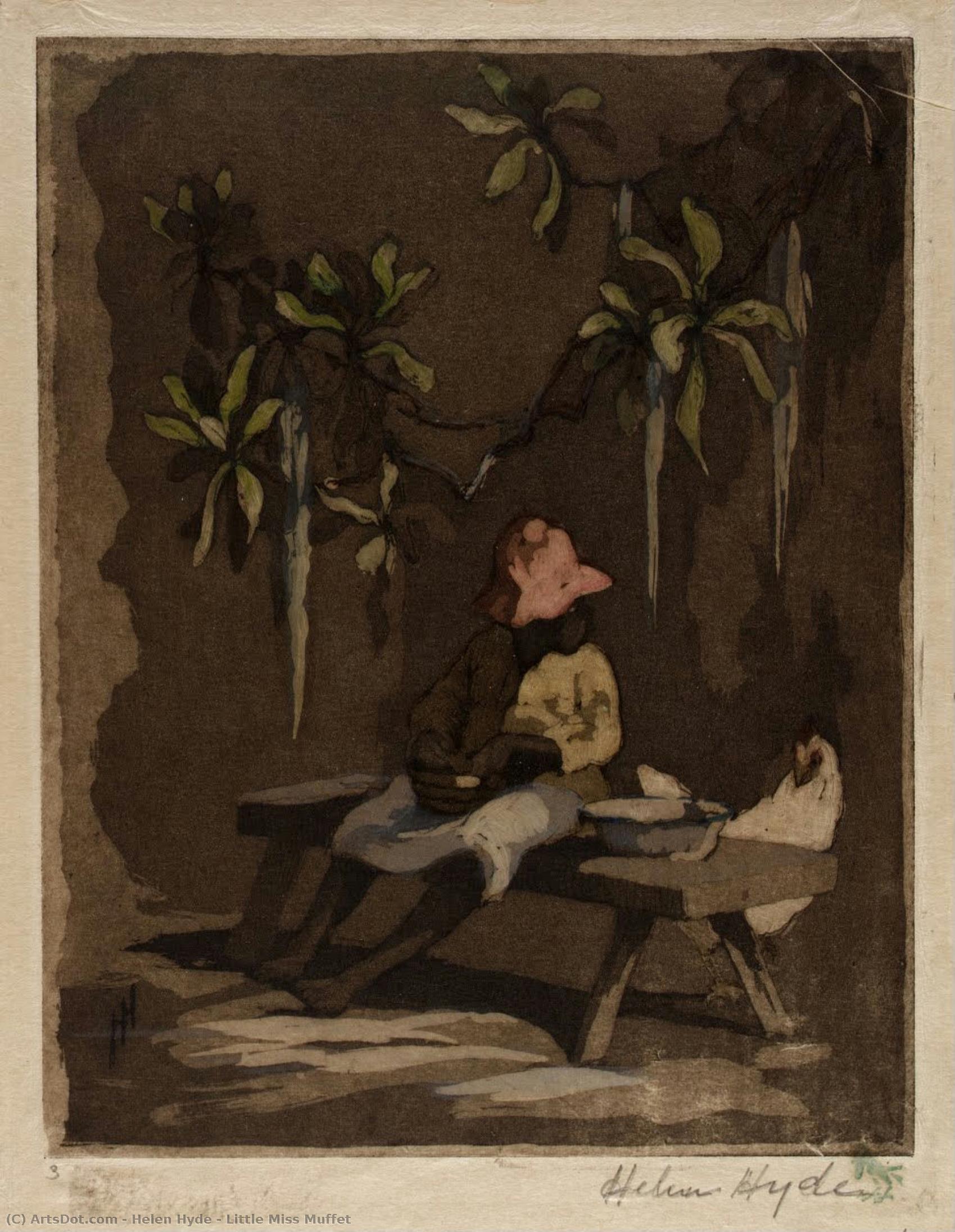
In the delicate interplay of light and shadow found within Helen Hyde’s 1918 masterpiece, “Little Miss Muffet,” we encounter far more than a mere illustration of a nursery rhyme. This striking color etching on paper serves as a profound exploration of vulnerability and the transformative power of quiet observation. At first glance, the viewer is drawn into a peaceful garden setting, where a young figure sits poised upon a bench, lost in the pages of a book. Yet, beneath this tranquil surface lies a sophisticated narrative of resilience. Hyde masterfully captures a moment frozen in time, inviting us to witness the stillness that precedes discovery, making it an exquisite piece for those who appreciate art that speaks softly yet carries immense emotional weight.
The composition is a triumph of understated suggestion. Hyde positions Miss Muffet—a figure embodying innocence and fragility—upon a bench accompanied by another, slightly larger seat, a subtle arrangement that symbolizes stability and the presence of support in a changing world. Above her, a bird perched upon a branch acts as a visual metaphor for freedom and aspiration, creating a beautiful juxtaposition against the grounded, contemplative nature of the child. This careful balance of elements ensures that the artwork remains dynamic, pulling the eye through a landscape of symbolic resonance where every leaf and shadow contributes to a larger story of harmony.
The Mastery of Japonism and Technique
To understand the soul of this work, one must look toward the artist’s profound engagement with Japonisme. Having studied traditional ink painting and woodblock printing techniques in Japan, Hyde brought an Eastern aesthetic sensibility to her American roots. In “Little Miss Muffet,” this influence is palpable in the meticulous attention to detail and the use of muted, harmonious tones. The palette, dominated by earthy browns and serene greens, evokes a sense of timelessness and healing, reminiscent of the contemplative garden traditions found in Japanese art.
The technical execution of this piece is nothing short of extraordinary. Utilizing the complex process of color etching and aquatint, Hyde was able to layer tonal shades to achieve a velvety, rich surface texture that gives the paper a tactile depth. This layering allows for a sophisticated manipulation of light, where shadows do not merely darken the scene but add a sense of atmospheric weight and mystery. For the discerning collector or interior designer, this technical brilliance translates into a reproduction that possesses a remarkable lifelike quality, offering a sophisticated focal point that can anchor a room with its nuanced textures and classical elegance.
An Enduring Legacy for the Modern Collector
Beyond its technical merits, “Little Miss Muffet” stands as a testament to Hyde’s ability to distill complex human emotions into a deceptively simple visual form. It is an invitation to find beauty in unexpected places and to embrace the courage found in moments of quietude. As a piece of art, it transcends its era, offering a timeless message that resonates with the modern desire for peace and mindfulness.
Whether displayed in a curated gallery setting or as a soulful addition to a private study, this work provides an unparalleled sense of sophistication. It is a piece designed for those who seek more than mere decoration; it is for those who wish to surround themselves with art that possesses a narrative heartbeat, a historical soul, and a lasting aesthetic grace.
Questions & Answers
Are there works similar to "Little Miss Muffet"?
Artworks similar to "Little Miss Muffet" by Helen Hyde are gathered on the artwork's Similars page.
What are the dimensions of the original "Little Miss Muffet" by Helen Hyde?
The recorded dimensions of "Little Miss Muffet" by Helen Hyde are 22 x 17 cm. Reproductions can be ordered in other sizes while keeping the same proportions.
What placement suits the format of "Little Miss Muffet" by Helen Hyde?
The portrait format of "Little Miss Muffet" by Helen Hyde is recommended for a living room. Format and space together guide the placement of a reproduction.
Artist Biography
Early Life and Education
- Born: Lima, New York (April 6, 1868)
- Died: Pasadena, California (May 13, 1919)
- Helen Hyde's artistic journey began early. She received initial instruction from Ferdinand Richardt at the age of twelve.
- Her family moved to San Francisco, where she continued her education at the California School of Design.
- Further studies took her to Europe, including Berlin and Paris, where she studied with Franz Skarbina, Raphael Collin, and Félix Régamey.
- Régamey's extensive Japanese art collection significantly influenced Hyde’s artistic direction, introducing her to Japonism.
Artistic Development and Influences
- Upon returning to California, Hyde experimented with color etching and began depicting scenes of San Francisco's Chinatown.
- A pivotal moment was her 1899 journey to Japan, where she immersed herself in Japanese culture and artistic techniques.
- She studied traditional ink painting with Kano Tomonobu and learned woodblock printing from Emil Carlsen.
- Key Influences: Japonism, Mary Cassatt's prints, and the traditional Japanese art forms she encountered during her time in Japan.
- Her style blended Western artistic training with Japanese aesthetics, creating a unique visual language.
Major Works and Techniques
- Notable Works: "A Monarch of Japan" (1901), "Baby Talk" (1909), "Sausalito," "Footbridge," and "Her Bit."
- Techniques: Hyde was primarily known for her color etching and woodblock prints. She employed a divided labor system in Japan, utilizing Japanese carvers and printers.
- “A Monarch of Japan” earned first place at the Nihon Kaiga Kyokai exhibition in 1901.
- "Baby Talk" received a gold medal at the Alaska–Yukon–Pacific Exposition in 1909.
- Her prints often depicted Japanese women and children, reflecting her fascination with their daily lives and cultural traditions.
Achievements and Recognition
- Exhibitions: Hyde’s work was exhibited widely both nationally and internationally.
- Awards: She received numerous awards for her prints, including medals at the Alaska–Yukon–Pacific Exposition and the Panama-Pacific International Exposition.
- Collections: Her works are held in prestigious collections such as the Brooklyn Museum, the Art Institute of Chicago, the Library of Congress, and the Smithsonian American Art Museum.
- Membership: She was a member of several art societies, including the Chicago Society of Etchers and the Printmakers Society of California.
Historical Significance
- Helen Hyde played a significant role in bridging Western and Japanese artistic traditions.
- Her innovative use of color etching and woodblock printing techniques contributed to the development of American printmaking.
- She is recognized as one of the foremost American artists working within the Japonism movement.
- Hyde's depictions of Japanese life offer valuable insights into a period of cultural exchange and artistic innovation.
- Her legacy continues to inspire contemporary artists and collectors alike, with her works remaining highly sought after.

Helen Hyde
1868 - 1919 , United States of America
Quick Facts
- Full Name: Helen Hyde
- Nationality: American
- Date Of Birth: 1868
- Date Of Death: 1919
- Place Of Birth: Lima, United States of America
- Notable Artworks:
- A Monarch of Japan
- Baby Talk
- Sausalito
- Footbridge
- Her Bit
- Artistic Movement Or Style: Color etching, Woodblock prints
- Artists Who Influenced This Artist:
- Franz Skarbina
- Raphael Collin
- Félix Régamey
- Emil Carlsen
- Kano Tomonobu