Preview
 Send
Send Share
Share
 Details
 Guide
Guide

 Download
 Similars
 X-Ray
X-Ray Diaporama
 Stats
StatsMauve District
 Acrylic On Canvas
- WallArt
- Color Field Painting
 1966
1966 261.0 x 241.0 cm
 MOMA - Museum of Modern Art
 Read More
Giclée / Art Print
Museum-quality giclée or canvas print with fast production and flexible finish options. ( Buy Hand Made Painting Switch to Digital Image)




P118B $10

P118H $10

P118W $10

P438Z $10

P508JH $12

P508YH $12

P805H $10

P805Z $10

P919BZ $10

P919G $10

P919XJ $10

P959ZH $10

P968JZ $12

W106C $8

W218G $10

W218JH $8

W218Y $10

W307PJ $10

W316G $10

W316PJ $8

W316Y $10

W398PJ $8

W4111J $10

W500HY $15

W500JH $15

W692G $12

W849H $8

W940BG $15

W953PJ $8




Pick from our preset sizes that match the artwork's original proportions.

You may enter your own dimensions to fit a specific frame or space. If your selected size does not match the original image's proportions, we will either crop the artwork or extend the image with a mirrored or solid-fill edge. A digital mockup will be sent for your approval before production begins.
Please note that the on-screen preview does not reflect the actual cropping or extension. Only the mockup will accurately show the final composition.
While custom sizes are available, we recommend selecting a dimension from the predefined list to preserve the original proportions.
Worldwide Delivery () in 2 weeks instead of standard 4/5 weeks. (26 September)

Free Worldwide Express Shipping

High-Quality Linen Canvas

Full Shipping Insurance

Customs Tax Refund Guarantee

True Color Matching Guarantee

100-Day Return Policy (Defects Only)

100% Money-Back Guarantee

Bulk Discount Offer
 Glass option is only available in size under 110 CM

Mauve District
Giclée / Art Print
Reproduction Size
-


Total Price
$ 81
A Symphony in Mauve: Helen Frankenthaler’s “Mauve District”
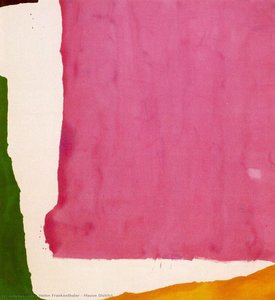
Helen Frankenthaler's "Mauve District," painted in 1966, isn’t merely a canvas adorned with color; it’s an immersive experience, a testament to the artist’s revolutionary approach to painting and her profound connection to the landscape. This work, currently residing within the hallowed halls of the Museum of Modern Art in New York City, embodies the core tenets of Color Field painting – a movement that sought to elevate color itself as the primary subject matter, moving away from traditional representational forms.
The painting immediately captivates with its expansive mauve field, dominated by a large, subtly defined square. However, this initial impression quickly dissolves into a complex interplay of textures and layers. Frankenthaler’s signature “soak-stain” technique—a process she pioneered—is vividly demonstrated here. She poured thinned acrylic paint directly onto the raw canvas, allowing it to bleed and pool, creating an organic, almost topographical surface. This deliberate rejection of brushstrokes results in a remarkably luminous quality; the colors seem to vibrate with an internal light, as if emanating from within the very fabric of the painting.
The Language of Color and Space
Beyond its visual allure, “Mauve District” speaks volumes about Frankenthaler’s evolving artistic philosophy. Following her initial explorations in Abstract Expressionism, she began to experiment with ways to integrate color directly into the support – the canvas itself – rather than applying it solely to a surface. This shift fundamentally altered the relationship between paint and ground, creating a sense of depth and dimensionality previously unseen in painting. The subtle variations within the mauve field—shifts in tone and intensity—suggest an underlying geography, evoking the feeling of vast open spaces or rolling hills. The strategically placed wedge of exposed canvas acts as a visual counterpoint to the painted surface, simultaneously emphasizing and negating the boundaries of the artwork.
Historical Context and Artistic Innovation
“Mauve District” emerged during a period of intense experimentation in American art. The late 1960s witnessed a burgeoning interest in color theory and non-objective painting, fueled by artists like Mark Rothko and Barnett Newman. Frankenthaler’s work stands apart through its dynamic layering and the way she manipulated the canvas as an active participant in the creative process. Her technique wasn't simply about applying color; it was about creating a visual dialogue between pigment and material, a conversation that continues to resonate with viewers today.
Symbolism and Emotional Resonance
While Frankenthaler herself resisted assigning definitive interpretations to her paintings, “Mauve District” undeniably evokes feelings of tranquility, contemplation, and perhaps even a touch of melancholy. The muted palette—a blend of pinks, purples, and blues—creates a sense of serenity, while the textured surface invites tactile engagement. The painting’s expansive scale further contributes to its immersive quality, drawing the viewer into a world of color and form. It's a piece that rewards prolonged observation, revealing new nuances with each glance.
A Timeless Masterpiece
“Mauve District” remains a pivotal work in Helen Frankenthaler’s oeuvre and a cornerstone of Color Field painting. Its innovative technique, evocative imagery, and profound emotional resonance continue to captivate audiences worldwide. Whether admired for its technical brilliance or appreciated for its ability to transport the viewer to another realm, this painting stands as a testament to the transformative power of color and the enduring legacy of one of America’s most influential artists.
Artist Biography
A Pioneer of Color and Form: The Life and Art of Helen Frankenthaler
Helen Frankenthaler, born in 1928 in Manhattan, emerged as a pivotal figure in postwar American painting, bridging the fervent energy of Abstract Expressionism with the serene expanses of Color Field painting. Raised within a progressive Jewish intellectual family – her father a judge, her mother an immigrant from Germany – she was immersed in a world that valued both tradition and innovation. This upbringing fostered a spirit of inquiry that would define her artistic journey. From an early age, Frankenthaler received rigorous art education, studying under Rufino Tamayo at the Dalton School and later honing her skills at Bennington College with Paul Feeley, alongside brief mentorship from Hans Hofmann. These formative experiences laid the groundwork for her groundbreaking explorations in abstraction.The ‘Soak-Stain’ Revolution
Frankenthaler's most enduring contribution to art history is undoubtedly her development of the “soak-stain” technique in 1952. This revolutionary method involved pouring thinned oil paint directly onto unprimed canvas laid flat on the floor, allowing the pigment to seep into the fabric itself. This was a radical departure from traditional painting practices, which emphasized layering and brushwork. The result was an ethereal quality of translucent color, where forms seemed to float and dissolve within the weave of the canvas. Mountains and Sea, created that same year, is widely considered the seminal work demonstrating this technique – a pivotal moment not only in Frankenthaler’s career but also in the evolution of abstract painting. The painting's expansive washes of color evoked natural landscapes without resorting to representation, hinting at horizons, bodies of water, and geological formations. This innovative approach profoundly influenced artists like Morris Louis and Kenneth Noland, who would go on to become leading figures in the Color Field movement. Frankenthaler didn’t merely paint *on* the canvas; she collaborated with it, allowing the material itself to participate in the creative process.Expanding Artistic Boundaries
While celebrated for her pioneering work with stain painting, Helen Frankenthaler was an artist of relentless experimentation. In the early 1960s, she embraced acrylic paints, drawn to their brighter hues and ability to create sharper delineations between forms. This shift allowed for a greater degree of control and precision in her compositions. However, her artistic curiosity extended far beyond the confines of painting. Throughout her career, Frankenthaler fearlessly explored diverse media, including ceramics, sculpture, tapestry, and printmaking – particularly woodcuts. She even ventured into theatrical design, creating sets and costumes for the Royal Ballet. This willingness to embrace new challenges underscored her belief that art should be a continuous process of discovery and reinvention. She saw no inherent hierarchy between artistic disciplines, viewing each as offering unique possibilities for expression.Recognition and Legacy
Frankenthaler’s impact on the art world was recognized early in her career with inclusion in the influential “Fifteen Unknowns” exhibition in 1950 and her first solo show at Tibor de Nagy Gallery in 1951. Major retrospective exhibitions followed, including those at the Jewish Museum (1960), the Whitney Museum of American Art (1969), and a comprehensive traveling retrospective in 1989. In 1966, she represented the United States at the prestigious Venice Biennale, further solidifying her international reputation. Her contributions were formally acknowledged with the National Medal of Arts in 2001. Helen Frankenthaler died in 2011, leaving behind a vast and influential body of work that continues to inspire artists today. The Helen Frankenthaler Foundation, established during her lifetime, remains dedicated to promoting public interest in the visual arts and preserving her artistic legacy. Her paintings are held in major museum collections worldwide, serving as testaments to her enduring vision and innovative spirit. She is remembered not only for her technical innovations but also for her lyrical sensibility – a quality that imbues her abstract compositions with an emotional resonance that transcends stylistic boundaries.
Helen Frankenthaler
1928 - 2011 , United States of America
Quick Facts
- Artistic Movement Or Style: Abstract Expressionism, Color Field
- Artists Or Movements Influenced By This Artist:
- Morris Louis
- Kenneth Noland
- Artists Who Influenced This Artist:
- Jackson Pollock
- Hans Hofmann
- Date Of Birth: December 12, 1928
- Date Of Death: December 27, 2011
- Full Name: Helen Frankenthaler
- Nationality: American
- Notable Artworks: ['Mountains and Sea']
- Place Of Birth: Manhattan, USA
Related Articles

Kandinsky's Masterpieces: 25 Paintings That Define Abstract Art | OriginalUniqueArt
Journey through Wassily Kandinsky's 25 most iconic abstract paintings. Explore his revolutionary use of color, form & spiritual expressionism. Find museum-quality Kandinsky reproductions and elevate your home decor with OriginalUniqueArt.com. Discover all masterpieces on OriginalUniqueArt.com!
Verdant Visions: Exploring the Symbolism & Aesthetic Impact of Green in Art History
Explore the rich history & symbolism of green in art! Discover iconic paintings, techniques, and how to bring verdant harmony into your home with OriginalUniqueArt's expert guide.

Abstract Expressionism's 10 Defining Masterpieces |
Explore 10 defining Abstract Expressionism masterpieces by Pollock, Rothko & de Kooning. Discover the stories behind these iconic paintings and find museum-quality art reproductions to elevate your home decor on .
Color Field Painting: The Emotional Power of Pure Abstraction and Chromatic Depth
Explore the profound emotional depth of Color Field painting. Discover the history of mid-century abstraction, from Rothko to Newman, and learn how pure color transforms the viewer's experience through our expert art history guide.
Blush & Brilliance: 10 Iconic Paintings Dominated by Light Pink Tones |
Explore 10 iconic paintings bathed in captivating light pink tones! From Monet's Impressionism to Renoir’s romance, discover the stories behind these blush-hued masterpieces. Find museum-quality art reproductions & decor inspiration at .