Preview
 Send
Send Share
Share
 Details
 Guide
Guide

 Download
 Similars
 X-Ray
X-Ray Diaporama
 Q&A
Q&A Stats
StatsThe Sphinx

- 105.0 x 206.0 cm


 Read More
Giclée / Art Print
Museum-quality giclée or canvas print with fast production and flexible finish options. ( Buy Hand Made Painting Switch to Digital Image)




P118B $10

P118H $10

P118W $10

P438Z $10

P508JH $12

P508YH $12

P805H $10

P805Z $10

P919BZ $10

P919G $10

P919XJ $10

P959ZH $10

P968JZ $12

W106C $8

W218G $10

W218JH $8

W218Y $10

W307PJ $10

W316G $10

W316PJ $8

W316Y $10

W398PJ $8

W4111J $10

W500HY $15

W500JH $15

W692G $12

W849H $8

W940BG $15

W953PJ $8




Pick from our preset sizes that match the artwork's original proportions.

Type the width and the height you need, to fit your frame or your wall. A print can only be cut, never made bigger than the picture, so a size with a different shape loses a part of the image. We send you a digital mockup to approve before we print anything. The picture shown on this page does not show the real cut — only the mockup does.
Worldwide Delivery () in 2 weeks instead of standard 4/5 weeks. (10 November)

Free Worldwide Express Shipping

High-Quality Linen Canvas

Full Shipping Insurance

Customs Tax Refund Guarantee

True Color Matching Guarantee

100-Day Return Policy (Defects Only)

100% Money-Back Guarantee

Bulk Discount Offer
 Glass option is only available in size under 110 CM

The Sphinx
Giclée / Art Print
Reproduction Size
-


Total Price
$ 81
A Dream Weaver’s Vision: Introducing The Sphinx
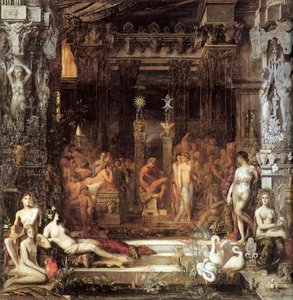
Gustave Moreau's The Sphinx, painted in 1864, isn’t merely a depiction of the legendary creature; it’s an immersion into a realm of potent myth and deeply personal symbolism. This captivating work, housed within the Clemens-Sels-Museum in Neuss, Germany, stands as a cornerstone of the Symbolist movement – a period defined by its rejection of realism in favor of exploring the hidden depths of the human psyche and the power of allegory. Moreau, a master of evocative imagery and layered meaning, invites us into a world where gods and mortals intertwine, and mysteries linger just beyond our grasp.

Decoding the Symbol: The Sphinx as Guardian
Moreau’s Sphinx isn't a straightforward representation of the ancient Greek beast; it’s a carefully constructed embodiment of enigma and protection. Seated atop a rugged, almost primordial cliff face overlooking an endless expanse of ocean, she embodies a watchful guardianship. Her wings, reminiscent of both angels and birds of prey, suggest a connection to the divine yet also hint at a predatory instinct. The figures surrounding her – angelic forms and other mythological creatures – aren’t merely decorative; they contribute to the painting's atmosphere of otherworldly wonder and underscore the Sphinx’s role as a gatekeeper between realms.
The central mystery lies in what she guards. While the exact nature of this secret remains deliberately obscured, it speaks to the core themes of Moreau’s Symbolist work: the pursuit of hidden knowledge, the confrontation with the unknown, and the inherent ambiguity of existence. The composition itself is meticulously crafted – a deliberate layering of visual cues designed to stimulate interpretation and contemplation.
A Masterclass in Symbolism: Technique and Influence
Moreau’s technique is as captivating as his subject matter. Executed in oil on canvas, the painting showcases his mastery of rich color palettes—deep blues, ochres, and greens—and intricate brushwork that creates a palpable sense of texture and depth. He employs a technique reminiscent of Renaissance masters like Mantegna, imbuing the scene with an archaic quality while simultaneously forging a distinctly modern Symbolist aesthetic. The use of muted tones and carefully placed highlights draws the viewer’s eye to key elements, guiding their gaze through the complex composition.
The Sphinx profoundly influenced subsequent generations of artists, including Matisse and Rouault, who were drawn to Moreau's ability to infuse everyday subjects with symbolic weight. It stands as a testament to his pioneering role in shaping the Symbolist movement and his enduring legacy as a visionary artist.
Beyond the Canvas: Context and Legacy
Considered one of Moreau’s earlier works, The Sphinx foreshadows the more elaborate and intensely personal symbolism that would characterize his later paintings. It's important to note that Moreau was deeply influenced by mythology, religion, and literature—particularly the works of Dante and Shakespeare—and these influences permeate his art. His fascination with the darker aspects of human experience – loss, despair, and the struggle for meaning – is powerfully conveyed through this evocative image.
Today, reproductions of The Sphinx offer a unique opportunity to bring Moreau’s dreamlike world into your home or office. OriginalUniqueArt offers meticulously hand-painted reproductions that capture the painting's original beauty and symbolic depth, allowing you to experience the power of this iconic artwork firsthand.
Questions & Answers
Is "The Sphinx" by Gustave Moreau a well-known artwork?
"The Sphinx" by Gustave Moreau has an iconic popularity level. This classification reflects how widely the work is recognized.
Where does "The Sphinx" sit within Gustave Moreau's body of work?
"The Sphinx" shares with Gustave Moreau's other works its Symbolist Painting style and the recorded themes: mythological, allegorical symbolism, ancient egyptian, religious themes, symbolist movement, artistic trends, dreamlike world, subjective vision.
What explains the copyright situation of "The Sphinx" by Gustave Moreau?
"The Sphinx" by Gustave Moreau is in the public domain - its copyright has expired. Copyright duration runs from the artist's death, which occurred in 1898.
Artist Biography
The Life and Art of Gustave Moreau
Gustave Moreau was a French artist who lived a life deeply connected to the streets of Paris. Born in the city on April 6, 1826, he spent his years navigating the shifting currents of the nineteenth century. He was a central figure in the Symbolist movement, a period that looked away from the literal world to find meaning in the unseen. His work was not a pursuit of mere imitation, but an attempt to give form to the internal landscape of the human psyche.
His output was immense. Throughout his life, he produced over 15,000 paintings, watercolors, and drawings. This vast collection reflects a man who was constantly translating myth and religion into a personal visual language. He worked with an intensity that saw him create a massive body of work before he passed away in Paris on April 18, 1898.
His art often focused on the heavy, psychological weight of ancient stories. Rather than simply illustrating a scene, he sought to capture the spiritual essence of his subjects. This approach made him a singular voice in a time when many of his peers were focused on the fleeting light of the natural world. His dedication to this inward exploration left behind a profound record of the human soul.
Early Life, Family and Training
Born into a bourgeois family in Paris, France, Gustave Moreau grew up in a household where structure and melody met. His father, Louis Jean Marie Moreau, worked as an architect and archivist, providing a sense of order and historical depth to their home. His mother, Adèle-Pauline Desmoutier, was a musician, and her influence added a rhythmic sensibility to the family's atmosphere. From a very young age, Gustave showed a natural talent for drawing, a gift that seemed to emerge almost instinctively as he explored the world around him.
His formal education began at Collège Rollin, which is known today as Collège-lycée Jacques-Decour. This early schooling provided the foundation for his later, more specialized studies. He eventually entered the École des Beaux-Arts, where he underwent rigorous academic training. It was here that he studied under figures such as François-Édouard Picot, learning the technical discipline required to master the classical traditions of his time.
Artistic Development and Italian Travels
By the 1850s, Moreau felt the pull of the past, a need to understand the foundations of the art he so deeply respected. This led him to Italy, a period that would fundamentally reshape his vision. He did not merely observe the works of the masters; he lived among them, spending his time making hundreds of copies and studies of Old Master paintings. These were not simple exercises for him. Through the act of replication, he sought to absorb the secrets of composition and the psychological depth found in the works of Michelangelo and Leonardo da Vinci. He studied their anatomy and their ability to capture the human spirit, absorbing their techniques to build his own visual language.
While the Italian masters provided a structural foundation, other influences added a layer of emotional intensity to his developing style. He found himself drawn to the dramatic use of color seen in the works of Eugène Delacroix. This fascination with how color could convey narrative and feeling became a cornerstone of his approach. He was not interested in the objective reality of the world around him, but rather in how light and pigment could express the internal movements of the soul. His time in Italy allowed him to synthesize these diverse influences, blending the classical precision of the Renaissance with a more modern, expressive use of color.
Technique and Symbolic Style
Moreau’s approach to the canvas was a slow, deliberate process. He favored a meticulous layering of paint, building up surfaces that possessed a heavy, physical presence. This method allowed him to create rich textures that seemed to hold light within them. To deepen the spiritual weight of his subjects, he often incorporated gold leaf, a choice that lent his scenes a Byzantine quality. He was less interested in the surface of the natural world and more focused on the expressive power of color and form to convey a specific mood or a hidden meaning.
His paintings are filled with a dense language of symbols. A serpent might appear to represent temptation, while jewels are used to signify earthly desires. These elements do not merely decorate the scene; they act as visual cues for the viewer to look toward the psychological or the spiritual. Through this intricate detail, he built a dreamlike atmosphere where the boundaries of reality felt thin. The figures in his work often seem to exist in a state of suspension, caught between the physical and the ethereal.
- Salome Dancing before Herod
- Jupiter and Semele
- Orpheus
- The Apparition
- Desdemona
Notable Masterpieces and Works
Many of Moreau's most recognized paintings emerged from his deep interest in the stories of antiquity and the Bible. In 1864, he exhibited Oedipus and the Sphinx, a work that helped establish his reputation. His fascination with the figure of Salome led to several different interpretations. One of his most famous works is Salome Dancing before Herod, which captures the tension of the biblical narrative through his unique, detailed approach. He also produced The Apparition between 1874 and 1876, a piece that highlights the strange, dreamlike atmosphere he often sought to create.
As his career progressed, his compositions grew in complexity. In 1885, he painted Voices of Evening, a watercolor that demonstrates his ability to use soft textures to convey a sense of spiritual quietude. Later in his life, in 1895, he completed Jupiter and Semele, a work that reflects the grand, mythological scale he favored. His canvases often felt less like windows into a real room and more like stages for the subconscious, where light and shadow worked together to suggest something beyond the physical world.
- The Daughters of Thespius, 1853
- Pieta, 1854
- Jason and Medea, 1865
- The Death of Sappho, 1872
- Hercules and the Hydra, 1876
- Saint Martin, 1882
Circle, Pupils and Teaching
In his later years, Moreau moved from the quiet seclusion of his studio into the classroom. In 1893, he accepted a professorship at the École des Beaux-Arts, a position that allowed him to pass his ideas to a new generation of painters. He did not teach his students to merely mimic his hand or his specific way of applying paint. Instead, he encouraged them to look inward. He urged them to embrace their own imagination and to find their own unique modes of individual expression, pushing them to move beyond the rigid rules of the academy.
This emphasis on the internal life of the artist left a mark on many who sat in his lectures. Among those who studied under him was Henri Matisse, who would go on to reshape the landscape of modern art. Georges Rouault was another of his pupils, absorbing the lessons of symbolism and personal vision that Moreau championed. Through these students, his belief in the importance of the subconscious and the spiritual became a part of the broader evolution of French painting.
Legacy and Enduring Influence
By the 1890s, Moreau had become a central figure in the Symbolist movement. He did not seek the spotlight, yet his presence was felt deeply by those who followed him. His influence reached into the classrooms of the École des Beaux-Arts, where he encouraged his students to look inward and embrace their own imagination. This focus on individual expression helped pave the way for the modern art that would emerge in the decades following his death.
While his specific style was sometimes met with mixed reactions during his lifetime, his importance was recognized again in the latter half of the 20th century. This period saw a significant reevaluation of his work, as people looked past the surface to find the psychological depth he had spent his life exploring. He is now widely regarded as a precursor to modern art, a man who helped shift the focus of painting from the external world to the internal soul.
The Musée Gustave Moreau in Paris remains a place where his vision is preserved. The building itself, which he helped transform into a museum, keeps his memory alive in the very space where he lived and worked. It is a quiet place that holds the weight of his many years of study and creation.
Where to See the Works Today
To experience his art in the most intimate way, one can visit the Musée Gustave Moreau in Paris, France. This museum is housed in the very building that served as his home and studio. Walking through these spaces allows you to see the environment where he lived and worked, providing a direct connection to his daily life and creative process.
Beyond his personal residence, several major institutions hold his paintings. In Paris, the Louvre also maintains two of his works in its collection. For those traveling further, the Metropolitan Museum of Art in New York holds two more of his paintings, allowing his vision to reach audiences far beyond the streets of France.
- Oedipus and the Sphinx (1864)
- Jason and Medea (1865)

Gustave Moreau
1826 - 1898 , France
Quick Facts
- Artistic Movement Or Style: Symbolism
- Artists Or Movements Influenced By This Artist:
- Henri Matisse
- Georges Rouault
- Artists Who Influenced This Artist:
- Eugène Delacroix
- Michelangelo
- Leonardo da Vinci
- Full Name: Gustave Moreau
- Nationality: French
- Notable Artworks:
- Salome Dancing before Herod
- Jupiter and Semele
- Orpheus
- The Apparition
- Desdemona
- Place Of Birth: Paris, France
- Date Of Birth: 1826
- Date Of Death: 1898
Related Articles

The Enduring Power of Painting: A Historical & Contemporary Exploration of Form and Emotion
Explore the rich history & enduring techniques of oil painting with OriginalUniqueArt. Discover masterpieces, learn about art collecting, and find authentic handmade reproductions crafted by skilled artists.

Oil on Canvas: A Historical & Technical Exploration of a Timeless Artistic Medium
Explore the rich history & enduring techniques of oil painting on canvas. Discover the science behind its longevity, conservation practices, and contemporary relevance. Expert insights for art enthusiasts.
Gustave Moreau: Symbolism's Enigmatic Visionary & Precursors of Modern Fantasy Art
Explore the captivating world of Gustave Moreau, the leading Symbolist painter. Discover his iconic masterpieces, influences, and lasting legacy. Expert analysis for collectors & art enthusiasts.

The Enduring Legacy of Oil on Canvas: Technique, History & Aesthetic Impact
Explore the rich history & techniques of oil painting – from Renaissance masters to Impressionism. Discover pigments, layering methods, and why this timeless medium endures. Expert insights for artists & art enthusiasts.
Echoes of Olympus: Mythological Narratives in Western Art Through the Ages
Explore the captivating history of mythological narratives in Western art! From ancient Greece to modern masterpieces, discover iconic artworks & symbolism. Expert analysis and high-quality reproductions at OriginalUniqueArt.