Switch to Print
 Read More







































 For artworks or reproductions larger than 105 cm (approximately 41 inches) on any side, the frame will be shipped as a kit, disassembled. This method ensures safe delivery and prevents damage during transport.


A Golden Embrace
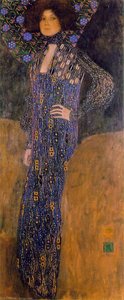
Step closer and observe how the light seems to emanate from within the canvas itself. In this work, created during the golden phase of the artist's career between 1906 and 1909, a couple is held in a profound, intimate embrace. They are enveloped by a heavy, shimmering cloak that obscures much of their physical form, leaving only the tenderness of their connection visible. The composition draws the eye inward, using verticality to create a sense of quiet enclosure. It feels as though the rest of the world has fallen away, leaving only this singular, luminous moment.
The surface is a dense arrangement of patterns and precious textures. You can see the influence of Byzantine mosaics in the way the gold leaf interacts with the oil paint, creating a surface that shifts as you move. The man’s robe is adorned with dark, geometric shapes—rectangles and squares that suggest strength—while the woman’s garment flows with softer, organic floral motifs. These contrasting elements meet at the center of the embrace, where the gold leaf binds them together in a singular, radiant entity.
Symbolism and the Secessionist Spirit
This piece emerged from a period of great rebellion in Vienna. As a founding member of the Vienna Secession, the artist sought to break free from the rigid academic traditions of the time. This movement favored a Gesamtkunstwerk, or total work of an art, where the boundaries between fine painting and decorative design become blurred. In this painting, that philosophy is realized through the flattened perspective and the heavy use of ornamentation. The background is not a window into a landscape, but a rich field of gold punctuated by jewel-toned circles and shapes in blues, reds, and greens.
Every detail carries a weight of meaning. The patch of flowers beneath the kneeling figures suggests themes of fertility and the blossoming of life. The gold itself acts as more than decoration; it represents a spiritual union, lifting the subjects into a realm that feels separate from reality. There is a deliberate tension between the heavy, metallic textures and the soft, human emotion expressed in the tilt of a head or the curve of a shoulder. It is an exploration of intimacy through the language of pattern and light.
Questions & Answers
What explains the copyright situation of "The kiss" by Gustav Klimt?
"The kiss" by Gustav Klimt is in the public domain - its copyright has expired. Copyright duration runs from the artist's death, which occurred in 1918.
Can I see "The kiss" by Gustav Klimt on my own wall before buying?
"The kiss" has an augmented reality preview: the artwork's AR Preview page shows it in your own space on a compatible device.
What is the dominant hue of "The kiss" by Gustav Klimt?
"The kiss" leans toward an ochre to sepia tone.
More about this painting
 Send
Send Share
Share
 Details
 Guide
Guide

 Download
 Similars
 Diaporama
 Q&A
Q&A Stats
Stats Top100