
 Preview
 Send
Send Share
Share
 Details
 Guide
Guide

 Download
 Similars
 X-Ray
X-Ray Diaporama
 Stats
StatsGold Cavalier


 Read More
Giclée / Art Print
Museum-quality giclée or canvas print with fast production and flexible finish options. ( Buy Hand Made Painting Switch to Digital Image)




P118B $10

P118H $10

P118W $10

P438Z $10

P508JH $12

P508YH $12

P805H $10

P805Z $10

P919BZ $10

P919G $10

P919XJ $10

P959ZH $10

P968JZ $12

W106C $8

W218G $10

W218JH $8

W218Y $10

W307PJ $10

W316G $10

W316PJ $8

W316Y $10

W398PJ $8

W4111J $10

W500HY $15

W500JH $15

W692G $12

W849H $8

W940BG $15

W953PJ $8




Pick from our preset sizes that match the artwork's original proportions.

Type the width and the height you need, to fit your frame or your wall. A print can only be cut, never made bigger than the picture, so a size with a different shape loses a part of the image. We send you a digital mockup to approve before we print anything. The picture shown on this page does not show the real cut — only the mockup does.
Worldwide Delivery () in 2 weeks instead of standard 4/5 weeks. (26 October)

Free Worldwide Express Shipping

High-Quality Linen Canvas

Full Shipping Insurance

Customs Tax Refund Guarantee

True Color Matching Guarantee

100-Day Return Policy (Defects Only)

100% Money-Back Guarantee

Bulk Discount Offer
 Glass option is only available in size under 110 CM

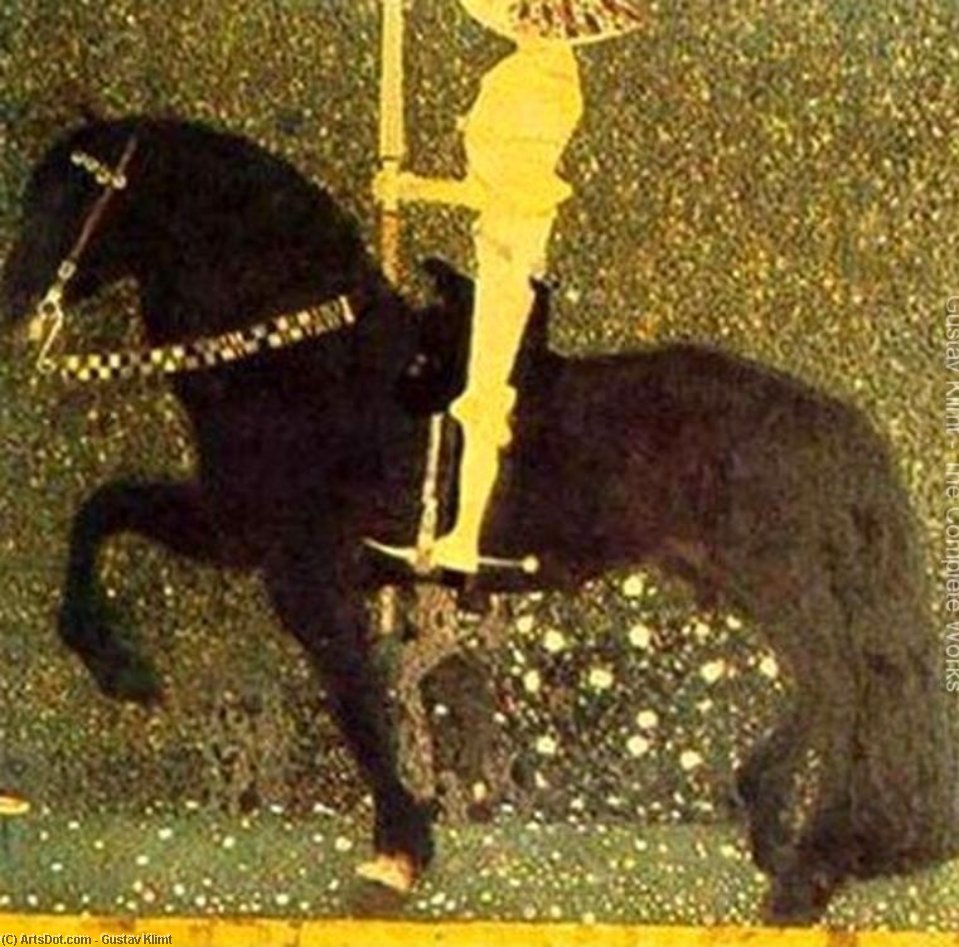
Gold Cavalier
Giclée / Art Print
Reproduction Size
-


Total Price
$ 81
A Glimpse into Klimt’s Golden World: The Enigmatic ‘Gold Cavalier’
Gustave Klimt's *Gold Cavalier* is more than just a painting; it’s an immersion into the opulent, symbolic universe that defines his unique artistic vision. Created during a pivotal period in art history, this work exemplifies the height of the Art Nouveau movement and foreshadows the burgeoning Symbolist aesthetic. The artwork presents a striking figure – a rider on horseback – rendered with Klimt's signature lavish use of gold leaf and intricate detailing, inviting viewers to contemplate its layered meanings. It’s a piece that doesn’t simply depict a scene but evokes a mood, a sense of both power and melancholy, resonating deeply within the viewer long after they’ve turned away.Power and Mystery in Composition
The painting depicts a solitary equestrian figure, powerfully silhouetted against a richly textured background. The cavalier, adorned in what appears to be ceremonial or aristocratic attire, holds a sword – symbols traditionally associated with nobility, courage, and perhaps even conflict. The horse itself is rendered as a dark, almost spectral presence, its form merging with the abstracted foliage that surrounds it. This compositional choice emphasizes the rider’s dominance while simultaneously creating an air of mystery and isolation. The shallow depth of field compresses the space, drawing the viewer's eye directly to the central figures and intensifying their impact. It is a deliberate flattening of perspective, characteristic of Klimt’s style, that draws influence from Japanese woodblock prints which captivated European artists at the turn of the 20th century. The effect isn’t one of realism but of symbolic representation, where form serves to amplify meaning rather than mimic life.Technique and Style: A Masterclass in Art Nouveau
*Gold Cavalier* is a stunning demonstration of Klimt’s technical prowess. He masterfully employs oil paints alongside extensive gold leaf application, creating a shimmering surface that captivates the eye. The background isn't merely decorative; it’s built up from countless small dots and swirling patterns – a technique reminiscent of Pointillism but adapted to serve Klimt’s more ornamental purposes. This meticulous approach is characteristic of Art Nouveau, where intricate detail and organic forms were highly valued. The use of gold isn't simply aesthetic; it elevates the work beyond the material realm, imbuing it with a sense of spirituality and transcendence. It speaks to Klimt’s fascination with Byzantine mosaics and his desire to create art that was both visually stunning and deeply symbolic.Symbolism and Historical Context
Klimt was a master of symbolism, embedding layers of meaning within his works. The presence of a bird soaring above the scene is often interpreted as representing freedom or spiritual aspiration. The clock visible in the background serves as a potent *memento mori*, reminding us of the passage of time and the inevitability of mortality. The golden hue itself isn’t simply aesthetic; it symbolizes wealth, spirituality, and transcendence – themes frequently explored in Klimt's oeuvre. Created during Vienna’s “Golden Age,” *Gold Cavalier* reflects the cultural ferment and artistic innovation of the period. Klimt was a leading member of the Vienna Secession, a group of artists who rebelled against the conservative academic traditions of the time. His work challenged conventional notions of beauty and representation, paving the way for modern art movements like Expressionism. It is believed that this painting may be an allegory for the artist himself, a solitary figure navigating a world of beauty and decay.Emotional Impact & Interior Design Considerations
*Gold Cavalier* evokes a sense of solemn grandeur and introspective contemplation. The painting’s rich colors and intricate details create a visually stunning focal point that can elevate any interior space. Its dark, dramatic palette pairs well with neutral tones and luxurious fabrics, making it an ideal addition to libraries, dining rooms, or studies. A high-quality reproduction allows art enthusiasts and designers alike to experience the beauty and symbolism of this masterpiece without the constraints of rarity or cost. The painting’s inherent drama and symbolic weight make it a conversation starter, a piece that invites contemplation and adds depth to any collection.Questions & Answers
What mood does "Gold Cavalier" by Gustav Klimt express within Art Nouveau?
"Gold Cavalier" carries a mysterious emotional tone within the Art Nouveau movement.
What emotion does "Gold Cavalier" by Gustav Klimt convey?
"Gold Cavalier" by Gustav Klimt conveys a mysterious emotional tone.
From which country does the Art Nouveau work "Gold Cavalier" come?
"Gold Cavalier" was created by Gustav Klimt, born in Austria, within the Art Nouveau movement. The artist's origin links the work to Art Nouveau as practiced by artists from Austria.
Artist Biography
A Life Forged in Gold and Shadow
Born on July 14, 1862, in Baumgarten, near Vienna, Gustav Klimt entered a world where the boundaries of art and craft were intimately linked. His father, Ernst Klimt, worked as a gold engraver, a profession that left an indelible mark on his son’s visual language. The young Gustav learned to appreciate the weight of precious metals and the precision of fine detail long before he ever held a brush. This early exposure to the luster of gold leaf would later define his most famous period. Despite the financial hardships that forced his family through frequent moves within Vienna, his talent was undeniable. By 1876, he had entered the Vienna Kunstgewerbeschule, focusing on architectural painting under Ferdinand Laufberger.
His early professional years were marked by a steady, academic success. Alongside his brother Ernst and Franz von Matsch, Klimt formed a partnership that secured essential commissions for decorative murals and ceilings. These works required a disciplined hand and an eye for large-scale ornamentation. He found himself working on significant projects, such as the staircases of the Burgtheater in Vienna, earning the Gold Cross of Merit from Emperor Franz Joseph I. During this time, he looked toward the historical styles of Hans Makart, yet a restless energy was already beginning to stir beneath his formal training.
The Rebellion of the Secession
By the late 1890s, the constraints of the Viennese academic establishment had become stifling. Klimt sought a space where innovation could exist outside the rigid dictates of tradition. In 1897, he became the first president of the Vienna Secession, a movement designed to embrace new currents like Art Nouveau, Symbolism, and Japonism. This was an era of profound change, and Klimt stood at its center. He rejected the heavy, historical academicism in favor of organic lines and symbolic depth. His work began to explore the complexities of human intimacy, sexuality, and mortality with a frankness that often unsettled the conservative public.
This period of defiance brought both significant friction and profound creative growth. A notable instance occurred around 1900, when his commissions for the University of Vienna ceiling paintings—specifically Philosophy—were criticized as being too provocative. The backlash was severe enough that Klimt eventually withdrew from further public commissions, choosing instead to focus on private patronage. This shift allowed him to refine a more personal, decorative style. He drew heavily from the flattened perspectives and patterned aesthetics of Japanese art, integrating these elements into compositions that blurred the distinction between fine painting and ornamental design.
The Golden Era and Final Transitions
Around 1900, Klimt entered his most recognizable phase, often called his golden period. Inspired by the mosaics of Ravenna and medieval manuscripts, he began using gold leaf to create surfaces that seemed to radiate their own light. Works such as The Kiss (1907-1908) demonstrate this mastery, featuring figures enveloped in a shimmering, patterned aura. His portraits from this time, including the Portrait of Adele Bloch-Bauer I, captured more than mere physical likeness; they conveyed a psychological weight through the use of intricate, mosaic-like textures.
As his life drew toward its end, Klimt’s style underwent another subtle transformation. The heavy ornamentation of the golden phase began to give way to a more restrained and angular aesthetic. In works completed in 1918, such as The Jurisprudence, there is a move toward expressive simplification and sharper lines, perhaps reflecting the influence of the burgeoning Expressionist movement. His final years were marked by this continued evolution, even as he faced the physical toll of the Spanish Flu pandemic. He passed away on February 6, 1918, leaving behind a body of work that fundamentally altered the trajectory of Austrian modernism.

Gustav Klimt
1862 - 1918 , Austria
Quick Facts
- Artistic Movement Or Style:
- Symbolism
- Art Nouveau
- Vienna Secession
- Artists Or Movements Influenced By This Artist:
- Egon Schiele
- Art Nouveau
- Artists Who Influenced This Artist: ['Hans Makart']
- Full Name: Gustav Klimt
- Nationality: Austrian
- Notable Artworks:
- The Kiss
- Portrait of Adele Bloch-Bauer I
- Place Of Birth: Baumgarten, Austria
- Date Of Birth: 1862
- Date Of Death: 1918
Related Articles

The Vienna Secession: A Golden Revolution of Modernism and the Legacy of Gustav Klimt
Explore the profound impact of the Vienna Secession movement. Discover how visionaries like Gustav Klimt revolutionized modern art through symbolism, gold leaf, and the concept of Gesamtkunstwerk in this expert-led historical guide.

The Vienna Secession: A Rebellion of Form & Spirit in Fin-de-Siècle Art
Discover the revolutionary Vienna Secession art movement! Explore Klimt, Olbrich & more. Learn about its history, characteristics & lasting influence on modern art. High-quality reproductions available.
Gustav Klimt: A Golden Legacy of Sensuality & Symbolism in Viennese Art
Explore the captivating world of Gustav Klimt with OriginalUniqueArt. Discover his iconic paintings, the Vienna Secession movement, & enduring legacy. High-quality reproductions available.
Art Nouveau's Golden Age: 10 Masterpieces for Your Home |
Journey into Art Nouveau's golden age! Explore 10 masterpieces by Klimt, Mucha & more. Discover captivating stories behind iconic paintings, floral motifs & flowing lines. Find museum-quality art reproductions for your home at .

25 Klimt Masterpieces: A Journey Through Iconic Art & Decor
Delve into the world of Gustav Klimt with our top 25 masterpieces! Explore his iconic paintings – 'The Kiss,' 'Portrait of Adele,' and more. Discover museum-quality reproductions & curated decor ideas. Explore the full collection online at OriginalUniqueArt.com.


