Preview
 Send
Send Share
Share
 Details
 Guide
Guide

 Download
 Similars
 X-Ray
X-Ray Diaporama
 Q&A
Q&A Stats
StatsThe Appraisal


 Read More
Giclée / Art Print
Museum-quality giclée or canvas print with fast production and flexible finish options. ( Buy Hand Made Painting Switch to Digital Image)




P118B $10

P118H $10

P118W $10

P438Z $10

P508JH $12

P508YH $12

P805H $10

P805Z $10

P919BZ $10

P919G $10

P919XJ $10

P959ZH $10

P968JZ $12

W106C $8

W218G $10

W218JH $8

W218Y $10

W307PJ $10

W316G $10

W316PJ $8

W316Y $10

W398PJ $8

W4111J $10

W500HY $15

W500JH $15

W692G $12

W849H $8

W940BG $15

W953PJ $8




Pick from our preset sizes that match the artwork's original proportions.

Type the width and the height you need, to fit your frame or your wall. A print can only be cut, never made bigger than the picture, so a size with a different shape loses a part of the image. We send you a digital mockup to approve before we print anything. The picture shown on this page does not show the real cut — only the mockup does.
Worldwide Delivery () in 2 weeks instead of standard 4/5 weeks. (5 November)

Free Worldwide Express Shipping

High-Quality Linen Canvas

Full Shipping Insurance

Customs Tax Refund Guarantee

True Color Matching Guarantee

100-Day Return Policy (Defects Only)

100% Money-Back Guarantee

Bulk Discount Offer
 Glass option is only available in size under 110 CM

The Appraisal
Giclée / Art Print
Reproduction Size
-


Total Price
$ 81
A Quiet Encounter in the American Heartland
In the quiet, sun-drenched landscapes of the American Midwest, Grant Wood captured moments that felt both profoundly ordinary and deeply significant. The Appraisal, painted in 1931, stands as a masterful window into this era, inviting viewers to step into a scene of rural intimacy and subtle tension. The painting presents us with two women positioned before a farmhouse, their interaction centered around the delicate act of evaluation. One woman holds a chicken, her focus intent, while the other observes with a gaze that suggests a deeper, perhaps more critical, assessment is underway. This is not merely a depiction of farm life; it is a carefully composed narrative that breathes life into the stillness of the rural landscape.
The composition is anchored by the presence of the house in the background, which stretches across the canvas to provide a sense of stability and permanence. Scattered throughout the scene, birds flutter near the periphery, adding a layer of natural vitality to the domestic setting. Through his meticulous attention to detail, Wood creates a world that feels tactile and real, where the weight of the chicken and the texture of the women's clothing can almost be felt by the observer. For collectors and decorators alike, this piece offers a sense of grounded tranquility, making it an ideal centerpiece for spaces that value heritage, warmth, and a connection to the earth.
The Mastery of Regionalism and Flemish Influence
As a leading figure of the Regionalism movement, Grant Wood sought to elevate the American experience by finding beauty in the mundane. Unlike many of his contemporaries who looked toward the abstract, Wood turned his eyes toward the heartland, focusing on the lives of ordinary people, their struggles, and their quiet triumphs. In The Appraisal, we see this mission realized through a style that blends a rugged American authenticity with the refined precision of European masters. Wood was deeply inspired by the 15th-century Flemish painter Jan van Eyck, and this influence is unmistakable in his use of light and clarity.
The technique employed here is characterized by an almost hyper-realistic precision, where every shadow and highlight serves to define form and depth. The color palette is dominated by earthy tones—muted greens, warm browns, and soft ochres—which harmonize with the subject matter to evoke a sense of timelessness. This careful application of color and light does more than just replicate reality; it imbues the scene with a psychological weight. There is an underlying tension beneath the surface of this peaceful encounter, a subtle social commentary on the socioeconomic shifts occurring in rural America during the early 20th century. It is this complexity, hidden within a seemingly simple scene, that makes Wood's work so enduringly fascinating.
An Invitation to Timeless Elegance
For the discerning interior designer or art enthusiast, a high-quality reproduction of The Appraisal offers more than just visual appeal; it provides a conversation piece steeped in history. The painting’s geometric balance and rhythmic composition allow it to integrate seamlessly into various decor styles, from rustic farmhouse aesthetics to sophisticated, classical interiors. It brings with it an atmosphere of nostalgia and intellectual depth, encouraging guests to linger and contemplate the stories held within its frames.
Owning a piece that echoes the spirit of Grant Wood is an opportunity to celebrate the resilience and beauty of the human spirit. Whether placed in a sunlit study or a grand living area, this artwork serves as a reminder of the profound narratives found in life's smallest transactions. It remains a testament to a period when art sought to find the extraordinary within the ordinary, making it a timeless addition to any curated collection.
Questions & Answers
Does "The Appraisal" by Grant Wood use strong contrasts or soft harmonies?
In "The Appraisal", a statement contrast is paired with a strong color unity harmony.
What feeling is "The Appraisal" associated with?
"The Appraisal" by Grant Wood conveys a tense emotional tone.
When was "The Appraisal" made?
"The Appraisal" dates from 1931. The date places the work within Grant Wood's career and its era.
Artist Biography
Early Life and Career
Grant DeVolson Wood, an American painter, was born on February 13, 1891, in rural Iowa. His life changed dramatically after the death of his father in 1901, when his mother relocated the family to Cedar Rapids. Wood began his artistic journey as an apprentice in a local metal shop before enrolling at the Handicraft Guild in Minneapolis in 1910—an art school notable for being run by women and focused on the Arts and Crafts movement.
Artistic Influences and Style
Wood’s art was deeply influenced by Jan van Eyck, the 15th-century Flemish master renowned for his precise and luminous technique. This meticulous clarity became a hallmark of Wood’s own style, best exemplified in his most celebrated work, American Gothic. As a leading figure in the American Regionalism movement—a style emphasizing the realistic depiction of rural and small-town America—Wood developed a uniquely American voice that combined European craftsmanship with Midwestern authenticity.
Notable Works and Contributions
American Gothic (1930): A defining image of 20th-century American art, often compared to Leonardo da Vinci’s Mona Lisa and Edvard Munch’s The Scream for its cultural resonance. The Stone City Art Colony (1932): Founded by Wood near his hometown, the colony provided vital support for artists during the Great Depression. University of Iowa School of Art (1934–1941): As a teacher, Wood inspired a generation of artists to find beauty and meaning in the familiar landscapes of the American Midwest.
Legacy and Later Life
Grant Wood passed away on February 12, 1942, at the age of 51, due to pancreatic cancer. His estate was left to his sister, Nan Wood Graham—immortalized as the female figure in American Gothic. Today, his personal belongings and many of his works are preserved at the Figge Art Museum in Davenport, Iowa. Wood’s devotion to portraying the dignity of everyday American life continues to influence artists and scholars worldwide.
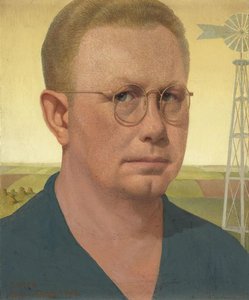
Grant Wood
1891 - 1942 , United States of America
Quick Facts
- Full Name: Grant DeVolson Wood
- Nationality: American
- Date Of Birth: 1891
- Date Of Death: 1942
- Place Of Birth: Anamosa, United States of America
- Notable Artworks:
- American Gothic
- Portrait of Nan
- The Appraisal
- Spring In Town
- Artistic Movement Or Style: American Regionalism
- Artists Who Influenced This Artist: ['Jan van Eyck']
- Artists Or Movements Influenced By This Artist: ['Regionalism']
Related Articles

Sandstone & Sunlight: 10 Masterpieces of Earth-Toned Art |
Journey through 10 iconic paintings bathed in 'sand' tones – from Van Gogh to Monet. Explore the stories, techniques & warm palettes of these timeless masterpieces. Find museum-quality art reproductions at and bring classic beauty home.

Grant Wood & American Regionalism: Identity, Myth & the Rural Landscape
Explore the world of Grant Wood & American Regionalism with OriginalUniqueArt. Discover the symbolism behind 'American Gothic', recurring themes, and the movement's lasting impact on art history. High-quality reproductions available.

American Regionalism: The Soul of the Heartland and the Mastery of Grant Wood
Explore the profound history of American Regionalism. Discover how Grant Wood captured the heart of the Midwest through masterpieces like American Gothic. An expert guide to the movement, its cultural impact, and the enduring beauty of American Realism.
Earthy Hues & Masterpieces: Top 10 Paintings with 'Mushroom' Tones |
Explore 10 iconic paintings with captivating 'mushroom' tones! Discover Van Gogh, Monet & Rembrandt’s masterpieces—earthy palettes, rich history & artistic techniques. Find museum-quality art reproductions and curated decor ideas at

Earthy Hues & Masterpieces: Top 10 Paintings Dominated by Clay Tones |
Explore 10 iconic paintings dominated by rich clay tones – from Rembrandt's warmth to Van Gogh’s earthy landscapes. Discover art history, techniques & find museum-quality reproductions at . Explore the full collection online!