Preview
 Send
Send Share
Share
 Details
 Guide
Guide

 Download
 Similars
 X-Ray
X-Ray Diaporama
 Stats
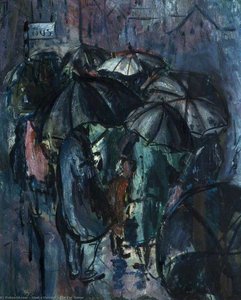
StatsThe Bus Queue
 1949
1949 39.0 x 31.0 cm
 Read More
The artwork displayed on this page is protected by copyright law, which means we cannot legally create or sell an identical reproduction. This protection is enforced under international agreements such as the Berne Convention and by national laws, including those outlined by the U.S. Copyright Law - Title 17.
This method fully complies with copyright regulations because it does not involve copying or duplicating the protected artwork. Instead, it is a creative reinterpretation - a new painting that is influenced by the original but not identical to it.
Giclée / Art Print
Museum-quality giclée or canvas print with fast production and flexible finish options. ( Buy Hand Made Painting Switch to Digital Image)




































Pick from our preset sizes that match the artwork's original proportions.

Type the width and the height you need, to fit your frame or your wall. A print can only be cut, never made bigger than the picture, so a size with a different shape loses a part of the image. We send you a digital mockup to approve before we print anything. The picture shown on this page does not show the real cut — only the mockup does.
Worldwide Delivery () in 2 weeks instead of standard 4/5 weeks. (24 October)

Free Worldwide Express Shipping

High-Quality Linen Canvas

Full Shipping Insurance

Customs Tax Refund Guarantee

True Color Matching Guarantee

100-Day Return Policy (Defects Only)

100% Money-Back Guarantee

Bulk Discount Offer
 Glass option is only available in size under 110 CM

The Bus Queue
Giclée / Art Print
Reproduction Size
-


Total Price
$ 81
A Glimpse into Everyday Life
The scene is set on a city street, with cars parked along the sidewalk and individuals carrying handbags. The umbrellas come in various sizes and colors, adding visual interest to the image. The overall atmosphere of the painting suggests that it was created during the rainy season or in an area prone to rain. Gladys Maccabe's use of oil on panel creates a sense of depth and texture, drawing the viewer into the scene. Key Features:- The painting's small size belies its impact, with intricate details that reward close inspection.
- The use of color is muted, with earthy tones dominating the palette.
- The composition is balanced, with the figures arranged in a harmonious pattern.
The Ulster Museum is also home to other notable works, including pieces by Sir John Lavery, such as On the Loing: An Afternoon Chat (also known as Under the Cherry Tree). You can explore these artworks and more on /art/list/?Filter=8YDKN2-Sir-John-Lavery-On-the-Loing:-An-Afternoon-Chat-(also-known-as-Under-the-Ch...
Questions & Answers
Can I watch "The Bus Queue" as a full-screen slideshow?
"The Bus Queue" by Gladys Maccabe can be viewed as a slideshow on the artwork's Diaporama page.
Who sells hand-painted copies of "The Bus Queue" by Gladys Maccabe?
You can order a hand-painted reproduction of "The Bus Queue" by Gladys Maccabe directly on its Hand-Painted Reproduction page: a hand-painted oil reproduction on linen canvas, made to order.
What is the luminance of "The Bus Queue" by Gladys Maccabe?
The colors of "The Bus Queue" show a dark luminance.
Artist Biography
A Life Shaped by Color and Line
In the quiet town of Randalstown, County Antrim, a young girl named Gladys Moore Maccabe began to see the world through a lens of fine detail and design. She was born into a household where art was woven into the very fabric of daily life; her mother, Elizabeth, worked as a designer in the linen industry, while her father, George Chalmers, brought the disciplined beauty of calligraphy and illumination to their home. This early immersion in craftsmanship meant that by the age of thirteen, her talent was already finding its way into national publications. The precision required for such work stayed with her as she moved to Belfast to study sculpture and commercial art at the Belfast School of Art.
Her path was deeply intertwined with that of Max Maccabe, a fellow artist and musician whom she married in 1941. Together, they shared more than a home; they shared a creative pulse, exhibiting their works side by side in galleries from Belfast to London. They were part of a circle of painters known as The Contemporary Ulster Group, finding companionship in the shared experimentation of their era. Even as she navigated the complexities of her personal life, such as the loss of her father which led her to remain in Ulster rather than pursuing studies in London, her commitment to the local art scene never waed.
The Pulse of Everyday Life
Gladys possessed a particular eye for the movement of crowds and the quiet energy of communal spaces. Her canvases often focused on the simple, shared moments of Northern Irish life: the bustle of a market, the excitement of a race meeting, or the calm of a beach. She had a way of capturing people in their natural elements, whether they were waiting for a bus on a rainy day or gathered at a local fair. This interest in the human element extended to her still lifes and floral studies, where she applied the same careful observation she used for larger social scenes.
As the years progressed, the atmosphere around her changed. During the height of The Troubles in 1969, the peace of her earlier subjects was interrupted by the harsh realities of conflict. She turned her brush toward the streets of Belfast, documenting the presence of barricades and the heavy shadows cast by civil unrest. Works such as Barricades and Petrol Bomb Sequel reflected a landscape transformed by tension, showing that her art could hold both the charm of a summer market and the gravity of a changing society.
A Legacy of Advocacy and Recognition
Beyond her own brushwork, Gladys was a driving force for others. In 1957, moved by the lack of opportunities for her female peers, she founded the Ulster Society of Women Artists. She served as its first President, beginning with just ten members, to ensure that the talent of women in Northern Ireland would no longer go unnoticed. Her work as a journalist and arts correspondent further allowed her to shape the cultural conversation, bringing news of fashion and fine art to newspapers and television audiences alike.
Her many honors reflected a lifetime of dedication to the arts. She was appointed an MBE for her services to the community and held fellowships in several prestigious societies. Her paintings found permanent homes in significant collections, including:
- The Ulster Museum
- The Royal Ulster Academy
- The Arts Council of Ireland Collection
- The Imperial War Museum
Through her dual roles as a creator and an advocate, she left behind a record of a century defined by both beauty and struggle.

Gladys Maccabe
1918 - 2018
Quick Facts
- Artistic Movement Or Style: Realism
- Artists Or Movements Influenced By This Artist: ['Ulster Society of Women Artists']
- Artists Who Influenced This Artist: ['Sir George Chalmers']
- Full Name: Gladys Moore Maccabe
- Nationality: Northern Irish
- Notable Artworks:
- William Conor
- In the Park
- The Bus Queue
- Flower Seller
- Barricades
- Blazing Warehouse
- Petrol Bomb Sequel
- Funeral of a Victim
- Place Of Birth: Randalstown, Northern Ireland
- Date Of Birth: 1918
- Date Of Death: 2018