
 Preview
 Send
Send Share
Share
 Details
 Guide
Guide

 Download
 Similars
 X-Ray
X-Ray Diaporama
 Q&A
Q&A Stats
StatsSummer

- 76.0 x 64.0 cm


 Read More
Giclée / Art Print
Museum-quality giclée or canvas print with fast production and flexible finish options. ( Buy Hand Made Painting Switch to Digital Image)




P118B $10

P118H $10

P118W $10

P438Z $10

P508JH $12

P508YH $12

P805H $10

P805Z $10

P919BZ $10

P919G $10

P919XJ $10

P959ZH $10

P968JZ $12

W106C $8

W218G $10

W218JH $8

W218Y $10

W307PJ $10

W316G $10

W316PJ $8

W316Y $10

W398PJ $8

W4111J $10

W500HY $15

W500JH $15

W692G $12

W849H $8

W940BG $15

W953PJ $8




Pick from our preset sizes that match the artwork's original proportions.

Type the width and the height you need, to fit your frame or your wall. A print can only be cut, never made bigger than the picture, so a size with a different shape loses a part of the image. We send you a digital mockup to approve before we print anything. The picture shown on this page does not show the real cut — only the mockup does.
Worldwide Delivery () in 2 weeks instead of standard 4/5 weeks. (11 November)

Free Worldwide Express Shipping

High-Quality Linen Canvas

Full Shipping Insurance

Customs Tax Refund Guarantee

True Color Matching Guarantee

100-Day Return Policy (Defects Only)

100% Money-Back Guarantee

Bulk Discount Offer
 Glass option is only available in size under 110 CM

Summer
Giclée / Art Print
Reproduction Size
-


Total Price
$ 81
A Portrait of Abundance and Allegory
Giuseppe Arcimboldo’s “Summer,” painted in 1573, is not merely a portrait; it's an immersive allegory, a vibrant testament to the Renaissance fascination with nature, wealth, and the cyclical rhythms of life. This arresting image immediately captivates with its audacious composition: a figure, largely obscured by a dense profusion of fruits, vegetables, grains, and foliage, dominates the canvas. It’s a visual feast, a carefully constructed puzzle where each element—the blushing apples, the plump pears, the sturdy wheat stalks—contributes to a larger narrative of prosperity and fertility. The tight cropping, focusing intently on the upper torso and head, intensifies the impact, drawing the viewer into this extraordinary tableau.
Arcimboldo’s genius lies in his masterful manipulation of materials and technique. Executed in oil on wood panel, the painting showcases an astonishing level of detail. Lines delineate the contours of each fruit and vegetable with precision, while subtle shading and layering create a remarkable sense of texture – you can almost feel the rough skin of an onion or the yielding flesh of a peach. The lighting, emanating from a single, unseen source, casts delicate shadows that imbue the scene with depth and three-dimensionality, lending a tangible quality to this fantastical assemblage.
The Renaissance Worldview
To understand “Summer,” one must consider the intellectual climate of 16th-century Italy. The Renaissance was a period of profound transformation, marked by a renewed interest in classical antiquity and a burgeoning spirit of humanism. Arcimboldo’s work reflects this shift, blending artistic skill with symbolic representation. The profusion of produce isn't simply decorative; it speaks to the importance of agriculture and harvest – vital elements of Renaissance society. The image directly aligns with the era’s preoccupation with themes of abundance, wealth, and the interconnectedness of humanity and nature. It’s a visual embodiment of the belief that earthly prosperity reflected divine favor.
Furthermore, Arcimboldo's work was often commissioned by powerful figures like Rudolf II, Holy Roman Emperor, who appreciated his ability to create complex allegories within seemingly simple portraits. The choice of fruits and vegetables held specific meanings – wheat symbolized fertility and abundance, grapes represented joy and celebration, while garlic signified protection and good health. The image functioned as a visual language, communicating ideas about power, status, and the natural order.
Symbolism and Emotional Resonance
Beyond its historical context, “Summer” resonates with a powerful emotional depth. The obscured face of the figure creates an intriguing sense of mystery – who is this person? The overwhelming abundance can be interpreted as both celebratory and slightly unsettling, hinting at the potential excesses of wealth and power. The image evokes a feeling of being immersed in nature, surrounded by its bounty, yet simultaneously aware of the fleeting nature of beauty and the inevitability of decay.
Arcimboldo’s innovative approach to portraiture challenged conventional notions of representation, transforming the human form into an elaborate still life. “Summer” stands as a testament to his artistic vision—a captivating blend of realism, symbolism, and sheer visual inventiveness that continues to fascinate viewers centuries later. It's a work that invites contemplation, prompting us to consider the relationship between humanity, nature, and the enduring power of art.
Questions & Answers
Which artist and which style stand behind "Summer"?
"Summer" was created by Giuseppe Arcimboldo in the Renaissance style. Artist and movement identify the work's tradition.
How is "Summer" by Giuseppe Arcimboldo proportioned, and how big is it?
"Summer" by Giuseppe Arcimboldo is a portrait composition measuring 76 x 64 cm in the original.
What kind of colors does "Summer" use?
"Summer" by Giuseppe Arcimboldo uses an earthy color palette. The palette summarizes the work's overall color character.
Artist Biography
Early Life, Family and Training
Born in Milan, Italy, in 1527, Giuseppe Arcimboldo entered a world where the boundaries of visual representation were already being tested. His path into the arts was a familial one, guided by his father, Biagio Arcimboldo, an artist who provided the essential foundation for his son's development. This early immersion in the craft ensured that the technicalities of design were ingrained in him from his earliest years.
As his talent matured, his education expanded beyond the domestic sphere. He sought the guidance of established masters, studying under the Milanese painter Giuseppe Meda and Bernardino Campi. These mentors helped refine his eye for detail and his understanding of form. By the age of 21, he had begun his professional career, working as a designer for stained glass and frescoes within local cathedrals. This early work required a disciplined command of color and composition, skills that would later support his more experimental endeavors.
Patrons and Courtly Commissions
Arcimboldo’s career found its most stable and influential footing within the halls of the Habsburg court. His appointment as court portraitist to the royal House of Habsburg marked a significant shift from his earlier design work. For over 25 years, he navigated the complex social and political requirements of imperial service, providing a visual language for one of Europe's most powerful dynasties.
His service began in Vienna, Austria, under the patronage of Holy Roman Emperor Ferdinand I. From this position, his influence expanded as he moved through the successive reigns of the family. He provided his talents to Maximilian II and eventually served the Emperor's grandson, Rudolf II, in Prague. This long-term relationship with the Habsburgs allowed him the freedom to develop his most distinctive and unusual compositions, moving far beyond the standard portraiture expected of a court official.
While his primary duty involved capturing the likenesses of the nobility, his responsibilities were often varied. His role within the court included designing costumes and decorations for festivals, as well as managing the organization of imperial collections. This multifaceted involvement in court life ensured that his presence was felt in both the formal ceremonies and the private intellectual circles of the imperial residences.
Technique and Unique Style
Arcimboldo’s most distinctive contribution to the visual language of the sixteenth century was the development of "composite heads." This method moved beyond the traditional boundaries of portraiture by constructing human likenesses from a meticulous assemblage of disparate objects. He specialized in grotesque symbolical compositions, where the anatomy of a face was reimagined through the arrangement of fruits, vegetables, flowers, animals, books, and various inanimate objects. These works were often viewed as curiosities, yet they required a sophisticated understanding of how to merge the organic with the artificial to create a recognizable human form.
His technical precision allowed him to transform the mundane into the anatomical. To achieve this, he utilized hatching and cross-hatching techniques, creating textures that mimicked the specific surfaces of his chosen materials. A peach might provide the soft curve of a cheek, while the prickly skin of an artichoke or the textured rind of a pumpkin could define a jawline or a nose. This careful manipulation of light and shadow ensured that the individual components, though clearly distinct, coalesced into a singular, coherent visage. His ability to render the velvety skin of fruit or the delicate petals of a flower with such accuracy allowed the viewer to oscillate between seeing a still life and seeing a person.
- The Librarian (circa 1566)
- Flora (1589)
- Vertumnus (c. 1590-1591)
Key Works and Masterpieces
The artist’s most distinctive approach reached a public milestone on New Year’s Day in 1569, when he premiered his composite heads to Maximilian II. These works, which assembled human likenesses from the bounty of the earth, signaled a departure from the more traditional portraiture of his early career. Among these assemblages, The Librarian emerged as a notable piece, part of a series depicting members of Maximilian's entourage. In this work, the subject is rendered through an accumulation of books, a choice that links the sitter's identity to his intellectual profession.
As his career progressed, his compositions grew in both complexity and botanical detail. In 1589, he completed Flora, a portrait of the Roman goddess of flowers that utilized blossoms and petals to define her features. This period of experimentation continued into his later years, culminating in the 1591 production of Vertumnus. This work, depicting the Roman god of the seasons, utilized a variety of fruits and vegetables to create the likeness of Holy Roman Emperor Rudolf II. The choice of produce was intended to represent the ruler's dominion over the natural and earthly realms.
- The Librarian (circa 1566)
- Flora (1589)
- Vertumnus (1591)
Legacy and Artistic Influence
The rediscovery of Arcimboldo’s vision arrived long after his death, finding a second life when the twentieth century sought to map the subconscious. His peculiar method of constructing human likenesses from the natural world provided a blueprint for the Surrealist movement. Painters such as Salvador Dalí and Pablo Picasso found a kindred spirit in his ability to manipulate perception, drawing from his habit of assembling disparate objects into a singular, recognizable identity. His work suggests that the boundary between the organic and the artificial is far more porous than traditional portraiture allows.
This eccentric approach is most clearly seen in his depictions of the seasons. In his portraits of Summer and Winter, the human form is entirely subsumed by the textures of the harvest and the cold, creating a visual riddle that demands a second glance. These compositions do more than mimic a face; they transform the anatomy of a person into a landscape of flora and fauna. By treating the human visage as a puzzle of botanical and inanimate parts, he anticipated the dreamlike juxtapositions that would later define modern surrealist thought.
Where to See His Works Today
The physical remnants of Arcimboldo’s imagination are scattered across Europe, preserved within the halls of institutions that once served the very courts he once entertained. In Vienna, the Kunsthistorisches Museum holds a significant portion of his output, including his studies of the seasons and various allegorical figures. These works remain in the city that served as a central hub for his career under the Habsburg rulers.
Other significant collections can be found in the major cultural centers of France and Italy. The Louvre in Paris houses several of his compositions, while the Uffizi Gallery in Florence maintains works that reflect his technical precision. His presence in these museums ensures that his peculiar method of assembling human likenesses from the natural world remains accessible to those studying the Mannerist period.
A notable collection of his paintings resides in Sweden, specifically within the Skokloster Castle. This site preserves works that arrived in the region following the historical movements of the seventeenth century. Visitors seeking to encounter his specific approach to portraiture might find these pieces particularly telling of his service to the imperial entourage.
- The Librarian (circa 1566)
- Vertumnus (1591)
- Flora (1589)
- Summer (1563)
- Winter (1573)

Giuseppe Arcimboldo
1527 - 1593 , Italy
Related Articles

Mastering the Surface: The Timeless Elegance and Technical Brilliance of Oil on Panel Painting
Discover the enduring allure of oil on panel painting. Explore the technical mastery, historical significance, and luminous depth that define this prestigious medium, from Renaissance masters to modern fine art reproductions for discerning collectors.
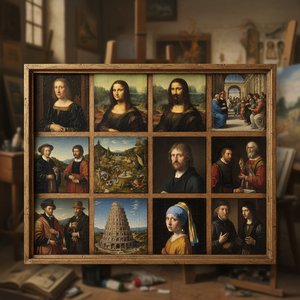
Oil on Panel Masters: 10 Paintings That Revolutionized Art |
Journey through 10 legendary 'Oil on Panel' masterpieces by Van Eyck, Bosch & Bruegel. Explore the stories behind these iconic Renaissance & Baroque paintings and find museum-quality art reproductions to elevate your home decor. Discover all masterpieces on !

The Bountiful Still Life: Symbolism & Artistic Representation of Fruit Across Art History
Explore the rich history of still life painting & the symbolism of fruit across art movements. Discover masterpieces from Caravaggio to Cézanne with OriginalUniqueArt – expert guidance & museum-quality reproductions.
Oil on Panel: A Historical Survey of Technique, Support & Aesthetic Evolution
Explore the rich history of oil on panel painting! Discover Renaissance techniques, support structures & aesthetic evolution. Expert insights for art collectors and enthusiasts.

Mastering the Surface: A Historical and Technical Guide to the Art of Oil on Panel Painting
Explore the profound history and technical brilliance of oil on panel painting. From Renaissance masters to modern techniques, discover why this rigid support offers unparalleled precision and permanence for fine art lovers and collectors.





