Preview
 Send
Send Share
Share
 Details
 Guide
Guide

 Download
 Similars
 X-Ray
X-Ray Diaporama
 Q&A
Q&A Stats
StatsFiori


 Read More
The artwork displayed on this page is protected by copyright law, which means we cannot legally create or sell an identical reproduction. This protection is enforced under international agreements such as the Berne Convention and by national laws, including those outlined by the U.S. Copyright Law - Title 17.
This method fully complies with copyright regulations because it does not involve copying or duplicating the protected artwork. Instead, it is a creative reinterpretation - a new painting that is influenced by the original but not identical to it.
Giclée / Art Print
Museum-quality giclée or canvas print with fast production and flexible finish options. ( Buy Hand Made Painting Switch to Digital Image)




































Pick from our preset sizes that match the artwork's original proportions.

Type the width and the height you need, to fit your frame or your wall. A print can only be cut, never made bigger than the picture, so a size with a different shape loses a part of the image. We send you a digital mockup to approve before we print anything. The picture shown on this page does not show the real cut — only the mockup does.
Worldwide Delivery () in 2 weeks instead of standard 4/5 weeks. (1 November)

Free Worldwide Express Shipping

High-Quality Linen Canvas

Full Shipping Insurance

Customs Tax Refund Guarantee

True Color Matching Guarantee

100-Day Return Policy (Defects Only)

100% Money-Back Guarantee

Bulk Discount Offer
 Glass option is only available in size under 110 CM

Fiori
Giclée / Art Print
Reproduction Size
-


Total Price
$ 81
A Tapestry of Warmth and Solitude
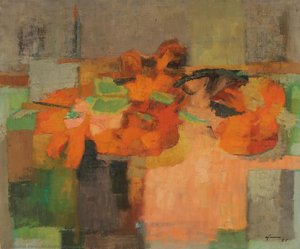
In the evocative oil painting Fiori, created in 1955 by the Italian master Giuseppe Ajmone, we are invited into a dreamlike realm where the boundaries between reality and abstraction begin to dissolve. The canvas presents a stylized depiction of figures seated within an outdoor setting, yet the scene transcends mere landscape. Through a masterful use of warm orange hues, pinks, and soft greens, Ajmone crafts an atmosphere that feels simultaneously intimate and profoundly melancholic. There is a palpable sense of stillness in the composition, as if we have stumbled upon a fleeting, quiet moment frozen in time. The flattened perspective denies the viewer traditional depth, instead pulling us into a textured, two-dimensional world where emotion takes precedence over anatomical precision.
The technique employed in Fiori is a testament to the expressive power of the painterly style. Ajmone utilizes loose, gestural brushstrokes that lend the work a tactile, rhythmic energy. Rather than relying on sharp outlines to define his subjects, he uses irregular lines and thick applications of paint to suggest form. This emphasis on texture allows the light—diffused and soft, as if filtered through an overcast sky—to dance across the surface of the canvas. The interplay between the vibrant oranges and the grounding darker browns and grays creates a visual tension that keeps the eye moving, discovering new layers of movement within the seemingly static figures.
The Expressionist Soul and Artistic Legacy
Rooted in the traditions of mid-century Expressionism, Fiori reflects the broader artistic dialogues occurring in post-war Europe. Having studied at the prestigious Brera Academy under luminaries such as Carlo Carrà, Ajmone was deeply influenced by the evolution of modernism. His work often bridges the gap between the semi-abstracted figures reminiscent of Picasso and the lush, color-driven intimacy found in the works of Bonnard. In this piece, the simplified, almost geometric rendering of the human forms serves a symbolic purpose; they become vessels for contemplation, representing the universal themes of solitude and the quiet connection shared between beings in a vast, changing world.
For the discerning collector or interior designer, Fiori offers more than just aesthetic beauty; it provides a profound emotional anchor for a space. The painting’s warm palette makes it an ideal centerpiece for rooms designed for relaxation and reflection, such as a study or a sophisticated lounge. As a high-quality reproduction, this work brings the historical weight of the 1950s Italian avant-garde into the modern home, offering a sophisticated touch of texture and color that inspires conversation and evokes a sense of timelessness.
Questions & Answers
Who created "Fiori"?
"Fiori" is attributed to Giuseppe Ajmone.
Who created "Fiori" and what style is it in?
Giuseppe Ajmone created "Fiori" within the Expressionism movement.
What is the dominant hue of "Fiori" by Giuseppe Ajmone?
"Fiori" leans toward a golden yellow range tone.
Artist Biography
early life and education
giuseppe ajmone, a renowned italian painter, was born in carpignano sesia, italy in 1923. he moved to milan in 1941 to study at the brera academy under the guidance of achille funi and carlo carrà.artistic career
ajmone's artistic career was marked by his participation in various exhibitions, including the manifesto del realismo (also known as oltre guernica) in 1946. he received an award at the first national exhibition of painting at bellagio. in 1950, he participated in the 25th international exhibition at the biennale of venice, followed by the premio senatore borletti for young italian painters in 1951.international exhibitions and collaborations
ajmone's work was showcased globally, including:- biennale di san paolo del brasile (1951 and 1959)
- biennale internazionale di tokyo (1959)
- pittsburgh international museum of art (1955 and 1958)
- copenhagen, dortmund, nuremberg, and buenos aires
notable works and style
ajmone's paintings often featured landscapes and semi-abstract figures. his style was influenced by notable artists such as bonnard, picasso, braque, and nicolas de staël. however, ajmone's work was characterized by its subtlety, melancholy, and intimacy.later life and legacy
ajmone settled in romagnano sesia (novara) in 1982, where he lived until his passing in 2005. his legacy continues to be celebrated through various exhibitions and the conservation of his work. view giuseppe ajmone's artworks on OriginalUniqueArt:- giuseppe ajmone | 10 artworks
- giuseppe ajmone: nudo alla finestra (museo del novecento, milan, italy)

Giuseppe Ajmone
1923 - 2005 , Italy
Quick Facts
- Full Name: Roy Fox Lichtenstein
- Nationality: American
- Date Of Birth: 1923
- Date Of Death: 2005
- Place Of Birth: Carpignano Sesia, Italy
- Notable Artworks:
- Look Mickey
- Whaam!
- Drowning Girl
- Artistic Movement Or Style: Pop Art
- Artists Who Influenced This Artist:
- Rembrandt
- Daumier
- Picasso
- Artists Or Movements Influenced By This Artist:
- Comic Strips
- Advertising
Related Articles

Beyond the Lines: Mastering the High-Impact World of Contemporary Abstraction
Master the high-impact world of contemporary abstraction. Discover how bold colors, textures, and modern movements like Abstract Expressionism can transform your space with premium, high-energy art curated for the design-conscious professional.
The Soul of Color: A Journey into the Emotional Resonance of Lyrical Abstraction
Embark on a cultural journey through Lyrical Abstraction. Explore how masters like Kandinsky used color and motion to translate emotion into visual poetry. Discover the profound beauty of abstract expressionism and learn to curate emotional resonance in your own art collection.

Abstract Expressionism's 10 Defining Masterpieces |
Explore 10 defining Abstract Expressionism masterpieces by Pollock, Rothko & de Kooning. Discover the stories behind these iconic paintings and find museum-quality art reproductions to elevate your home decor on .

Geometric Abstraction's 10 Defining Masterpieces | Art for Your Home - OriginalUniqueArt
Explore 10 defining masterpieces of Geometric Abstraction! Discover Kandinsky, Mondrian & Malevich’s iconic works. Find museum-quality art reproductions and curated decor ideas to elevate your home at OriginalUniqueArt.com.

Mastering Abstraction: The 25 Most Iconic Works by Wassily Kandinsky
Explore 25 iconic Kandinsky masterpieces and the birth of abstraction. Discover the full collection online at OriginalUniqueArt.com.