Switch to Print
 Read More







































 For artworks or reproductions larger than 105 cm (approximately 41 inches) on any side, the frame will be shipped as a kit, disassembled. This method ensures safe delivery and prevents damage during transport.


An Intimate Encounter with Light and Form
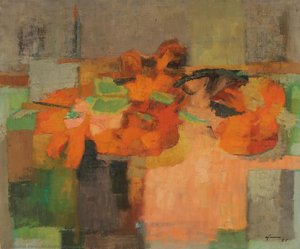
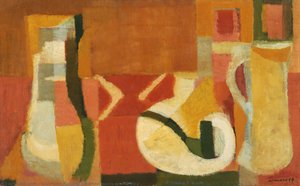
In the quiet, private moments of domestic life, there exists a profound beauty that often escapes the hurried gaze of the world. Giuseppe Ajmone, a master of capturing these ephemeral instances, invites us into such a moment with his 1954 masterpiece, Donna che si lava (Woman Washing). The painting presents us with a figure seen from behind, her back turned to the viewer as she engages in a ritual of cleansing. This perspective creates an immediate sense of voyeuristic intimacy, yet it remains deeply respectful, drawing the observer into a private sanctuary rather than intruding upon it. The composition is a delicate dance of light and shadow, where the warmth of pinks and yellows breathes life into the skin, transforming a mundane bathroom setting into a stage of vibrant, chromatic expression.
The technique employed by Ajmone reflects his deep connection to the post-war Italian tradition, blending elements of semi-abstraction with a palpable sense of reality. Influenced by the luminous palettes of Pierre Bonnard and the structural boldness of Picasso, Ajmone utilizes color not merely as a descriptive tool but as an emotional language. The way the light dances across the woman's form suggests a fluid, almost rhythmic movement, where the boundaries between the subject and her environment begin to soften. Scattered throughout the scene, objects such as a delicate cup, a bottle, and various bowls are rendered with a painterly touch that emphasizes texture and light over rigid detail, contributing to a dynamic composition that feels both grounded and dreamlike.
A Legacy of Italian Modernism
To understand the depth of Donna che lava, one must look toward the rich historical tapestry of Ajmone’s career. Emerging from the prestigious Brera Academy under the tutelage of masters like Achille Funi and Carlo Carrà, Ajmone was a central figure in the mid-century Italian art scene. His participation in landmark exhibitions, such as the Manifesto del Realismo and the prestigious Venice Biennale, places this work within a period of intense artistic exploration following World War II. This era was defined by a search for a new visual language—one that could reconcile the weight of tradition with the burgeoning freedom of modern abstraction. In this painting, we see that reconciliation perfectly realized; it is a work that honors the human figure while embracing the expressive potential of color and light.
For the discerning collector or interior designer, this piece offers more than just visual appeal; it provides an emotional anchor for a sophisticated space. The warmth of the palette makes it an ideal centerpiece for rooms designed to evoke tranquility and refinement. Whether placed in a sun-drenched morning room or a moody, contemporary study, the painting’s ability to command attention through subtle nuance ensures it remains a conversation piece for years to come. Owning a reproduction of such a significant work allows one to bring a fragment of Italian modernism into the home, fostering an environment of cultured contemplation and timeless elegance.
Questions & Answers
Is "Donna che si lava" by Giuseppe Ajmone a bright or a dark artwork?
Overall, "Donna che si lava" is recorded as brilliant. Perceived brightness describes how light or dark the work appears.
Can I order an oil reproduction of "Donna che si lava"?
Hand-painted copies of "Donna che si lava" by Giuseppe Ajmone are sold on this website: a hand-painted oil reproduction on linen canvas, ordered from its Hand-Painted Reproduction page.
Can "Donna che si lava" by Giuseppe Ajmone, held at the Museo del Novecento, be legally reproduced?
The original "Donna che si lava" is at the Museo del Novecento, and the work is still protected by copyright.
More about this painting
 Preview
 Send
Send Share
Share
 Details
 Guide
Guide

 Download
 Similars
 X-Ray
X-Ray Diaporama
 Q&A
Q&A Stats
Stats