Menu
FREE ART CONSULTATION
PreviewPreview AR previewAR preview Buy Print Buy PrintBuy Image Buy Image SendSend
DetailsDetails Add to favorites Add to favorites DownloadDownload SimilarsSimilars X-RayX-Ray DiaporamaDiaporama

St Barbara

Experience the serene Renaissance beauty of St Barbara by Giovanni Antonio Boltraffio; discover this masterpiece echoing Italian artistic brilliance.

Discover Giovanni Antonio Boltraffio, a Lombard Renaissance painter known for his Leonardo-influenced portraits & Madonnas. Explore his works in Milan & Berlin.

Hand Made Oil Reproduction

Hand-painted oil on canvas in your size and frame, made to order by our artists. (Buy Print Buy PrintBuy Image Buy Image)

P118B $10
P118H $10
P118W $10
P438Z $10
P508JH $12
P508YH $12
P805H $10
P805Z $10
P919BZ $10
P919G $10
P919XJ $10
P959ZH $10
P968JZ $12
W106C $8
W218G $10
W218JH $8
W218Y $10
W307PJ $10
W316G $10
W316PJ $8
W316Y $10
W398PJ $8
W4111J $10
W500HY $15
W500JH $15
W692G $12
W849H $8
W940BG $15
W953PJ $8

Standard
custom
CM
INCH

Pick from our preset sizes that match the artwork's original proportions.

width
height

You may enter your own dimensions to fit a specific frame or space. If your selected size does not match the original image's proportions, we will either crop the artwork or extend the painting with additional hand-painted elements. A digital mockup will be sent for your approval before production begins.
Please note that the on-screen preview does not reflect the actual cropping or extension. Only the mockup will accurately show the final composition.
While custom sizes are available, we recommend selecting a dimension from the predefined list to preserve the original proportions.

Examples of what can be changed: Replace face with customer photo; Add pet (e.g., replace cat with dog); Include hidden message in background; Change background landscape or elements.
After order, OriginalUniqueArt.com team will email client for instructions and provide a mockup preview

Worldwide Delivery () in 3/4 weeks instead of standard 5 weeks. (16 August). No compromise on quality.

why_choose_icon
Free Worldwide Express Shipping
why_choose_icon
High-Quality Linen Canvas
why_choose_icon
Full Shipping Insurance
why_choose_icon
Customs Tax Refund Guarantee
why_choose_icon
True Color Matching Guarantee
why_choose_icon
60-Day Return Policy (Defects Only)
why_choose_icon
100% Money-Back Guarantee
why_choose_icon
Bulk Discount Offer

Total Price

$ 300

reproduction

St Barbara

Reproduction Medium

Reproduction Size

-

Total Price

$ 300

Quick Facts

  • Year: 1493
  • Movement: Renaissance
  • Notable elements or techniques:
    • Light and shadow
    • Richly detailed garments
  • Title: St Barbara
  • Medium: Painting
  • Location: Staatliche Museen (Berlin)

Art Quiz

There is only one correct answer for each question.

Question 1:
What is the central subject of the painting?
Question 2:
Which artistic period does the style of this painting most closely resemble?
Question 3:
According to the description, what object is St. Barbara holding in her right hand?
Question 4:
What notable historical connection is mentioned regarding the artist, Giovanni Antonio Boltraffio?
Question 5:
What element in the background is interpreted as a reference to St. Barbara's legend?

Artwork Description

The Serene Majesty of St. Barbara

To gaze upon this depiction of St. Barbara is to step into a moment suspended between earthly devotion and divine grace. The painting radiates a profound sense of contemplative peace, drawing the viewer into the quiet sanctity surrounding the saint. Her presence is commanding yet gentle; her long hair seems to catch an unseen light, framing a face etched with serene contemplation. The artist has masterfully captured not just a likeness, but a spiritual state—a quiet resilience that speaks across the centuries.

A Tapestry of Renaissance Technique and Color

The technical brilliance evident in this work is a testament to the mastery of its period. Notice how the light, seemingly originating from the upper left, sculpts the form of St. Barbara, creating soft gradations of shadow that lend incredible depth to her figure. This sophisticated handling of chiaroscuro gives the painting a three-dimensional vitality rarely matched. The color palette itself is a careful orchestration: the vibrant red cloak provides a dramatic counterpoint to the softer yellow robe and the muted earth tones of the background landscape. These rich, saturated hues, characteristic of High Renaissance sensibilities, anchor the divine subject within a believable, yet idealized, natural world.

Symbolism Woven into Form

Every element within this composition whispers a story rooted in Christian tradition. In her left hand, she cradles a small book, suggesting the sacred wisdom she embodies, while the chalice held aloft in her right speaks to ritual and enduring faith. Furthermore, the background is not merely decorative; it features that evocative tower structure on the left—a subtle but potent nod to the legend of her imprisonment, transforming the setting into an allegory for spiritual fortitude. These objects elevate the portrait from a mere depiction to a profound meditation on virtue.

Historical Echoes and Enduring Appeal

Dating to 1493, this piece stands as a beautiful artifact from the cusp of major artistic revolutions. Attributed in style to Giovanni Antonio Boltraffio, it carries the weight of Milanese Renaissance artistry—a period obsessed with perfecting human form while simultaneously reaching for the sublime. For those who appreciate art that speaks across epochs, owning a reproduction of this work is not simply decorating a space; it is curating a piece of history. It brings an aura of learned elegance and timeless devotion into any room, making it a breathtaking focal point for collectors and designers alike.


Artist Biography

Giovanni Antonio Boltraffio: A Shadow in the Studio of Leonardo

Giovanni Antonio Boltraffio, born around 1467 in the fertile artistic landscape of Lombardy, remains one of the most captivating figures of the High Renaissance. While history often casts him as a secondary figure, he was far more than a mere follower; he was a vital conduit through which the revolutionary innovations of Leonardo da Vinci were transmitted and refined. Growing up in a region steeped in tradition, Boltraftio’s early life likely benefited from an aristocratic Milanese upbringing, providing him with the foundational training necessary to enter the most prestigious workshop of his era. Around 1490, he began his profound association with Leonardo, a partnership that would span nearly four decades and define the trajectory of his creative soul.

To study Boltraffio is to witness a masterclass in artistic absorption. Within the walls of Leonardo’s studio, Boltraffio did not simply mimic; he interpreted. He breathed in the sfumato technique—that smoky, seamless transition between light and shadow—and applied it with a unique sense of clarity and structural precision. While Leonardo often pursued the ethereal and the scientifically enigmatic, Boltraffio brought a certain austerity and refined elegance to his subjects. His work possesses a crystalline quality that, while deeply indebted to his master’s atmospheric genius, maintains a distinctively Lombard character characterized by sharp detail and a serene, almost sculptural presence.

The Mastery of Portraiture and Devotional Grace

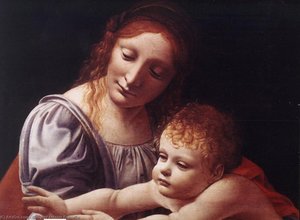
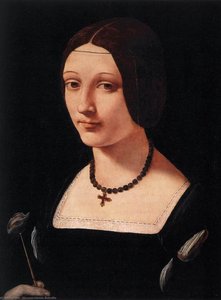
The true brilliance of Boltraffio lies in his ability to capture the quiet dignity of the human spirit. His portraits are renowned for their enigmatic beauty, often featuring subjects that seem caught in a moment of profound introspection. In works such as Portrait of a Young Woman, one can sense the lingering influence of Leonardo’s psychological depth, yet there is an unmistakable Boltraffio touch—a meticulous rendering of textures and a focused, luminous gaze that commands the viewer's attention. He had a remarkable gift for translating the nobility of his sitters into paint, creating images that feel both timeless and intimately human.

Beyond the secular realm, Boltraffio’s devotion to religious iconography allowed him to explore the heights of Renaissance symbolism. His depictions of the Madonna and Child serve as quintessential examples of his technical prowess and spiritual sensitivity. In these sacred compositions, he utilized color not merely for aesthetic beauty but as a profound theological language:

  • Blue was employed to represent the purity and celestial nature of the Virgin Mary.
  • Red served as a poignant symbol of the sacrifice and passion inherent in the Christ child's destiny.

Through these deliberate choices, Boltraffio transformed panels of wood into windows of divine contemplation, blending the physical reality of the Renaissance world with the spiritual aspirations of the era.

Legacy and Historical Significance

Though Boltraffio eventually moved away from the direct shadow of Leonardo to establish his own presence, his historical significance cannot be overstated. He acted as a crucial bridge between the experimental fervor of the early High Renaissance and the more structured, classical developments that followed in Northern Italy. His ability to synthesize Leonardo’s complex innovations with a more accessible, clear-eyed realism helped shape the aesthetic preferences of the Milanese school for generations.

Today, his surviving works, housed in prestigious institutions such as The Hermitage Museum and various collections in Berlin and Milan, continue to enchant art historians and enthusiasts alike. He remains a testament to the power of the collaborative studio environment—a reminder that greatness is often nurtured in the quiet, dedicated work of those who stand beside masters, refining a vision until it becomes something entirely their own.

Giovanni Antonio Boltraffio

Giovanni Antonio Boltraffio

1467 - 1516 , Italy

Quick Facts

  • Artistic Movement Or Style: Northern Renaissance
  • Artists Or Movements Influenced By This Artist: ['Italian Renaissance']
  • Artists Who Influenced This Artist: ['Leonardo da Vinci']
  • Date Of Birth: May 21, 1471
  • Date Of Death: April 6, 1528
  • Full Name: Albrecht Dürer
  • Nationality: German
  • Notable Artworks:
    • Melancholia I
    • Praying Hands
    • Knight, Death and the Devil
  • Place Of Birth: Nuremberg, Germany
Explore artworks organized by themes, styles, and characteristics.