Giovanni Antonio Boltraffio: A Shadow in the Studio of Leonardo
Giovanni Antonio Boltraffio, born around 1467 in the fertile artistic landscape of Lombardy, remains one of the most captivating figures of the High Renaissance. While history often casts him as a secondary figure, he was far more than a mere follower; he was a vital conduit through which the revolutionary innovations of Leonardo da Vinci were transmitted and refined. Growing up in a region steeped in tradition, Boltraftio’s early life likely benefited from an aristocratic Milanese upbringing, providing him with the foundational training necessary to enter the most prestigious workshop of his era. Around 1490, he began his profound association with Leonardo, a partnership that would span nearly four decades and define the trajectory of his creative soul.
To study Boltraffio is to witness a masterclass in artistic absorption. Within the walls of Leonardo’s studio, Boltraffio did not simply mimic; he interpreted. He breathed in the sfumato technique—that smoky, seamless transition between light and shadow—and applied it with a unique sense of clarity and structural precision. While Leonardo often pursued the ethereal and the scientifically enigmatic, Boltraffio brought a certain austerity and refined elegance to his subjects. His work possesses a crystalline quality that, while deeply indebted to his master’s atmospheric genius, maintains a distinctively Lombard character characterized by sharp detail and a serene, almost sculptural presence.
The Mastery of Portraiture and Devotional Grace
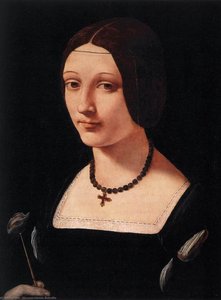
The true brilliance of Boltraffio lies in his ability to capture the quiet dignity of the human spirit. His portraits are renowned for their enigmatic beauty, often featuring subjects that seem caught in a moment of profound introspection. In works such as Portrait of a Young Woman, one can sense the lingering influence of Leonardo’s psychological depth, yet there is an unmistakable Boltraffio touch—a meticulous rendering of textures and a focused, luminous gaze that commands the viewer's attention. He had a remarkable gift for translating the nobility of his sitters into paint, creating images that feel both timeless and intimately human.
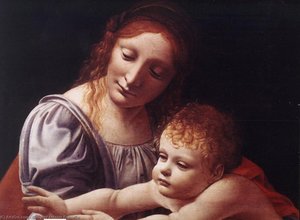
Beyond the secular realm, Boltraffio’s devotion to religious iconography allowed him to explore the heights of Renaissance symbolism. His depictions of the Madonna and Child serve as quintessential examples of his technical prowess and spiritual sensitivity. In these sacred compositions, he utilized color not merely for aesthetic beauty but as a profound theological language:
- Blue was employed to represent the purity and celestial nature of the Virgin Mary.
- Red served as a poignant symbol of the sacrifice and passion inherent in the Christ child's destiny.
Through these deliberate choices, Boltraffio transformed panels of wood into windows of divine contemplation, blending the physical reality of the Renaissance world with the spiritual aspirations of the era.
Legacy and Historical Significance
Though Boltraffio eventually moved away from the direct shadow of Leonardo to establish his own presence, his historical significance cannot be overstated. He acted as a crucial bridge between the experimental fervor of the early High Renaissance and the more structured, classical developments that followed in Northern Italy. His ability to synthesize Leonardo’s complex innovations with a more accessible, clear-eyed realism helped shape the aesthetic preferences of the Milanese school for generations.
Today, his surviving works, housed in prestigious institutions such as The Hermitage Museum and various collections in Berlin and Milan, continue to enchant art historians and enthusiasts alike. He remains a testament to the power of the collaborative studio environment—a reminder that greatness is often nurtured in the quiet, dedicated work of those who stand beside masters, refining a vision until it becomes something entirely their own.
Questions & Answers
Where is Giovanni Antonio Boltraffio from?
Giovanni Antonio Boltraffio was born in Italy.
Can I explore Giovanni Antonio Boltraffio's works by keyword?
Giovanni Antonio Boltraffio's works can be explored by keyword on the artist's By Keywords page. Each keyword groups the related artworks.
Can I explore Giovanni Antonio Boltraffio's works by color spectrum?
The Spectral Index of Giovanni Antonio Boltraffio is a page that organizes the artist's artworks by their colors.