Text size

() ·

A painting made for you, by hand

Moses' Trial by Fire

Hand Made Oil Reproduction

Hand-painted oil on canvas in your size and frame, made to order by our artists. ( Switch to Print Switch to Digital Image)

Collectible Description

Witness Giorgione's 'Moses’ Trial by Fire,' a lyrical High Renaissance masterpiece depicting a pivotal moment in Jewish history. Explore the enigmatic artistry and Venetian influence of this iconic painting, now available as a stunning hand-painted reproduction.

Artist Biography

Discover Giorgione (1477/8-1510), a key High Renaissance Venetian painter. Explore his poetic works, masterful use of color & atmosphere – like 'The Tempest' & 'Pastoral Concert'.

from ·

Chapter 1

How large should it be?

Slide to change the size; the picture on the left shows the frame at its real width. The proportions of the original are kept.

Standard
custom
CM
INCH

Pick from our preset sizes that match the artwork's original proportions.

width
height

Type the width and the height you need, to fit your frame or your wall. This is hand-painted, so for a size with a different shape the artist can paint a bit more around the picture, or cut a bit — you choose. We send you a digital mockup to approve before the painting starts. The picture shown on this page does not show the real result — only the mockup does.

Chapter 2

How should it arrive?

Choose the edges of the stretched canvas

Choose your frame

Corner sample of the WhiteWrap canvas edge finish, stretched on solid wood bars
White $1
Corner sample of the BlurSideWrap canvas edge finish, stretched on solid wood bars
Blurside $1
Corner sample of the ExtendedWrap canvas edge finish, stretched on solid wood bars
Extended $1
Corner sample of the P118B picture frame: moulded polystyrene, 5 cm wide and 3 cm thick
P118B $10
Corner sample of the P118H picture frame: moulded polystyrene, 5 cm wide and 3 cm thick
P118H $10
Corner sample of the P118W picture frame: moulded polystyrene, 5 cm wide and 3 cm thick
P118W $10
Corner sample of the P438Z picture frame: moulded polystyrene, 5.5 cm wide and 3.5 cm thick
P438Z $10
Corner sample of the P508JH picture frame: moulded polystyrene, 7 cm wide and 3.5 cm thick
P508JH $12
Corner sample of the P508YH picture frame: moulded polystyrene, 7 cm wide and 3.5 cm thick
P508YH $12
Corner sample of the P805H picture frame: moulded polystyrene, 5 cm wide and 3.5 cm thick
P805H $10
Corner sample of the P805Z picture frame: moulded polystyrene, 5 cm wide and 3.5 cm thick
P805Z $10
Corner sample of the P919BZ picture frame: moulded polystyrene, 7 cm wide and 3.5 cm thick
P919BZ $10
Corner sample of the P919G picture frame: moulded polystyrene, 7 cm wide and 3.5 cm thick
P919G $10
Corner sample of the P919XJ picture frame: moulded polystyrene, 7 cm wide and 3.5 cm thick
P919XJ $10
Corner sample of the P959ZH picture frame: moulded polystyrene, 5 cm wide and 3 cm thick
P959ZH $10
Corner sample of the P968JZ picture frame: moulded polystyrene, 6 cm wide and 4 cm thick
P968JZ $12
Corner sample of the W106C picture frame: solid wood, 5 cm wide and 3 cm thick
W106C $8
Corner sample of the W218G picture frame: solid wood, 5 cm wide and 3 cm thick
W218G $10
Corner sample of the W218JH picture frame: solid wood, 5 cm wide and 3 cm thick
W218JH $8
Corner sample of the W218Y picture frame: solid wood, 5 cm wide and 3 cm thick
W218Y $10
Corner sample of the W307PJ picture frame: solid wood, 6 cm wide and 3 cm thick
W307PJ $10
Corner sample of the W316G picture frame: solid wood, 6 cm wide and 3 cm thick
W316G $10
Corner sample of the W316PJ picture frame: solid wood, 6 cm wide and 3 cm thick
W316PJ $8
Corner sample of the W316Y picture frame: solid wood, 6 cm wide and 3 cm thick
W316Y $10
Corner sample of the W398PJ picture frame: solid wood, 5 cm wide and 3 cm thick
W398PJ $8
Corner sample of the W4111J picture frame: solid wood, 6.5 cm wide and 3.5 cm thick
W4111J $10
Corner sample of the W500HY picture frame: solid wood, 7 cm wide and 5 cm thick
W500HY $15
Corner sample of the W500JH picture frame: solid wood, 7 cm wide and 5 cm thick
W500JH $15
Corner sample of the W692G picture frame: solid wood, 8 cm wide and 4 cm thick
W692G $12
Corner sample of the W849H picture frame: solid wood, 5 cm wide and 3 cm thick
W849H $8
Corner sample of the W940BG picture frame: solid wood, 7.5 cm wide and 4.5 cm thick
W940BG $15
Corner sample of the W953PJ picture frame: solid wood, 6 cm wide and 3.5 cm thick
W953PJ $8
Corner sample of the H24-GOLD picture frame: carved wood with gesso, 10 cm wide and 6 cm thick
H24-GOLD $30
Corner sample of the H24-SILVER picture frame: carved wood with gesso, 10 cm wide and 6 cm thick
H24-SILVER $30
Corner sample of the H36-GOLD picture frame: carved wood with gesso, 15 cm wide and 6.5 cm thick
H36-GOLD $45
Corner sample of the H36-SILVER picture frame: carved wood with gesso, 15 cm wide and 6.5 cm thick
H36-SILVER $45
Frame preview
Framed

Moulding: . Overall size with the frame: .

Chapter 3

Who paints it, and should anything change?

Examples of what can be changed: Replace face with customer photo; Add pet (e.g., replace cat with dog); Include hidden message in background; Change background landscape or elements.
After order, OriginalUniqueArt.com team will email client for instructions and provide a mockup preview

Worldwide Delivery () in 3/4 weeks instead of standard 5 weeks. (7 November). No compromise on quality.

Chapter 4

The finishing touches

A nameplate, as in a museum?

Engraved Bronze Plaque Details

This elegant plaque features the artist's name and the title of the artwork, finely engraved for a timeless presentation.

It is made from bronze with a refined, elegant finish. The text is precisely laser-engraved for a sharp and permanent result. Measuring 9x2 cm, the plaque is compact yet easy to read. It's built to be durable and scratch-resistant, offering a professional, museum-quality look. Mounting is simple thanks to the included adhesive backing.

Transparent Acrylic Plaque Details

The plaque includes essential engraved details such as the artist's name, the title of the artwork, the date it was created, the type of media used-like oil on canvas or watercolor-a brief description of the piece, and a QR code that links to the complete artwork information.

It is crafted from clear acrylic, offering a sleek, modern appearance. The text is UV-engraved in black to ensure strong visual contrast. With a size of 10x15 cm, it ensures optimal readability. It comes equipped with two metal hooks for secure wall mounting. The plaque is designed to be weather-resistant, making it suitable for various environments, and it includes interactive features that work seamlessly with smartphone scanning.

Black Acrylic Plaque Details

This elegant plaque includes engraved information such as the artist's name, the title of the artwork, the date it was created, the type of media used (like oil on canvas or watercolor), a short description of the artwork, and a QR code for quick access to more information.

The plaque itself is made from refined black acrylic with a premium finish. The text is laser-engraved in white for high contrast and readability. Its size is 10x15 cm, designed to be easy to read. It comes with two metal hooks for professional mounting. The design is sleek and fits any interior style. It is also weather-resistant and durable, with built-in digital integration for mobile compatibility.

A protective varnish?

When do you need it?

Chapter 5

Your painting, as you ordered it

Moses' Trial by Fire

Reproduction Medium

Reproduction Size

-

Elite Senior Artist

More detail, finesse, and extra production time

-

Reproduction Frame

-

-

For artworks or reproductions larger than 105 cm (approximately 41 inches) on any side, the frame will be shipped as a kit, disassembled. This method ensures safe delivery and prevents damage during transport.

Professional assembly required - this is not a DIY product.
The kit must be assembled and the canvas stretched by an experienced professional framer, using wood glue (not supplied), a canvas stretching plier and clamps to hold the bars square while the glue dries. Incorrect assembly or uneven canvas tension can permanently damage the artwork and is not covered by our warranty.

  • All solid wood bars are included, precisely cut to size.

  • Assembled with the screws provided, plus wood glue for the corner joints, which is not supplied and must be sourced by your framer.

  • Professional tools are required and not included: a canvas stretching plier (tensioner) and clamps to hold the bars square while the glue dries.

Important:
The corner joints require wood glue, the bars must be held with clamps until the glue is fully dry, and tightening the canvas on the assembled frame requires a canvas stretching plier. None of these are included in the kit. Please arrange an experienced professional framer before ordering this size.

Nameplate

-

-

Protective Varnish

Glossy Varnish (enhances colors, protects against light/moisture)

-

Customize My Artwork

Examples of what can be changed: Replace face with customer photo; Add pet (e.g., replace cat with dog); Include hidden message in background; Change background landscape or elements.

-

Urgent

Worldwide Delivery () in 3/4 weeks instead of standard 5 weeks. (7 November). No compromise on quality.

-

Express Shipping

Worldwide Delivery () in 5 weeks. (14 November).

Included

Total Price

$ 300

Total Price $ 300

Glass option is only available in size under 110 CM

Included with every order

  • Free Worldwide Express Shipping
  • High-Quality Linen Canvas
  • Full Shipping Insurance
  • Customs Tax Refund Guarantee
  • True Color Matching Guarantee
  • 100-Day Return Policy (Defects Only)
  • 100% Money-Back Guarantee
  • Bulk Discount Offer

A Venetian Enigma: Unveiling Giorgione’s “Moses’ Trial by Fire”

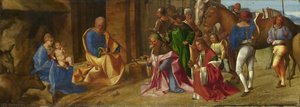
Giorgione’s “Moses’ Trial by Fire,” a painting shrouded in the mists of Venetian history and artistic mystery, is not merely a depiction of a biblical narrative; it's an invitation into a world of subtle emotion, atmospheric depth, and a nascent shift in Renaissance painting. Born Giorgio Barbarelli da Castelfranco in 1477, Giorgione’s tragically brief life – he died at just thirty-two or thirty-three – left behind a remarkably small body of work, each piece imbued with an almost haunting quality. “Moses’ Trial by Fire,” created around 1502-1505 and currently residing in the Uffizi Gallery in Florence, exemplifies this enigmatic genius. The painting draws its subject from Josephus's *Antiquities*, transforming a pivotal moment of faith and divine judgment into a profoundly contemplative scene.

The composition itself is deceptively simple yet remarkably powerful. Moses, rendered with an almost ethereal grace, stands at the center, not as a heroic figure of action, but as a man confronting an unknown future. He’s surrounded by a gathering – individuals whose faces are deliberately obscured, their identities subsumed into the painting's overall mood. The setting is equally evocative: a landscape bathed in a diffused light, suggesting neither day nor night, creating a timeless and otherworldly atmosphere. The trees, rendered with loose brushstrokes, seem to lean inwards, drawing the viewer into the scene, while distant mountains provide a dramatic backdrop, hinting at both earthly constraints and divine expanse.

The Language of Light and Shadow: Giorgione’s Venetian Innovation

What truly distinguishes “Moses’ Trial by Fire” is Giorgione's masterful manipulation of light and shadow. He eschews the sharp contrasts favored by earlier Renaissance painters, opting instead for a soft, atmospheric quality that became a hallmark of the Venetian school. This technique—often referred to as *sfumato*—blurs outlines and creates a sense of hazy depth, lending the scene an almost dreamlike quality. The light itself seems to emanate from within the painting, illuminating the figures with a gentle radiance rather than casting harsh shadows. This deliberate blurring wasn’t simply stylistic; it reflected Giorgione's interest in capturing not just what *was* seen, but also the *feeling* of being present at that moment – a core tenet of Venetian art.

Giorgione’s use of color is equally subtle and evocative. He employs muted earth tones—ochres, browns, and greens—to create a sense of harmony and tranquility. The absence of vibrant hues contributes to the painting's overall mood of quiet contemplation. Notice how he uses variations in tone to suggest texture – the rough bark of the trees, the folds of Moses’ garments, even the implied surface of the ground beneath his feet. This attention to detail elevates the scene beyond a simple illustration and transforms it into a richly textured visual experience.

Symbolism and Spiritual Resonance

Beyond its technical brilliance, “Moses’ Trial by Fire” is laden with symbolic meaning. The trial itself represents not just a test of Moses's faith but also a broader exploration of human vulnerability in the face of divine judgment. The obscured faces of the onlookers suggest that this event transcends individual identity and speaks to the shared experience of humanity before God. The crown, cast aside by Moses as an infant, symbolizes the rejection of worldly power and the embrace of spiritual authority – a potent image reflecting the core tenets of Christianity.

Furthermore, the painting’s ambiguous setting—neither clearly day nor night—can be interpreted as representing the liminal space between earthly existence and the realm of eternity. It's a moment suspended in time, inviting viewers to contemplate the mysteries of faith, destiny, and the enduring power of human spirit. The choice of depicting this pivotal event from Josephus’ *Antiquities* also highlights Giorgione’s engagement with classical sources and his desire to infuse biblical narratives with a distinctly Venetian sensibility.

Bringing “Moses’ Trial by Fire” Home: A Reproduction for the Soul

OriginalUniqueArt.com offers meticulously crafted, hand-painted oil reproduction of Giorgione's "Moses’ Trial by Fire," allowing you to experience the profound beauty and emotional resonance of this masterpiece in your own space. Our skilled artists replicate every nuance of Giorgione’s technique—the subtle sfumato, the atmospheric lighting, the delicate color palette—with unparalleled precision. A reproduction from OriginalUniqueArt.com is more than just a print; it's a tangible connection to one of the Renaissance’s most enigmatic and influential figures. It’s an opportunity to bring a touch of Venetian mystery and spiritual contemplation into your home, a testament to the enduring power of art.

Questions & Answers

How do contrast and harmony combine in "Moses' Trial by Fire"?

The color analysis of "Moses' Trial by Fire" by Giorgione records a statement contrast and a balanced harmony harmony.

What is "Moses' Trial by Fire" made with?

"Moses' Trial by Fire" is executed in oil on panel.

What is "Moses' Trial by Fire" about?

The themes present in "Moses' Trial by Fire" by Giorgione include moses, trial by fire, renaissance, josephus, venetian art, light, shadow, testament. Together they summarize the artwork's subject matter.

More about this painting

Preview AR preview Switch to Print Switch to Digital Image Send
Details Guide Add to favorites Download Similars X-Ray Diaporama Q&A Stats

In numbers

  • 29frames to choose from
  • standard sizes, in its own proportions
  • 5weeks to paint and deliver it
Giorgione

Giorgione

1477 - 1510, Italy

Quick facts about Giorgione

  • Artistic Movement Or Style: Venetian School
  • Artists Or Movements Influenced By This Artist:
    • Titian
    • Venetian School
  • Artists Who Influenced This Artist: ['Giovanni Bellini']
  • Full Name: Giorgio Barbarelli da Castelfranco
  • Nationality: Italian
  • Notable Artworks:
    • The Tempest
    • Pastoral Concert
    • Sleeping Venus
    • Judith
    • Portrait of a Venetian Gentleman
  • Place Of Birth: Castel Franco Veneto, Italy
  • Date Of Birth: 1477
  • Date Of Death: 1510

Artist Biography

A Venetian Enigma: The Life and Legacy of Giorgione

Giorgio Barbarelli da Castelfranco, known to the world as Giorgione, remains one of the most elusive and captivating figures in Renaissance art. Born in the small town of Castelfranco Veneto near Venice around 1477 or 1478 – the exact year is debated – his tragically short life, ending around 1510 at the age of thirty-two or thirty-three, belies an artistic impact that continues to resonate centuries later. Unlike many of his contemporaries whose lives are well documented, Giorgione’s story is shrouded in mystery, pieced together from scant historical records and the often romanticized accounts of Giorgio Vasari. What we do know suggests a man deeply immersed in the vibrant culture of Venice, a city that fostered both artistic innovation and a sensual appreciation for beauty. He likely apprenticed under Giovanni Bellini, a leading Venetian painter, absorbing the established traditions before forging his own unique path. Early commissions included portraits of prominent figures like Doge Agostino Barbarigo, demonstrating an immediate talent for capturing likeness and status. However, it was in his departure from conventional subject matter and his revolutionary approach to painting that Giorgione truly distinguished himself.

Poetic Visions: Style and Innovation

Giorgione’s artistic style marked a significant break from the prevailing Florentine emphasis on linear perspective and precise draftsmanship. He championed color, atmosphere, and an evocative moodiness that became hallmarks of the Venetian school. His technique involved softening outlines, employing subtle gradations of tone – *sfumato* – to create atmospheric effects, and prioritizing overall harmony over meticulous detail. This approach wasn’t merely a technical choice; it reflected a fundamentally different artistic sensibility. Giorgione sought not to replicate reality but to capture its essence, its fleeting emotions, and its poetic resonance. His paintings often feature enigmatic subjects and ambiguous narratives, inviting viewers into a world of contemplation rather than offering clear-cut stories. The Tempest, perhaps his most famous work, exemplifies this perfectly. The scene – a soldier and a nursing mother amidst a stormy landscape – has baffled art historians for centuries, its meaning remaining tantalizingly out of reach. Similarly, Pastoral Concert (Fête champêtre) presents an idyllic gathering of musicians in a pastoral setting, celebrated not for any specific narrative but for its harmonious composition and lyrical quality. These works weren’t intended to be puzzles to solve; they were meant to evoke feelings, moods, and a sense of wonder.

Masterpieces and Enduring Influence

Though his output was limited by his untimely death, Giorgione left behind a small but profoundly influential body of work. Sleeping Venus, likely completed with assistance from Titian after Giorgione’s passing, is an iconic depiction of the goddess, showcasing his mastery of color and form. The languid pose and soft flesh tones embody the Venetian appreciation for sensuality and beauty. Other notable works include Judith, an early example of his developing style, and portraits that reveal a keen ability to capture the character and essence of his subjects. Giorgione’s influence extended far beyond his own paintings. He was a mentor to Titian, who would become one of the most celebrated artists of the High Renaissance, carrying forward Giorgione's innovations in color and atmospheric painting. The emphasis on color and atmosphere profoundly impacted the development of Venetian painting, distinguishing it from the Florentine tradition and establishing Venice as a major center for artistic innovation.

A Lasting Legacy: Giorgione’s Historical Significance

Despite his brief career, Giorgione occupies a pivotal position in art history. He bridged the gap between earlier Venetian traditions and the innovations of Titian and other later masters, fundamentally altering the course of Italian painting. His emphasis on poetic mood, atmospheric effects, and ambiguous narratives paved the way for new artistic explorations and inspired generations of artists. The very mystery surrounding his life and work has contributed to his enduring mystique and appeal. He remains a symbol of artistic freedom, innovation, and the power of suggestion – a painter who dared to prioritize feeling over form, atmosphere over accuracy, and poetry over narrative.

Key Works by Giorgione

  • The Tempest (c. 1506-1508)
  • Pastoral Concert (Fête champêtre) (c. 1509)
  • Sleeping Venus (c. 1510)
  • Judith (1504)
  • Portrait of a Venetian Gentleman

Quick Facts

  • Year: 1502-1505
  • Location: Uffizi Gallery, Florence
  • Title: Moses' Trial by Fire
  • Notable elements: Soft light & tone
  • Artistic style: Venetian painting

Art Quiz

There is only one correct answer for each question.

Question 1:
According to the text, what biblical story does ‘Moses’ Trial by Fire’ depict?
Question 2:
Giorgione is known for his use of which artistic technique, contributing to the painting’s atmospheric quality?
Question 3:
In what city is ‘Moses’ Trial by Fire’ currently housed?
Question 4:
The image description mentions figures wearing ties. What does this suggest about the scene depicted?
Question 5:
Giorgione’s brief career and enigmatic life are largely based on the accounts of which Renaissance art historian?