Preview
 Send
Send Share
Share
 Details
 Guide
Guide

 Download
 Similars
 X-Ray
X-Ray Diaporama
 Stats
StatsNorth-South
 Acrylic On Canvas
- WallArt
- Cubism
 46.0 x 33.0 cm
 Galleria Civica di Arte Moderna e Contemporanea Torino
 Read More
The artwork displayed on this page is protected by copyright law, which means we cannot legally create or sell an identical reproduction. This protection is enforced under international agreements such as the Berne Convention and by national laws, including those outlined by the U.S. Copyright Law - Title 17.
This method fully complies with copyright regulations because it does not involve copying or duplicating the protected artwork. Instead, it is a creative reinterpretation - a new painting that is influenced by the original but not identical to it.
Giclée / Art Print
Museum-quality giclée or canvas print with fast production and flexible finish options. ( Buy Hand Made Painting Switch to Digital Image)




P118B $10

P118H $10

P118W $10

P438Z $10

P508JH $12

P508YH $12

P805H $10

P805Z $10

P919BZ $10

P919G $10

P919XJ $10

P959ZH $10

P968JZ $12

W106C $8

W218G $10

W218JH $8

W218Y $10

W307PJ $10

W316G $10

W316PJ $8

W316Y $10

W398PJ $8

W4111J $10

W500HY $15

W500JH $15

W692G $12

W849H $8

W940BG $15

W953PJ $8




Pick from our preset sizes that match the artwork's original proportions.

You may enter your own dimensions to fit a specific frame or space. If your selected size does not match the original image's proportions, we will either crop the artwork or extend the image with a mirrored or solid-fill edge. A digital mockup will be sent for your approval before production begins.
Please note that the on-screen preview does not reflect the actual cropping or extension. Only the mockup will accurately show the final composition.
While custom sizes are available, we recommend selecting a dimension from the predefined list to preserve the original proportions.
Worldwide Delivery () in 2 weeks instead of standard 4/5 weeks. (13 October)

Free Worldwide Express Shipping

High-Quality Linen Canvas

Full Shipping Insurance

Customs Tax Refund Guarantee

True Color Matching Guarantee

100-Day Return Policy (Defects Only)

100% Money-Back Guarantee

Bulk Discount Offer
 Glass option is only available in size under 110 CM

North-South
Giclée / Art Print
Reproduction Size
-


Total Price
$ 81
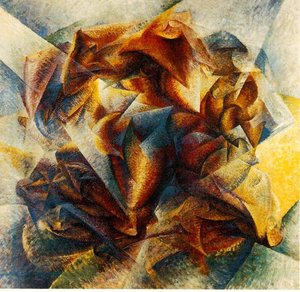
A Symphony of Motion: Gino Severini’s “North-South”
Gino Severini's "North-South," painted in 1912, isn’t merely a depiction of a Parisian marketplace; it’s an exhilarating embodiment of the Futurist spirit – a visual explosion capturing the dynamism and frenetic energy of modern urban life. Born in Cortona, Italy, in 1883, Severini initially embraced Divisionism before being swept into the revolutionary currents of Futurism, a movement that sought to dismantle traditional artistic conventions and celebrate speed, technology, and the raw power of the industrial age. This painting represents a pivotal moment in his career, showcasing a shift towards a more synthetic approach, heavily influenced by Cubist principles while retaining the core Futurist obsession with capturing fleeting moments of intense motion. The work immediately transports the viewer into a vibrant, almost overwhelming scene – a sensory overload rendered with remarkable precision and emotional intensity.Deconstructing Reality: Style and Technique
Severini’s style in “North-South” is undeniably Cubist, yet distinctly Futurist. He employs what's known as "simultaneous view," a technique pioneered by Futurists like Boccioni, where multiple perspectives are presented simultaneously within a single composition. This creates an illusion of movement and depth, mimicking the experience of navigating a bustling city street. The painting’s fragmented forms – the overlapping stalls, the blurred figures, the fractured signage – aren't simply stylistic choices; they represent a deliberate attempt to break down traditional spatial relationships and convey the sensation of speed and disorientation inherent in urban environments. Notice how the artist utilizes sharp, angular lines to define architectural elements and create a sense of dynamism, contrasting with the softer, more rounded forms of the human figures. The application of paint is equally significant; Severini employs broken brushstrokes and layered glazes, building up texture and creating a palpable sense of surface – you can almost feel the heat radiating from the marketplace and hear the clamor of voices.A Marketplace of Modernity: Historical Context
“North-South” was created during a period of immense social and technological change in Europe. The rise of industrialization, the proliferation of railways and automobiles, and the rapid growth of cities were fundamentally altering people’s lives and perceptions of space and time. Futurism, born out of this context, sought to capture these changes on canvas, rejecting the past and embracing the future with a fervent enthusiasm. Severini's choice of subject – a busy marketplace in Pigalle, a district known for its entertainment venues and vibrant nightlife – is particularly revealing. It’s not simply a snapshot of commerce; it’s a microcosm of modern urban life, teeming with activity, noise, and sensory stimulation. The inclusion of signs like “METRO” and “SORTIE” further emphasizes the painting's connection to the burgeoning infrastructure of Paris, highlighting the city’s role as a hub of innovation and progress.Symbolism in Motion: Interpreting the Details
Beyond its immediate visual impact, "North-South" is rich with symbolic meaning. The fragmented forms can be interpreted as representing the breakdown of traditional values and social structures under the pressures of modernity. The blurred figures suggest the anonymity and alienation experienced by individuals within a rapidly changing urban landscape. Even the seemingly random arrangement of objects – the fruits, vegetables, and merchandise displayed on the stalls – contributes to the painting’s overall sense of chaos and dynamism. The prominent signage, particularly “PIGALLE,” hints at the district's reputation as a center of entertainment and vice, adding another layer of complexity to the scene. The title itself, "North-South," subtly references the intersecting paths of movement within the city – the flow of people, goods, and information that define modern urban life.A Legacy of Velocity: Emotional Impact
Ultimately, “North-South” is a powerfully evocative work of art that captures the exhilarating and disorienting experience of navigating a rapidly changing world. It’s not a comfortable or serene scene; it's deliberately jarring and unsettling, reflecting the anxieties and uncertainties of modern life. Yet, within this chaos lies a sense of energy and vitality – a celebration of speed, innovation, and the relentless pursuit of progress. Severini masterfully translates these complex emotions onto canvas, creating an artwork that continues to resonate with viewers today, reminding us of the transformative power of art to capture the spirit of its time. It remains a testament to the Futurist vision—a bold declaration of modernity’s frenetic beauty.Questions & Answers
How well known is "North-South" by Gino Severini?
"North-South" is classified as recognized.
How do contrast and harmony combine in "North-South"?
The color analysis of "North-South" by Gino Severini records a statement contrast and a softly mixed palette harmony.
How do the colors of "North-South" relate to each other?
The colors of "North-South" by Gino Severini show a softly mixed palette harmony. Harmony describes how the colors relate to each other.
How is the palette of "North-South" by Gino Severini described?
The colors of "North-South" form an earthy palette. This classification describes the dominant color families.
What is the luminance of "North-South" by Gino Severini?
The colors of "North-South" show a gentle luminance luminance.
Where can I see the original "North-South" by Gino Severini?
"North-South" by Gino Severini is on display at the Galleria Civica di Arte Moderna e Contemporanea Torino, Turin, Italy. The museum listing refers to the original work, not to reproductions.
From which country does the Cubism work "North-South" come?
The Cubism work "North-South" was made by an artist born in Italy.
Who is the author of "North-South", and in which movement?
Gino Severini created "North-South" within the Cubism movement.
Artist Biography
Early Life and the Seeds of Artistic Rebellion
Gino Severini emerged into the world on April 7, 1883, in the picturesque Tuscan town of Cortona, Italy. His beginnings were humble; his father a junior court official, his mother a dressmaker – a background that instilled in him both a sensitivity to form and an awareness of societal structures. Formal education proved ill-fitting for the young Severini’s restless spirit. Expelled at fifteen alongside classmates for a youthful indiscretion involving stolen exam papers, he found himself cast adrift from conventional schooling. This expulsion, however, wasn't a derailment but rather a catalyst, freeing him to pursue his burgeoning artistic inclinations independently while working as a shipping clerk. The move to Rome in 1899 marked a turning point; it was there, amidst the ancient ruins and vibrant street life, that he began formal art classes, quickly becoming captivated by the shimmering effects of Divisionism – a technique championed by artists like Giacomo Balla and Umberto Boccioni, who would soon become pivotal figures in his artistic journey. These formative years laid the essential groundwork for Severini’s eventual embrace of Futurism, igniting within him a desire to capture the dynamism of modern life.Embracing the Velocity of Futurism
The invitation to join Filippo Tommaso Marinetti and Umberto Boccioni in the burgeoning Futurist movement proved transformative for Severini. He became a signatory of the *Manifesto of the Futurist Painters* in 1910, aligning himself with a revolutionary ideology that celebrated speed, technology, and the intoxicating energy of modernity. This wasn’t merely an artistic choice; it was a philosophical commitment to shattering tradition and forging a new aesthetic language for a rapidly changing world. Severini played a crucial role in disseminating Futurist ideas internationally, notably organizing the movement's first exhibition outside Italy at Galerie Bernheim-Jeune in Paris in 1912. His work during this period, exemplified by paintings like *North-South* (1915), embodies the Futurist obsession with capturing motion and energy through fragmented forms and a vibrant, almost explosive palette. Unlike some of his colleagues who focused on machines, Severini often turned to urban scenes and dancers as subjects, reflecting his fascination with portraying the rhythms and sensations of modern life – the swirling skirts, the flashing lights, the pulsating crowds.A Synthesis of Styles: Cubism and Beyond
Severini’s artistic style was never confined by rigid dogma; it was a constantly evolving synthesis of influences. While deeply rooted in the Futurist aesthetic, his work also demonstrated a profound engagement with Cubism, particularly after his pivotal visit to Paris in 1911. He absorbed elements of geometric abstraction and fragmented perspectives, incorporating them into his compositions to create dynamic arrangements that conveyed a sense of simultaneity and movement. Artists like Umberto Boccioni, Carlo Carrà, and Giovanni Francesco Romanelli were significant influences, but Severini’s unique vision allowed him to forge his own path. *Waltz*, for instance, showcases this masterful fusion of styles – the swirling energy of dance rendered through a Cubist lens, resulting in a painting that feels both chaotic and harmonious. Following the First World War, a shift occurred in Severini's artistic direction, mirroring a broader “return to order” prevalent throughout Europe. He explored classical themes and forms, yet retained his distinctive use of color and composition, demonstrating an ability to adapt and evolve without abandoning his core aesthetic principles.Later Years and Enduring Legacy
The years following the First World War saw Severini continuing to experiment with diverse artistic media, including mosaic and fresco, expanding his creative horizons beyond the canvas. He divided his time between Paris and Rome, producing works that reflected both his Italian heritage and his immersion in Parisian culture. Beyond his painting, he became a prolific writer on art theory, contributing significantly to the intellectual discourse surrounding modernism. Gino Severini passed away in Paris on February 26, 1966, at the age of 83, leaving behind a rich and multifaceted body of work. His legacy as a key figure in the Futurist movement – and a significant contributor to 20th-century Italian art – endures. Today, his paintings are held in prominent museums worldwide, including the Galleria Civica di Arte Moderna in Venice, serving as testaments to his lasting impact on the development of modern art and continuing to inspire generations of artists and viewers alike. He remains a vital link between the past and present, reminding us of the power of art to capture the energy and complexity of the human experience.
Gino Severini
1883 - 1966 , Italy
Quick Facts
- Full Name: Gino Severini
- Nationality: Italian
- Date Of Birth: 1883
- Date Of Death: 1966
- Place Of Birth: Cortona, Italy
- Notable Artworks:
- North-South
- Waltz
- Self-Portrait
- Artistic Movement Or Style: Futurism, Cubism
- Artists Who Influenced This Artist:
- Giacomo Balla
- Umberto Boccioni
- Artists Or Movements Influenced By This Artist: ['Marino Parenti']
Related Articles

Exploring the Vibrant World of Marianne North: A Journey Through Botanical and Exotic Landscapes
Discover the breathtaking botanical world of Marianne North. Explore her vibrant Victorian oil paintings of exotic landscapes, from Brazil to Jamaica, through an expert art-historical lens. Perfect for classic art enthusiasts and collectors of fine natural history art.
Cubist Expressionism's 10 Defining Masterpieces | Art for Your Home
Explore 10 defining Cubist Expressionism masterpieces by Picasso, Braque & more. Discover the stories behind these bold, geometric paintings and bring museum-quality art to your home with OriginalUniqueArt.com. Explore the full collection online.
Cubist Portraits: A Professional Guide to Integrating Geometric Abstraction into Modern Hospitality Design
Elevate hospitality interiors with Cubist portraits. Our expert guide for hotel designers explores integrating geometric abstraction into modern spaces through high-quality, scalable oil reproductions and custom multi-panel solutions for large-scale architectural projects.

Fragmented Reality: A Guide to the Power and Perspective of Cubist Still Life Art
Explore the profound depth of Cubist still life art. Our expert guide delves into the revolutionary techniques of Picasso and Braque, offering art enthusiasts a deep understanding of fragmented reality, geometric form, and the enduring power of Cubism in fine art.
Marianne North's Masterpieces: 25 Botanical Paintings That Bloom With Adventure | OriginalUniqueArt
Journey through the vibrant world of Marianne North’s botanical paintings! Explore 25 iconic artworks from this Victorian artist, celebrating exotic flora & travel. Find museum-quality reproductions and curated decor ideas at OriginalUniqueArt.com.